

Cloud Reporting Architecture: A CFO's Blueprint for Compliance-First Finance in India
By BiPivot Team · 16 August 2026
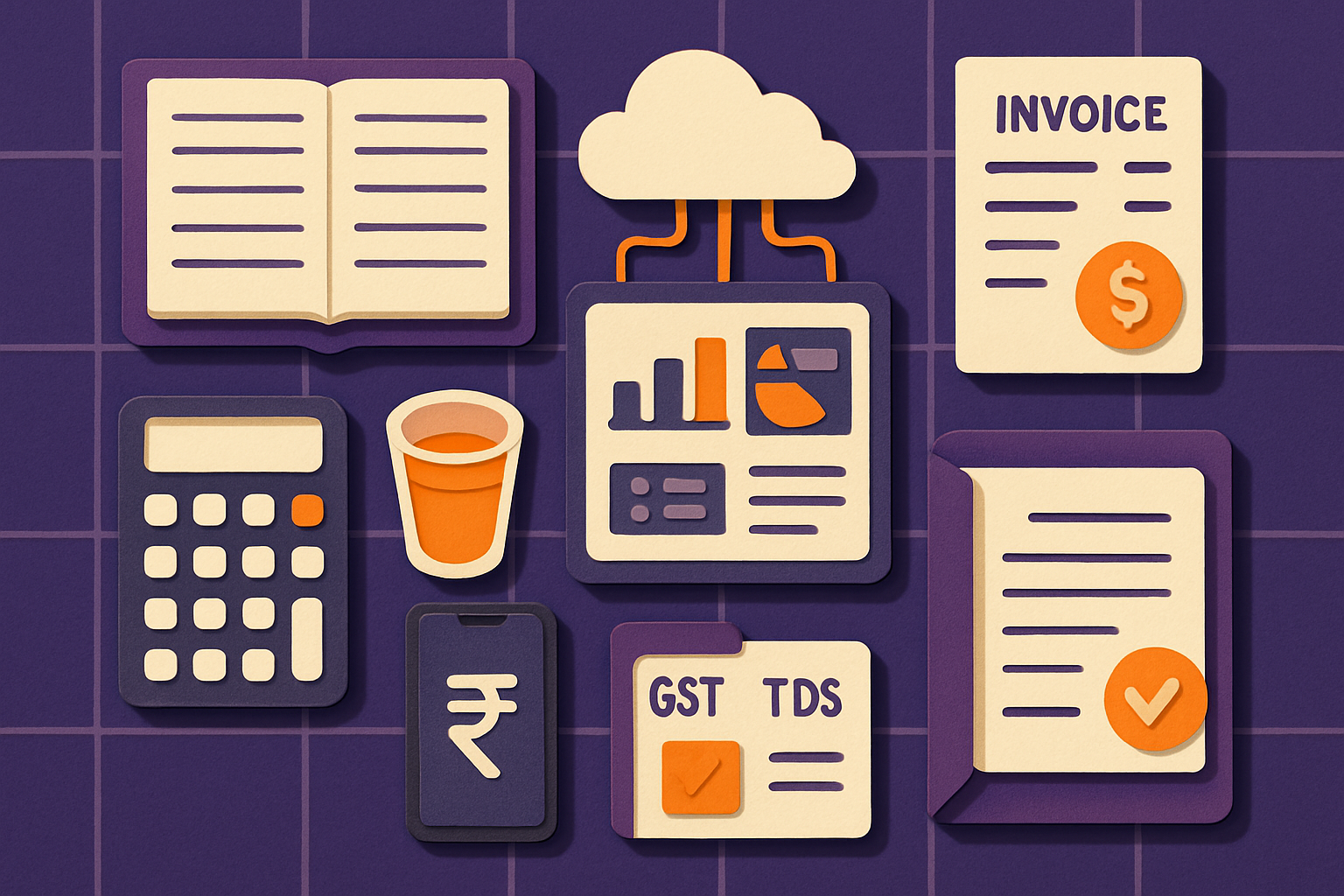
Most mid-sized Indian companies don't have a data problem. They have an architecture problem. The GST returns are filed on time, the TDS challans are paid, Tally is reconciled every month — but ask the CFO for a real-time cash position across four GSTINs and three legal entities, and the answer is still "give me two days and an Excel file." That gap between compliance and insight is exactly what cloud reporting architecture is meant to close, and in 2026 it has stopped being an IT project and become a board-level risk and growth conversation.
What Does "Cloud Reporting Architecture" Actually Mean for a CFO?
Strip away the vendor jargon and cloud reporting architecture is simply the designed pathway your financial data takes — from the point it's created in Tally, SAP, a POS system or a bank feed, to the point it lands on a CFO's dashboard as a decision-ready number. Architecture, not just software, is the operative word. A company can buy Power BI licenses for every analyst and still have a reporting mess if the underlying data model, refresh cadence, access controls and audit trail aren't designed as a system.
For an Indian CFO, this system has to satisfy three masters simultaneously: the regulator (MCA, RBI, GSTN), the auditor, and the business (sales heads, plant controllers, the board). Get the architecture right and all three are served by the same pipeline. Get it wrong, and you end up maintaining three parallel versions of the truth — one for GST filing, one for the board deck, one for the bank's working capital review — each reconciled manually, each a source of error.
The market is voting with its wallet on this. Cloud ERP revenue in India is projected to rise from roughly 54% of total software revenue in 2025 to 72% by 2031, according to Ken Research, and the overall India ERP market is expected to nearly triple from $4.5 billion in 2024 to $11.5 billion by 2035 — a CAGR of 8.9%, per SaaSWorx. Finance and accounting alone made up 29.45% of the India ERP market in 2025 and is growing at 18.08% CAGR through 2031, according to Mordor Intelligence. This isn't a large-enterprise phenomenon either — SMEs are the fastest-growing segment, expanding at a 19.2% CAGR between 2026 and 2031, outpacing large enterprises on the same Mordor Intelligence dataset.

Why Has Compliance Become the Design Constraint, Not an Afterthought?
Three regulatory realities now sit at the center of any Indian cloud reporting architecture, and each one changes how you design the pipeline — not just how you use it after it's built.
The MCA audit trail mandate. Since April 1, 2023, every company using accounting software must maintain a tamper-proof, continuously active audit trail for each transaction, and daily backups of books of account must sit on a local Indian server, per the requirement documented by corpus.blog. This isn't a "nice-to-have" logging feature you bolt on later — it has to be a first-class object in your data model from day one, because auditors will ask for it during statutory audit, and NFRA-level scrutiny of listed and large private companies has only intensified since.
RBI's payment data localization rule. For any company processing payments (and most mid-sized firms now do, through payment gateways, vendor payouts, or salary disbursement platforms), the RBI requires that payment system data be stored exclusively in India. If data is processed outside India, it must be deleted from foreign servers and returned within one business day, per the summary in IncorpX's compliance guide. If your reporting architecture pulls payment data through a global SaaS tool hosted in Singapore or Virginia by default, you may already be non-compliant without knowing it.
The DPDP Act's data flow controls. India's Digital Personal Data Protection Act 2023 doesn't impose blanket localization, but it gives the government explicit power to restrict data transfers to specific countries, as explained by Captain Compliance. That means your cloud architecture needs to be flexible enough to redirect data residency if the regulatory list changes — a real possibility given how actively this space is evolving.
The practical response from the big platforms has been to build in India. SAP, Oracle and Microsoft have all established data centers within the country specifically to address residency and compliance requirements, per SaaSWorx. If you're evaluating any cloud reporting stack in 2026, "which region does this actually store and process my data in" should be question one in the RFP, not a footnote in the contract.
We've written in detail about how Microsoft Fabric fits into this compliance-first picture for finance teams — see our CFO's guide to Microsoft Fabric for Indian finance teams — and how GST filing itself can be automated end-to-end in our GST return automation playbook. This article focuses one level up: the architecture that has to exist before any of those automations can work reliably.
What Does a Compliance-First Architecture Actually Look Like?
Think of it as four layers, each with a distinct job:
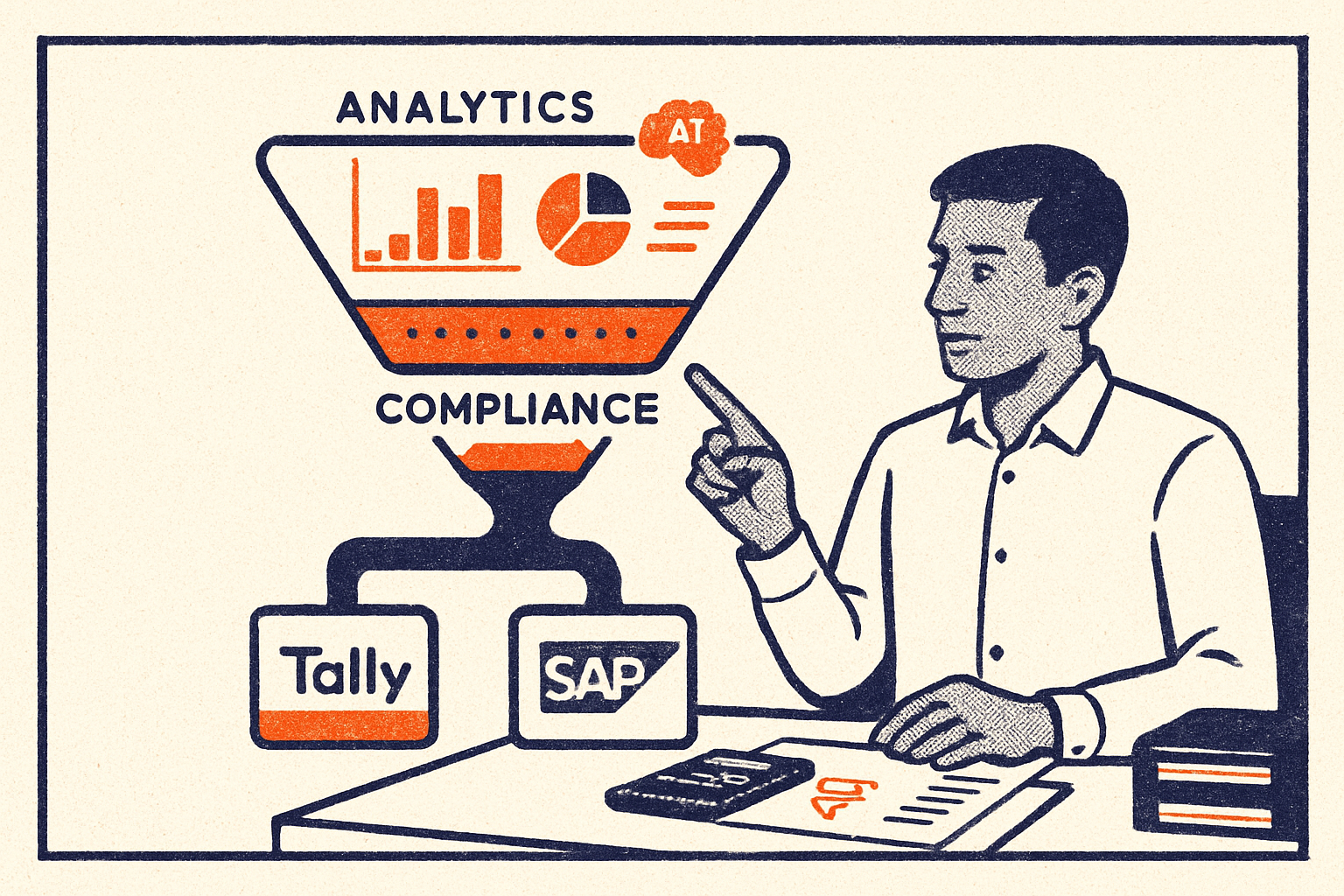
1. Source layer. Tally, SAP, Zoho Books, bank statements, POS systems, e-invoicing data, payroll — wherever transactions originate. Most mid-sized Indian companies run a hybrid mix here; 99% of organizations in India were utilizing a diverse combination of hybrid cloud architecture, according to an IBM study reported by Digital Creed, and Indian finance stacks are no exception — Tally on-premise sitting alongside a cloud CRM and a cloud payroll system is the norm, not the exception.
2. Integration and staging layer. This is where data is extracted, validated, and normalized before it touches any report. This is also where audit-trail logging has to be embedded — every transformation, every correction, timestamped and immutable. If you're moving data out of Tally specifically, our Tally-to-Power-BI guide walks through the mechanics of that pipeline in depth; if SAP is your core, the SAP-to-Power-BI integration guide covers the equivalent for that stack.
3. Governance and residency layer. Access controls, data masking for PII, and — critically — control over where the data physically sits. This is the layer that answers the RBI and DPDP questions, and it needs to be explicit in your architecture diagram, not assumed.
4. Consumption layer. Dashboards, board packs, GST/TDS reconciliation views, cash flow visibility. This is the layer most vendors sell you first, but it's the least important to get right if the three layers beneath it are broken — a beautiful dashboard fed by unreconciled, non-compliant data is worse than no dashboard at all, because it creates false confidence.
A Worked Example: The ₹180 Crore Auto-Components Manufacturer
Consider a mid-sized auto-components manufacturer in Pune with ₹180 crore annual revenue, three plants, and a single Tally instance per plant. Before restructuring their reporting architecture, month-end close took 11 working days: each plant's Tally data was exported manually, GST returns were reconciled separately by three different accountants, and the CFO got a consolidated P&L only by the 15th of the following month — too late to catch a working capital problem before it became a covenant breach conversation with the bank.
After implementing a proper integration and staging layer — automated nightly extracts from all three Tally instances into a common data model, with an audit-trail log capturing every adjustment entry — month-end close dropped to 4 working days. More importantly, GST input credit reconciliation across the three GSTINs, previously a 3-day manual task done by a senior accountant earning roughly ₹9 lakh a year, became a same-day automated match with exceptions flagged for review. The real saving wasn't the accountant's time; it was catching a ₹34 lakh input credit mismatch two months earlier than they would have under the old process, before the invoice-matching window closed.
How Do You Justify the Cost When Budgets Are Tight?
This is where most CFOs get the TCO math wrong. They compare the annual license cost of a cloud reporting platform against the cost of "doing nothing" — meaning, against zero. But doing nothing isn't free. It has a cost; it's just hidden in places the P&L doesn't itemize.
Run this comparison for a typical ₹150–300 crore revenue company:
Cost of the fragmented legacy status quo (annual):
- 2 dedicated staff for manual reconciliation and MIS compilation: ₹14–18 lakh in fully loaded cost
- Delayed decision-making — capital allocated to a loss-making product line for an extra quarter because the real margin picture arrived 6 weeks late: opportunity cost easily ₹25–50 lakh on a mid-sized product mix
- Compliance risk exposure — a single missed GST reconciliation leading to blocked input tax credit of, say, ₹15–20 lakh, plus interest and penalty under Section 50
- Statutory audit overrun — auditors spending an extra 40–60 hours chasing manual audit trails, billed at ₹2,500–4,000/hour: ₹1–2.4 lakh in incremental audit fees, every year
Cost of a properly architected cloud reporting stack (annual):
- Platform and integration licensing for a company this size: typically ₹8–15 lakh depending on user count and data volume
- Implementation and change management, amortized: ₹3–6 lakh/year over a 3-year horizon
- Reduced headcount need for manual reconciliation, redeployed to analysis rather than data-wrangling
The "cost of inaction" framing matters because Indian mid-market digital transformation isn't optional anymore in the eyes of finance leadership itself — 74% of Indian CFOs named digital transformation their top priority in an October 2025 survey by Wolters Kluwer. The question a board should be asking isn't "why are we spending ₹12 lakh on cloud reporting" — it's "what is the ₹40–70 lakh in hidden annual leakage we're currently absorbing by not having it."
We've mapped this cost-of-inaction logic in more granular process terms elsewhere — for bank reconciliation specifically in Automating Bank Reconciliation, and for the vendor side of the ledger in Vendor Reconciliation Automation. Both are downstream applications of the same architectural principle this article is describing upstream.
Is This Just About Cloud ERP, or Something Bigger?
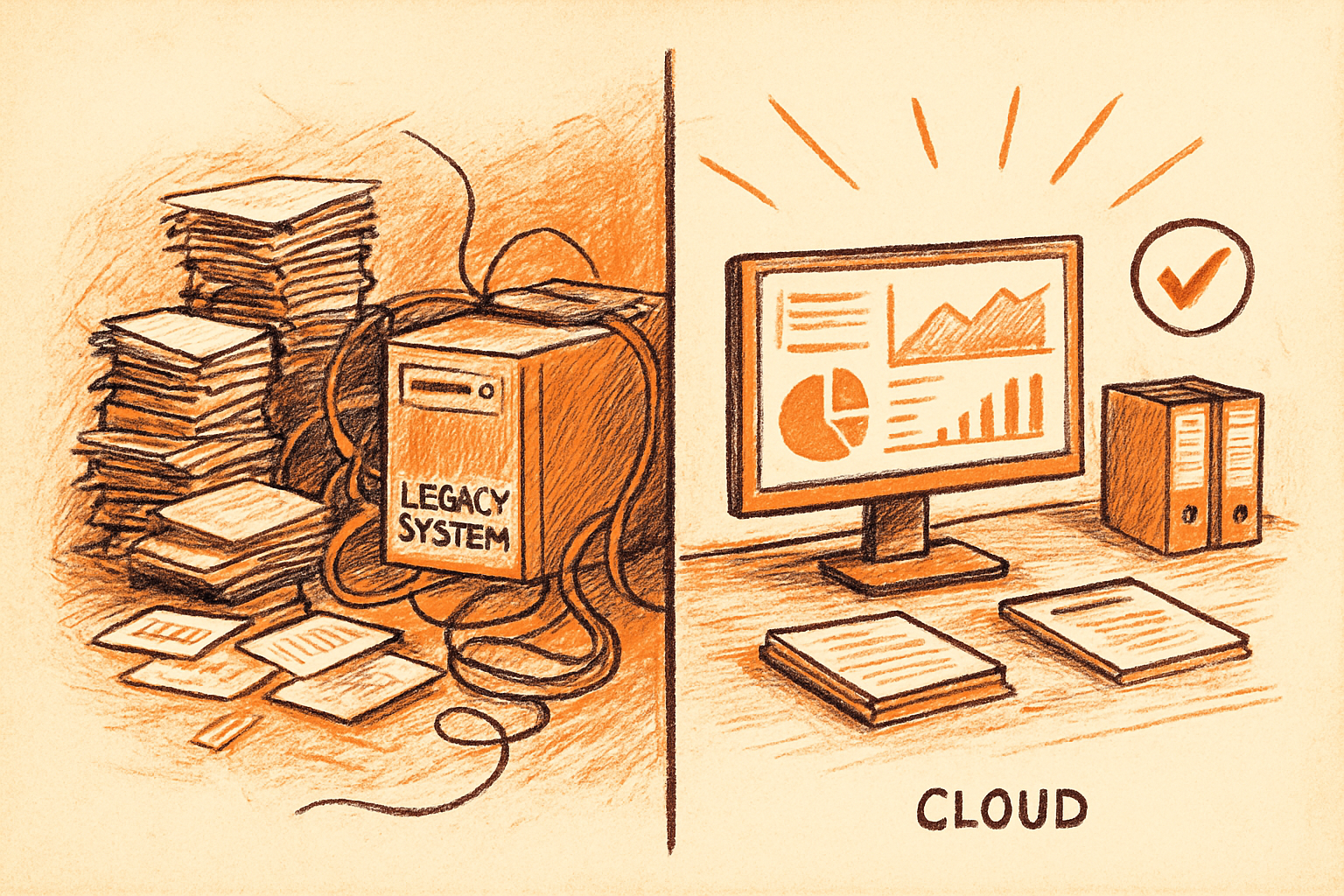
Cloud ERP adoption is the visible tip of a much larger shift. India's overall cloud computing market is projected to expand from USD 21,820 million in 2025 to USD 68,820 million by 2031, a 21.10% CAGR, according to Ken Research, and cloud technology as a whole is projected to contribute roughly 8% of India's GDP by 2026, potentially adding US$310–380 billion to the economy, per IBEF. India's own cloud adoption growth rate — 41% year-on-year in 2025 — is among the highest in the Asia-Pacific region, per SaaSWorx.
For finance specifically, this means the reporting architecture question is no longer "should we move off Tally or SAP on-premise" — globally, cloud ERP adoption already reached 64% in 2024, up sharply from 44% in 2020, according to Parsli's ERP statistics roundup. The real question for a mid-sized Indian CFO in 2026 is: given that roughly 53% of $10–100 million revenue companies already run a formal ERP system (also per Parsli), how do you architect the reporting layer on top of that ERP so it's compliant, real-time, and ready for the analytics your board is now expecting?
That last point deserves its own emphasis, because the India cloud analytics market is projected to grow at 29.7% CAGR from 2025 to 2030, reaching USD 2,975.3 million by 2030, per Horizon Research. That growth curve tells you where competitive advantage is shifting — not toward companies that simply digitized their books, but toward companies that turned digitized books into predictive, real-time decision tools. If your cash flow visibility still means a static Excel sheet updated weekly, our Cash Flow Dashboard Design blueprint is a good next read on what the consumption layer should actually look like once the architecture underneath it is sound.
How Does This Set You Up for AI — And Where Does It Go Wrong?
Every finance software vendor in India is currently pitching AI. Very few are being honest about the prerequisite: AI on top of messy, siloed, non-standardized data doesn't produce insight, it produces confidently wrong numbers faster. A predictive cash flow model trained on three different chart-of-accounts structures across three plants, none of them mapped to a common taxonomy, will forecast garbage with impressive-looking confidence intervals.
This is precisely why the compliance-first architecture matters as an AI foundation, not a parallel track. The same integration layer that gives you a clean, auditable, single version of transactional truth is the layer that makes anomaly detection, predictive forecasting and automated variance analysis viable. Skip the architecture and go straight for the AI layer, and you inherit the complexity tax that's already burning Indian mid-market budgets — recent research from TechCircle found Indian mid-market firms are losing an estimated 27% of their average AI budget to complexity overhead, amounting to roughly ₹33,000 crore in wasted AI spend annually across the market. That complexity overhead is almost always a symptom of skipping the architecture step and buying the AI feature first.
Our Modern Finance Tech Stack guide covers how to sequence these investments — architecture, then automation, then analytics, then AI — so you don't end up paying twice: once for the AI license, and again to fix the data foundation you should have built first.
What Should a CFO Do in the Next 90 Days?
Start narrow and concrete, not with a big-bang platform replacement.
- Audit your current data residency. List every system touching financial or payment data and confirm where it's physically hosted. If any payment-related data sits outside India even transiently, flag it for immediate remediation given the RBI's one-business-day return requirement.
- Check your audit trail compliance today, not at year-end. Pull a sample of 20 transactions from your accounting software and verify each has a continuous, tamper-evident log — this is what your statutory auditor will test first.
- Map your current close cycle and time-stamp each manual reconciliation step. This becomes your baseline for the cost-of-inaction calculation above.
- Pilot one integration, not the whole stack — pick your highest-friction process (GST reconciliation, bank reconciliation, or vendor matching) and prove the architecture on that before scaling it enterprise-wide. If procurement-to-payment is your bottleneck, our P2P automation guide is a good starting reference for that specific pilot.
How BiPivot Helps
BiPivot works with mid-sized Indian finance teams to design cloud reporting architectures that satisfy MCA, RBI and GST compliance requirements while making the data genuinely usable for real-time decisions and future AI initiatives. We start with your existing Tally or SAP setup, not a rip-and-replace, and build the integration and governance layers that make everything above them — dashboards, forecasting, audit readiness — actually trustworthy. Explore our approach at bipivot.com.