

GST Return Automation: A CFO's Playbook for Turning Compliance Into Control
By BiPivot Team · 6 August 2026
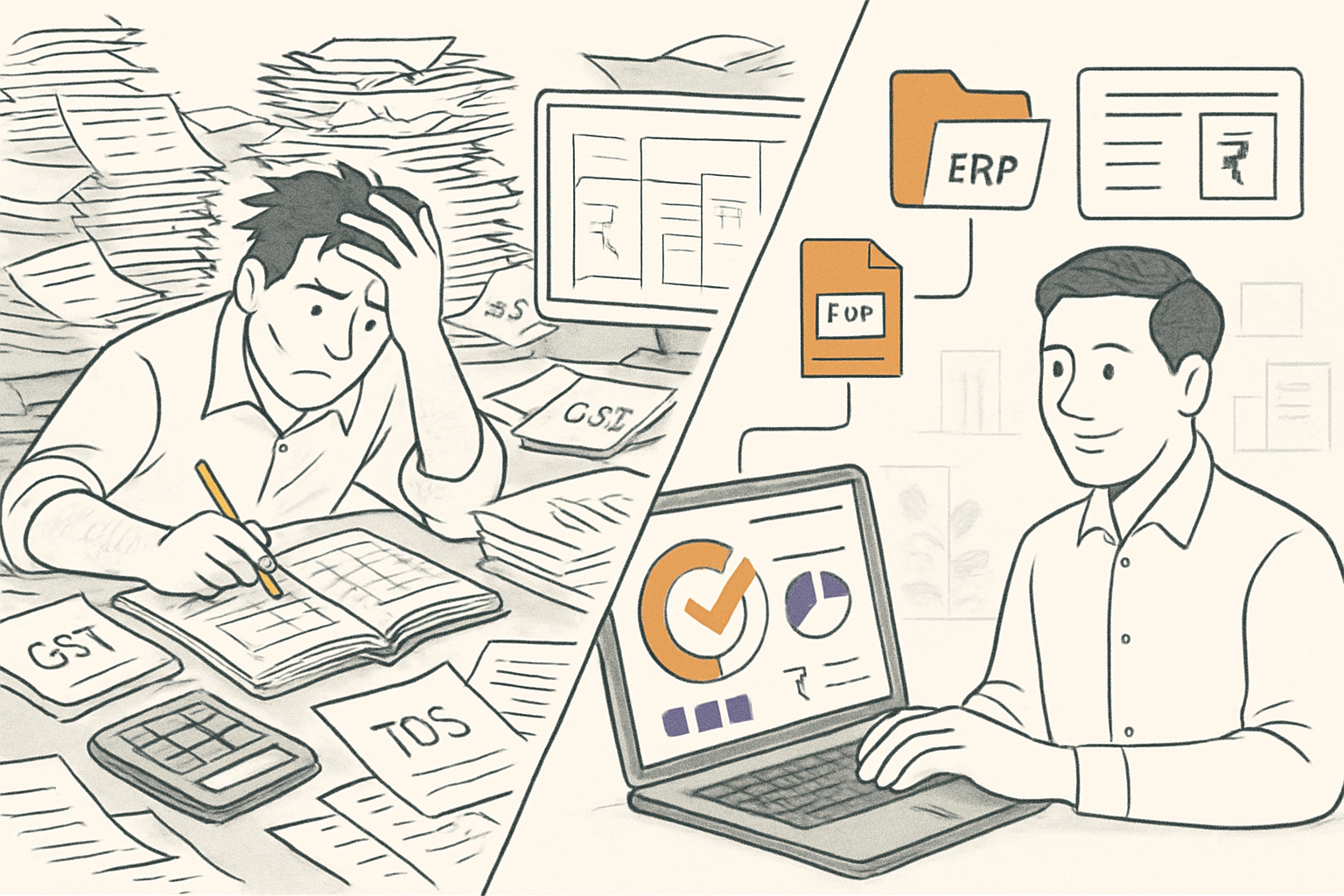
Every month, somewhere between the 10th and the 20th, a finance team at a ₹150-crore manufacturing company in Pune goes into a familiar scramble. Someone is downloading GSTR-2B. Someone else is cross-checking it against purchase registers in Excel using VLOOKUP formulas that break every time a vendor's invoice number has an extra space. A third person is calling suppliers to ask why their invoice hasn't shown up in the portal yet. This is not a hypothetical — it is the default operating model for most mid-sized Indian companies in 2026, and it is costing them far more than they realize.
GST return automation has moved past being a "nice-to-have" digitization project. It is now core financial infrastructure — as fundamental as your ERP or your banking relationship. This article lays out why mid-sized CFOs need to treat it that way, what the real ROI looks like in rupee terms, and how to sequence the shift without disrupting your existing Tally or SAP setup.
Why is manual GST filing still costing mid-sized companies so much in 2026?
Start with the honest number: manual GST processes at a typical mid-sized company consume more than 40 hours a month in reconciliation work alone, translating into ₹2-5 lakhs in salary cost every month spent purely on compliance grunt work rather than analysis or decision support (source: FICCI-cited industry data). Annualize that and you're looking at ₹24-60 lakhs a year — enough to hire two experienced financial analysts, or fund a genuine automation rollout with change to spare.
A FICCI industry survey found that nearly 87% of Indian taxpayers routinely encounter GST reconciliation or filing challenges (source: FICCI survey). These aren't exotic edge cases — they're the same recurring problems: incorrect invoice reporting, ITC mismatches against GSTR-2B, vendor non-compliance, and GST portal slowdowns during peak filing windows (source: practitioner pain point data).
Here's the part CFOs underweight: manual reconciliation isn't just slow, it's unreliable. When your team is matching thousands of line items by eye or with fragile spreadsheet formulas, the error rate isn't zero — it's closer to 10-15% on high-volume ledgers, and every missed match is either blocked ITC or an audit flag waiting to surface eighteen months later.
What does GST automation actually do differently from digital filing?
There's a meaningful distinction between "digital GST filing" (uploading JSON files through a portal or a basic utility) and genuine GST return automation. The latter integrates directly with your ERP or accounting system through certified API frameworks, so data integrity is maintained from the moment a transaction is booked to the moment a return is filed (source: API integration frameworks).
- GSTR-1 and GSTR-3B preparation — auto-populated from sales and purchase registers, with validation before submission rather than correction after rejection.
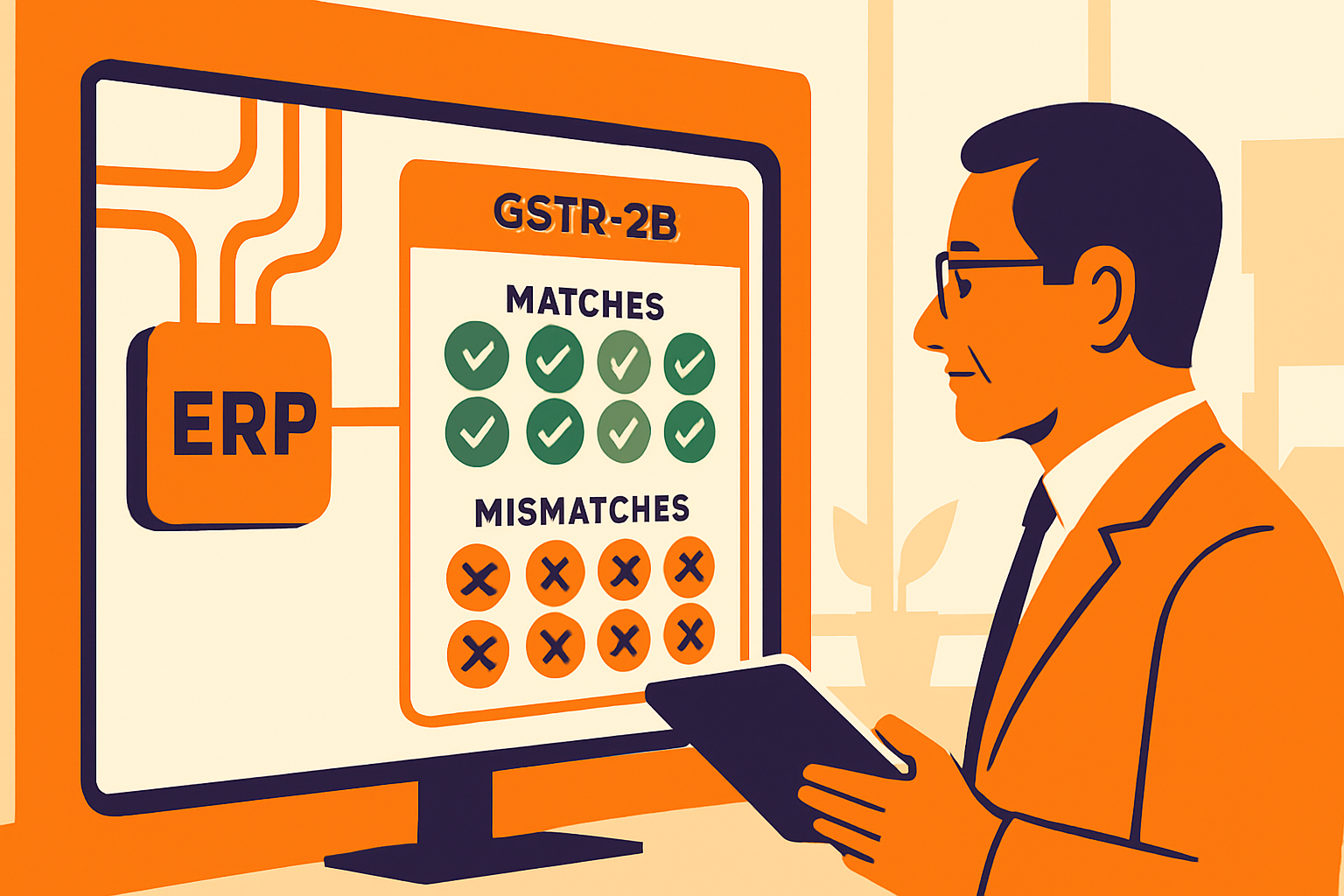
- ITC reconciliation against GSTR-2A/2B — automated import of purchase and supplier data straight from the GST portal, compared line-by-line against your books, with discrepancies flagged for verification rather than discovered during a departmental notice (source: reconciliation mechanics).
- Annual returns (GSTR-9/9C) — built up incrementally through the year rather than reconstructed in a panic each September.
- e-Invoicing and e-Way Bill generation — triggered automatically at the point of sale/dispatch, eliminating the separate manual step that most companies still treat as an afterthought.
- TDS automation — calculation, challan generation, and quarterly filings for Forms 24Q, 26Q, 27Q and 27EQ, plus automated issuance of Form 16/16A certificates (source: TDS and statutory reporting automation).
The philosophical shift is what matters most: continuous validation for duplicates, missing fields, or incorrect GSTINs happens at the point of transaction entry, not during month-end reconciliation. That converts compliance from a reactive correction exercise into a predictable, controlled process (source: continuous validation).
If your vendor master data is also a mess — duplicate vendor codes, mismatched PANs, inconsistent GSTINs — automation won't fix that layer for you. We've covered that specific problem in Vendor Reconciliation Automation: A CFO's Guide to Closing the GST-TDS-MSME Gap, which is worth reading alongside this piece since GST reconciliation quality is only as good as your vendor master.
What is the real working capital impact of ITC reconciliation?
Let's run the numbers on a real scenario. Say your company processes ₹8 crore in monthly purchases eligible for input tax credit at an average GST rate of 18%. That's roughly ₹1.44 crore in ITC claimable every month. Now assume that manual reconciliation, done at month-end with a two-week lag, results in even a 5% mismatch rate due to vendor filing delays, invoice number errors, or missed uploads. That's ₹7.2 lakhs of ITC blocked or delayed every month — cash that should be offsetting your output tax liability but instead sits stuck, forcing you to fund working capital through overdraft or cash credit at 9-11% interest.
Over a year, that's potentially ₹85 lakhs of ITC caught in reconciliation limbo at any given point, with the associated financing cost running into several lakhs annually just to bridge the gap. Automated systems that continuously reconcile against GSTR-2B as invoices are uploaded — rather than waiting for month-end — catch these mismatches within days, not weeks, which is the difference between claiming ITC in the same filing period versus losing a cycle.
This is precisely the kind of problem that automation quantifiably solves: companies leveraging GST automation report an 85-90% reduction in manual reconciliation time and a 95%+ reduction in matching errors (source: reconciliation and error reduction data). If you're already thinking about ITC in cash flow terms, it's worth reading our companion piece on the Working Capital Dashboard: A Practitioner's Build Guide for Mid-Sized Indian Companies, which shows how to wire ITC recovery timelines directly into your cash flow forecasting.
Why do mid-sized companies lag behind large enterprises on GST automation?
The market has grown fast — India's GST software market doubled from ₹2,400 crore in 24 to ₹4,800 crore in 2024 (source: GST software market sizing). But adoption is deeply uneven. Only 28% of mid-market companies with turnover between ₹50-500 crore have adopted advanced GST automation, compared to 65% of large enterprises (source: mid-market automation adoption gap).
This gap is not because mid-sized companies don't need automation — if anything, they need it more, since they run compliance-heavy operations without the dedicated tax teams that large enterprises maintain. The lag exists because mid-sized finance teams often assume automation requires a full ERP overhaul, when in practice most modern GST automation layers plug into existing Tally, Zoho Books, or SAP Business One setups without requiring a system replacement.
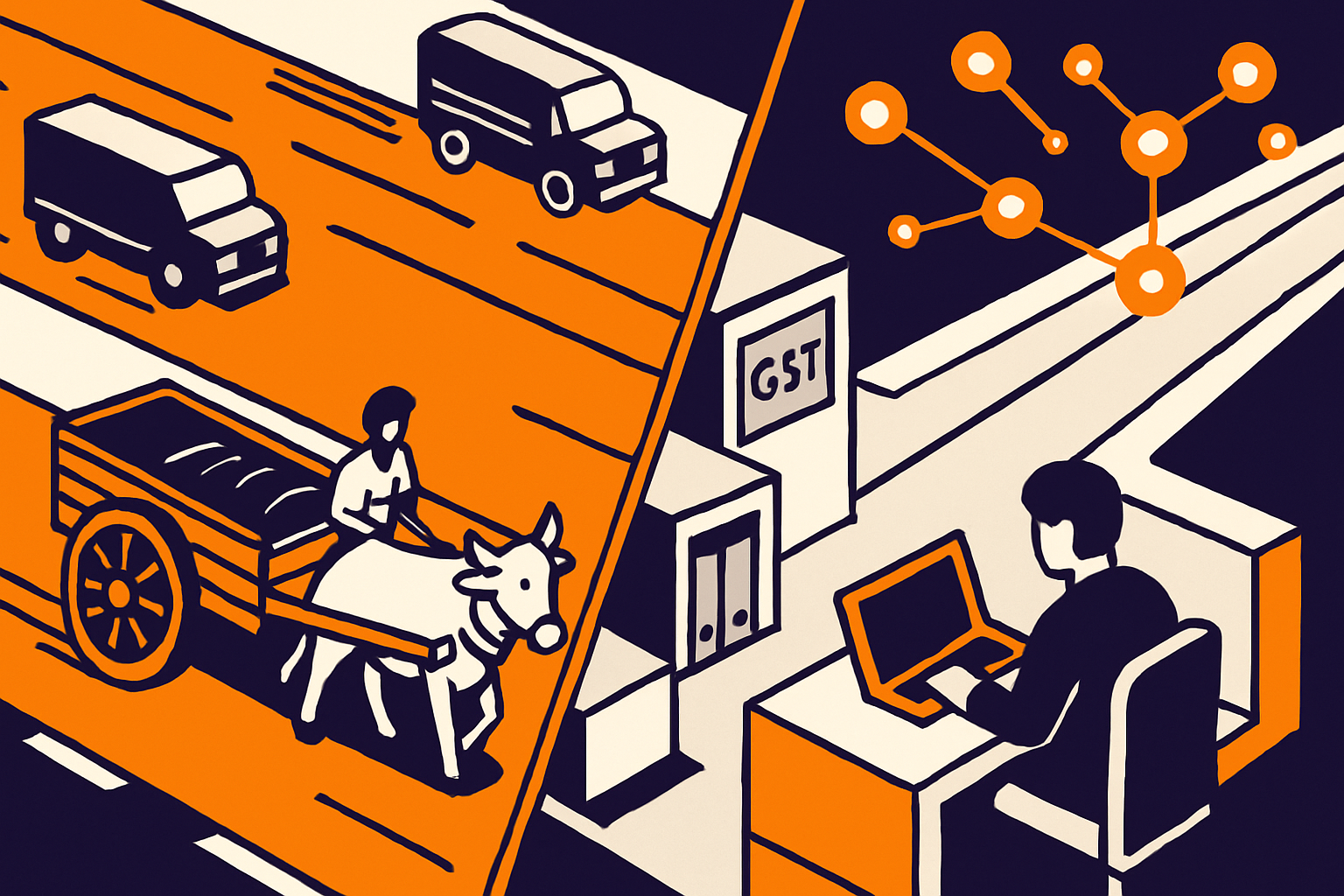
Doing GST manually in 2026 is like using a bullock cart on the expressway — it technically gets you there, but everything modern around you has already moved to a different speed, and you're now the bottleneck creating risk for everyone behind you.
The mid-market gap is precisely where the competitive opportunity sits. If your closest competitor is still filing manually and you've automated ITC reconciliation and TDS compliance, you're not just saving compliance cost — you're freeing up finance bandwidth for pricing analysis, vendor negotiation, and cash flow forecasting while they're still chasing GSTR-2B mismatches.
How does automated reconciliation actually work against GSTR-2A/2B?
Walk through what a properly automated reconciliation cycle looks like at a ₹200-crore auto components company:
- Continuous ingestion: As vendors upload invoices to the GST portal (even before the 2B cutoff), the automation platform pulls this data via API and stages it against your purchase register in near real time.
- Multi-field matching: The system matches on invoice number, invoice date, GSTIN, taxable value, and tax amount — not just a fuzzy total match, which is where most Excel-based reconciliation quietly fails.
- Exception flagging: Anything that doesn't match — a vendor who filed a different invoice number, a tax amount off by ₹340 due to rounding, a GSTIN typo — gets flagged with a suggested reason (timing difference, data entry error, vendor non-filing).
- Action routing: Mismatches route automatically to the AP team member responsible for that vendor relationship, with the specific discrepancy pre-identified, so no one is manually scanning thousands of rows.
- ITC claim decisioning: Only clean matches flow into the eligible ITC claimed in GSTR-3B, with provisional or blocked ITC tracked separately so nothing gets claimed prematurely and triggers a future notice.
For a company processing 3,000-4,000 purchase invoices a month, this cycle — done manually — eats a full week of one person's time every month. Automated, it runs continuously in the background with human review reserved only for genuine exceptions, typically 3-5% of total invoice volume.
If your sales-side data feeding into GSTR-1 is also inconsistent — different invoice formats across branches, manual entry errors in the sales register — that upstream problem compounds your GST filing risk. We've addressed that specific challenge in Sales Register Automation: Why Mid-Sized Indian CFOs Can't Afford Manual Sales Registers in 2026, which pairs naturally with the reconciliation workflow described here since accurate outward supply data is the foundation GSTR-1 automation depends on.
What role does AI actually play beyond basic automation?
Rule-based automation solves the mechanical problem — matching invoices, generating challans, populating returns. AI and machine learning solve a different, more valuable problem: prediction and pattern detection. AI-driven GST tools are increasingly used to predict tax liabilities ahead of filing, flag likely compliance lapses before they occur, and run smart reconciliations that learn from historical mismatch patterns rather than treating every discrepancy as new (source: AI/ML in GST automation).
Deloitte India's GST@9 survey, published in June 2026, found that over 99% of businesses report a positive or neutral experience with GST, with compliance digitization (cited by 69%) and tax process automation (cited by 54%) named as the key drivers of that improvement (source: Deloitte GST@9 survey). Even more telling: 89% of stakeholders surveyed said AI-led data processing and reconciliation should be the priority for the next phase of GST, often referred to as GST 2.0 (source: Deloitte GST 2.0 priorities). If you're evaluating whether to invest in AI-driven tools versus straightforward rule-based automation for your GST stack, our detailed comparison in AI vs Traditional Automation in Finance: What Mid-Sized Indian Companies Should Actually Choose walks through the decision criteria in more depth.
Why is cross-platform data consistency (GST, MCA, TDS) now a compliance necessity?
Here's something most CFOs still underestimate: the GST department doesn't look at your GST returns in isolation anymore. Data analysis techniques are actively used to scrutinize Income Tax Returns and MCA filings to identify entities that may not be discharging their full GST liability — meaning inconsistencies between your GST turnover, your ITR-reported revenue, and your MCA financial statements can trigger scrutiny even without a direct GST-side red flag (source: cross-platform data analysis by tax authorities).
MCA data — director details, financial health indicators, filing status — can also be joined with GST information via PAN to build a more complete compliance and due-diligence picture (source: MCA-GST data linkage). Practically, this means your GST automation strategy cannot live in a silo. If your GSTR-1 outward supply figures, your P&L revenue, and your MCA-filed financial statements tell three slightly different stories because they're maintained on three disconnected spreadsheets, you've created exposure regardless of how clean each individual filing looks.
The fix isn't more manual cross-checking — it's designing your automation architecture so that GST, TDS, and statutory reporting draw from the same underlying transaction data, with reconciliation differences explainable and documented, not accidental.
What do current GST filing volumes indicate about the future of compliance?
Monthly GST return filings across India now consistently exceed 1.1 crore submissions, with a compliance rate above 85% in recent years — a level of consistency that's largely attributable to automation and stricter enforcement working in tandem (source: GST filing volume and compliance rate). Enforcement is not going to get gentler from here — it's going to get more data-driven, faster, and less forgiving of manual errors. A finance function still relying on spreadsheet reconciliation isn't just slower than a competitor's automated one; it's operating with materially higher exposure in an environment where the tax administration's own detection tools are improving faster than most in-house compliance processes.
What is a practical 90-day roadmap for mid-sized CFOs to implement GST automation?
You don't need a big-bang ERP replacement to start. A realistic sequence looks like this:
- Weeks 1-2: Audit your current GST filing process end-to-end. Time how long GSTR-2B reconciliation actually takes each month and quantify ITC currently sitting in mismatch/blocked status.
- Weeks 3-6: Integrate an API-based GST automation layer with your existing accounting system (Tally, Zoho, SAP) for GSTR-1 and 3B preparation, starting with your highest-volume GSTIN/branch.
- Weeks 7-10: Layer in continuous GSTR-2A/2B reconciliation with exception routing to AP owners, and connect TDS challan generation and Form 16A issuance to the same data pipeline.
- Weeks 11-13: Extend automation to remaining branches/GSTINs, and build a management dashboard tracking ITC recovery rate, mismatch aging, and filing timeliness as ongoing KPIs — not just a once-a-year GSTR-9/9C exercise.
This kind of phased rollout mirrors how we'd recommend approaching any finance automation initiative — start where the pain and the ROI are both highest, prove it, then scale. If you want a broader framework for sequencing automation investments across your finance function, our piece on How CFOs Can Build a Data-Driven Finance Function covers the operating model this fits into.
How can BiPivot assist with GST return automation?
BiPivot works with mid-sized Indian finance teams to design GST return automation that plugs into your existing Tally or ERP setup — covering GSTR-1/3B preparation, continuous GSTR-2A/2B reconciliation, and TDS filing workflows without a system overhaul. We focus on measurable outcomes: hours saved, ITC recovered, and mismatch rates driven toward zero. Visit BiPivot to talk through where your GST compliance stack stands today.