

Vendor Reconciliation Automation: A CFO's Guide to Closing the GST-TDS-MSME Gap
By BiPivot Team · 4 August 2026
Every mid-sized Indian company we've worked with has a version of the same story: the vendor sends a statement showing an outstanding balance of, say, ₹18.4 lakh. The company's books show ₹16.9 lakh. Nobody can explain the ₹1.5 lakh gap without spending three days pulling invoices, credit notes, and TDS certificates out of email threads and Tally exports. Multiply that by 150-200 active vendors, and you understand why finance teams spend the last week of every month firefighting instead of closing books.
This isn't a training problem. It's a structural one. Vendor statement reconciliation means methodically comparing every transaction a vendor claims — invoices, credit notes, payments received — against what your own books show for that vendor (Mynd Solutions). In India, that comparison has to simultaneously satisfy GST law, TDS provisions, and the MSMED Act — three regulatory regimes that don't talk to each other, layered on top of ordinary commercial disputes. Mid-size Indian companies typically carry vendor balance mismatches of 2-5% of total accounts payable at year-end (OneFinOps) — on a ₹40 crore AP book, that's ₹80 lakh to ₹2 crore sitting in dispute, unreconciled, and often untraceable to a root cause.
This article is about why that gap exists, exactly how automation closes it, and what a realistic 3-6 month rollout looks like for a company that's still running reconciliation out of Excel and Tally.
Why Does Vendor Reconciliation Break Down in Indian Companies Specifically?

Four categories of mismatch show up again and again, and each has a distinctly Indian flavor.
1. TDS netting differences. A vendor invoices ₹5,00,000. You deduct TDS at 2% under Section 194C (₹10,000) and pay ₹4,90,000. The vendor's ledger, if not updated for the deduction, still shows ₹5,00,000 receivable. Multiply this across 40 invoices a month and the "unreconciled" figure balloons — even though nothing is actually wrong. TDS adjustment is, in fact, the single most common cause of reconciliation differences in Indian businesses (OneFinOps). Manual reconciliation teams routinely misclassify these as genuine disputes and waste hours chasing vendors who did nothing wrong.
2. GST input tax credit mismatches. Under the current GST framework, ITC eligibility depends on the invoice appearing in your GSTR-2B. If a vendor has recorded and filed an invoice but your accounts team never entered it (a classic missed-invoice scenario), you lose eligible ITC. Conversely, if you've claimed ITC on an invoice the vendor hasn't yet filed, you're exposed to a reversal demand plus interest at the next assessment. GST reconciliation exists precisely to catch invoices the vendor has recorded that are missing from your books, protecting ITC and avoiding penalties (Mynd Solutions). On a company claiming ₹60 lakh in monthly ITC, even a 3% leakage from unreconciled invoices is ₹1.8 lakh gone every month, permanently.
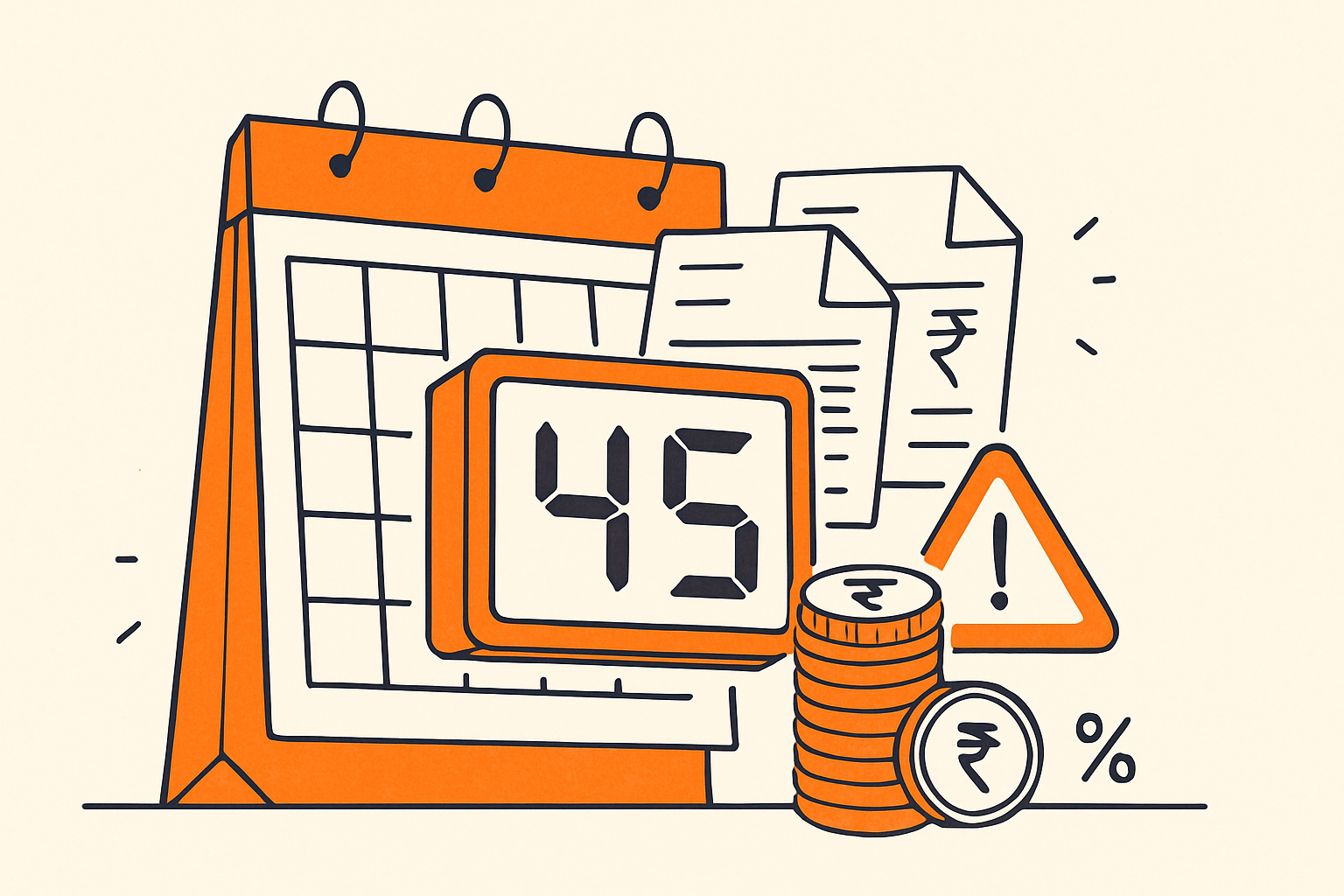
3. MSMED Act payment timelines. If your vendor is a registered Micro, Small, and Medium Enterprise, the MSMED Act requires payment within 45 days of acceptance of goods or services. Miss that window and the interest penalty is compound interest at three times the RBI bank rate — not simple interest, compound (Mynd Solutions). On a ₹25 lakh overdue payment sitting unpaid for 90 days beyond the deadline, that compounding penalty can run into lakhs. Most companies don't even know which of their vendors are MSME-registered because nobody's cross-checked Udyam registration numbers against the vendor master in two years.
4. Duplicate and timing differences. Two invoices entered under slightly different reference numbers, a payment recorded in March that the vendor books in April, a credit note issued but never applied — these are the everyday grit of AP, common to any reconciliation exercise but magnified by manual, spreadsheet-based tracking that can't cross-reference thousands of line items at once (xFlow).
How Exactly Does Automation Fix Each of These?
This is where most vendor-reconciliation content gets vague — "AI matches transactions" — without explaining the mechanics. Here's what a properly configured system actually does.
TDS-aware matching. The matching engine doesn't just compare invoice amount to payment amount. It's configured with your applicable TDS sections and rates, so when it sees an invoice of ₹5,00,000 and a payment of ₹4,90,000, it automatically nets the ₹10,000 as a TDS deduction, checks it against the rate applicable to that vendor category, and flags it only if the deducted amount doesn't match the expected rate — say, if 4% was deducted instead of 2%, which usually means a vendor PAN mismatch or wrong section applied.
GSTR-2B cross-validation. Automated systems ingest your GSTR-2B data monthly and cross-check every vendor invoice in your books against it before you claim ITC. Modern AI-powered reconciliation tools ingest vendor statements, bank entries, and GST data together, using fuzzy logic and India-specific tax awareness to match records that would never line up in a simple exact-match spreadsheet formula (AI Accountant). Fuzzy matching matters enormously here — a vendor invoice number like "INV/2026-27/0342" and your ERP's internal reference "PO4521-0342" describe the same transaction but no VLOOKUP will ever match them. The AI layer learns these patterns per vendor over 2-3 reconciliation cycles.
MSME deadline tracking. The system tags every vendor against MCA and Udyam registration status — using the Corporate Identity Number (CIN) as a stable lookup key is the standard approach for verifying incorporation details, PAN, GST registration and filing status against Ministry of Corporate Affairs data (Thirdwatch) — and then runs a live 45-day countdown clock on every invoice from a registered MSME vendor, flagging it at day 30 so AP can prioritize payment before the interest clock starts.
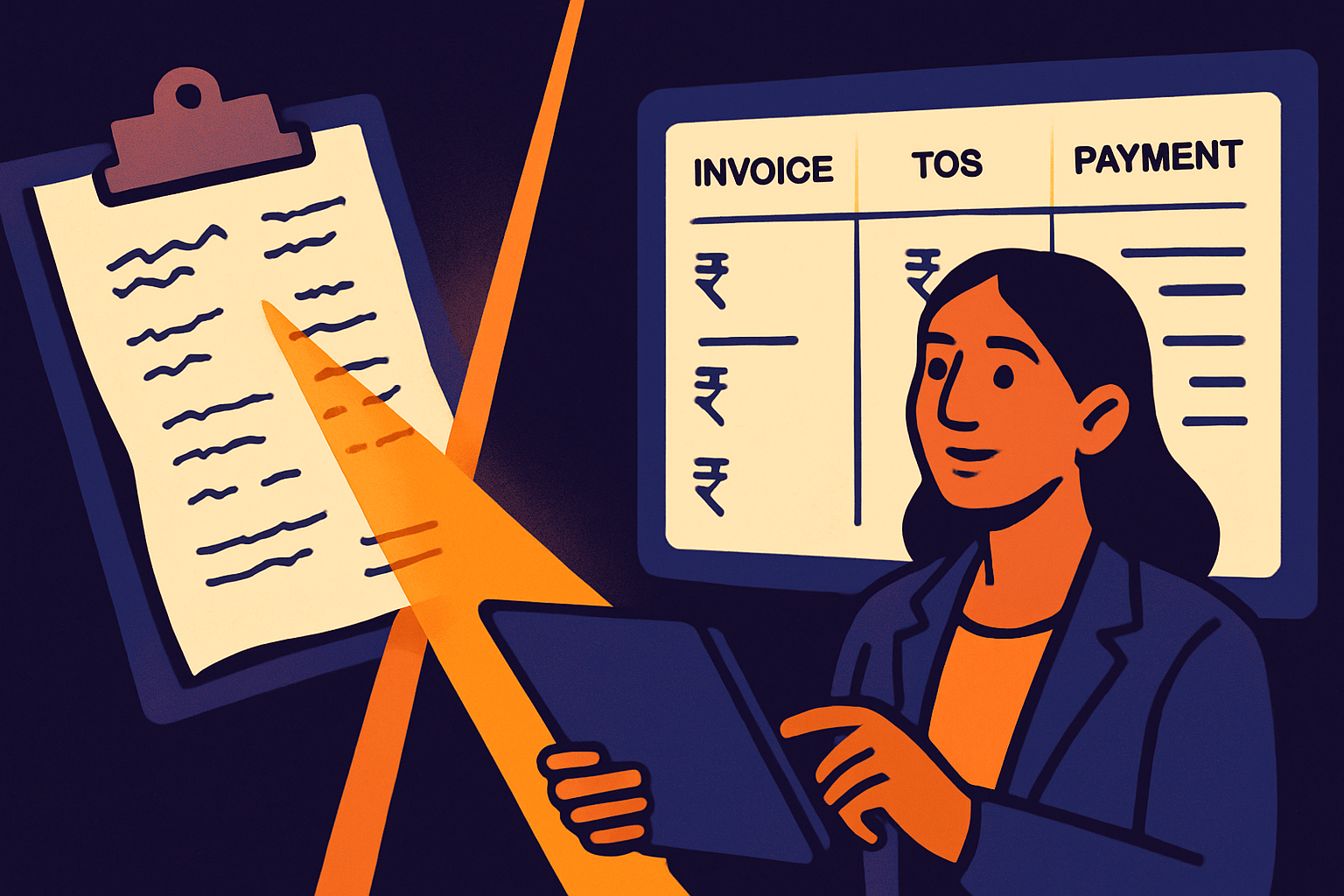
OCR ingestion for inconsistent vendor formats. Not every vendor sends a clean Excel statement. Many send scanned PDFs, some send handwritten ledger extracts, some just email a WhatsApp screenshot of their books. OCR extracts line items from these formats regardless of layout, converting them into structured data the matching engine can process — this is the technical backbone of what's now branded as "automated statement reconciliation" in the Indian market (AI Accountant).
The accuracy numbers back this up: modern AI-powered reconciliation tools now achieve 99.5% accuracy on high-volume transaction datasets (AI Accountant), a level no manual team sustains once vendor count crosses 100-150.
What's the Actual ROI, in Rupees?
Skip the vague "efficiency gains" language and look at the direct numbers relevant to a mid-sized company.
Labor cost. Automated reconciliation has been shown to cut back-office labor costs by 30-40% (Kosh.ai). If your AP team of 4 executives costs ₹28 lakh annually in fully-loaded compensation, and reconciliation consumes roughly 40% of their time (a realistic estimate for teams still running Excel-based matching), automation frees up ₹4-4.5 lakh in redeployable capacity per year — not headcount cuts, but capacity to handle 2-3x the vendor volume without hiring.
Close speed. Indian finance teams adopting automation report 50-75% less manual reconciliation effort and 2-5 day faster month-end closes (AI Accountant). For a CFO trying to get MIS out to the board by the 5th working day instead of the 10th, this is often the single largest lever — see our related piece on MIS reporting best practices for how a faster close feeds directly into board-ready reporting.
Broader automation ROI. Finance and accounting automation in India delivers an estimated 214% ROI over three years for SMBs (Bizeract) — vendor reconciliation is typically one of the highest-payback modules within that broader automation stack because the discrepancy-hunting labor it replaces is so manually intensive.
ITC protection. Take a company with ₹7.2 crore in annual GST input claims. Even a conservative 2% leakage from unmatched or late-filed vendor invoices — invoices the vendor filed in GSTR-1 but which never got captured against the corresponding purchase entry — is ₹14.4 lakh in permanently lost ITC per year. Automated GSTR-2B matching catches this before the filing deadline, not after.
MSME penalty avoidance. A company with ₹3 crore in annual MSME vendor payments, of which even 15% (₹45 lakh) routinely misses the 45-day window by an average of 30 days, is exposed to compound interest at 3x the RBI bank rate — at a current repo-linked bank rate near 6.5%, that's roughly 19.5% annualized, compounding. On ₹45 lakh for 30 days, that's a real, avoidable liability of roughly ₹72,000-₹75,000 per cycle, repeating every month it's not fixed, before you even count the reputational damage of an MSME vendor filing a complaint with the Facilitation Council.
What Does a Realistic Implementation Roadmap Look Like?
Manual reconciliation using spreadsheets is genuinely fine for a company with 20-30 vendors. It becomes error-prone and inefficient specifically as supplier count grows past that (xFlow) — which is exactly the inflection point most mid-sized Indian companies hit as they scale past ₹100-150 crore in revenue. A phased implementation typically spans 3-6 months (Mynd Solutions). Here's how we structure it with clients:
Month 1 — Planning and vendor triage. Segment vendors into three tiers: top 20 by transaction volume (usually 60-70% of total AP value), MSME-registered vendors (regulatory risk regardless of size), and the long tail. Pilot on Tier 1 and MSME vendors only — don't attempt all vendors at once.
Month 2 — Pilot and data integration. Connect the reconciliation tool to your ERP (Tally, SAP, Zoho Books, whatever you run), your GSTR-2B feed, and your bank statement source. If you've already worked through bank reconciliation automation, you'll recognize this integration pattern — vendor reconciliation is the natural next module because it reuses the same OCR and matching infrastructure. Run the pilot in parallel with manual reconciliation for one full month to validate accuracy before switching off the manual process.
Month 3-4 — Exception handling workflow design. This is the step most companies skip. Automation doesn't eliminate discrepancies — it surfaces them faster and filters out the noise (TDS netting, timing differences) so your team only manually investigates genuine exceptions. Build a workflow: who owns TDS-related flags, who owns MSME payment escalations, who owns genuine vendor disputes, and what the resolution SLA is for each category.
Month 5 — Full rollout to Tier 2/3 vendors. Once the pilot vendors show consistent match rates above 95%, extend to the remaining vendor base. Vendor non-cooperation is a real friction point here — some vendors won't send statements in any structured format. Contractual clauses requiring monthly statement submission, combined with OCR that can parse whatever format they do send, solves most of this without a confrontation.
Month 6 — Embed into monthly close. Reconciliation should be integrated into the monthly or periodic close process for key vendors, not treated as a year-end scramble — waiting until year-end lets minor mismatches accumulate into large, hard-to-trace discrepancies (Perfect Accounting). By month six, reconciliation should be a standing agenda item in your close checklist, not a special project.
If your company hasn't yet moved off spreadsheets for core financial processes generally, it's worth reading why Excel alone is no longer enough for mid-sized Indian companies before scoping this project — vendor reconciliation is usually the second or third module that breaks after invoice processing and bank reconciliation.
What Happens to the AP Team Once Reconciliation Is Automated?
This is the question CFOs ask us most often, and it's a legitimate one. The honest answer: the headcount doesn't disappear, but the job description does. AI adoption among accounting firms globally surged from 9% in 2024 to 41% in 2025, with 77% planning to increase AI investment — yet only 37% of firms currently invest in AI training for their teams (Dokka). That gap — heavy investment in tools, light investment in people — is where automation projects quietly fail. The software works fine; the team doesn't trust its output because nobody explained how the matching logic works or what to do when it flags an exception.
Practically, this means retraining your AP executives away from manual line-by-line matching and toward three new skills: reviewing and adjudicating the exceptions the system flags (usually 3-5% of transactions, not 100%), interpreting the monthly discrepancy trend to spot systemic issues (a vendor whose invoices consistently mismatch might indicate a billing system problem on their end, not yours), and feeding reconciliation insights into working capital decisions — which vendors to negotiate better terms with, which MSME relationships need faster payment cycles to avoid penalty exposure. Our piece on building a data-driven finance function covers this transition in more depth — the reconciliation automation project is often the first place a CFO can demonstrate, concretely, what "data-driven" actually means to a skeptical finance team.
Is This Worth Doing Now, Given the Regulatory Direction?
Yes, and the regulatory trend makes it more urgent rather than less. The GST e-invoicing threshold dropped to ₹1 crore in 2025, bringing significantly more SMEs — likely including many of your own vendors — under mandatory e-invoicing (AI Accountant). That means more of your vendor base now generates structured, machine-readable invoice data by default, which makes automated matching easier, not harder, to implement. The broader reconciliation software market reflects this shift too, projected to reach approximately USD 3,206.7 million by 2031 at a 15.5% CAGR from 2024 (Kosh.ai) — vendor reconciliation is riding the same wave as bank and cash reconciliation automation, and companies that wait until the e-invoicing mandate forces their hand will be retrofitting under pressure instead of building a considered rollout.
How BiPivot Helps
BiPivot works with mid-sized Indian finance teams to design and implement vendor reconciliation systems that are configured for GST, TDS, and MSMED Act specifics from day one — not generic matching logic retrofitted for Indian compliance. If you're evaluating where reconciliation automation fits in your broader finance transformation roadmap, explore our consulting work or browse our tools, including the invoice extractor, or visit bipivot.com to see how we approach this end to end.