

Sales Register Automation: Why Mid-Sized Indian CFOs Can't Afford Manual Sales Registers in 2026
By BiPivot Team · 5 August 2026
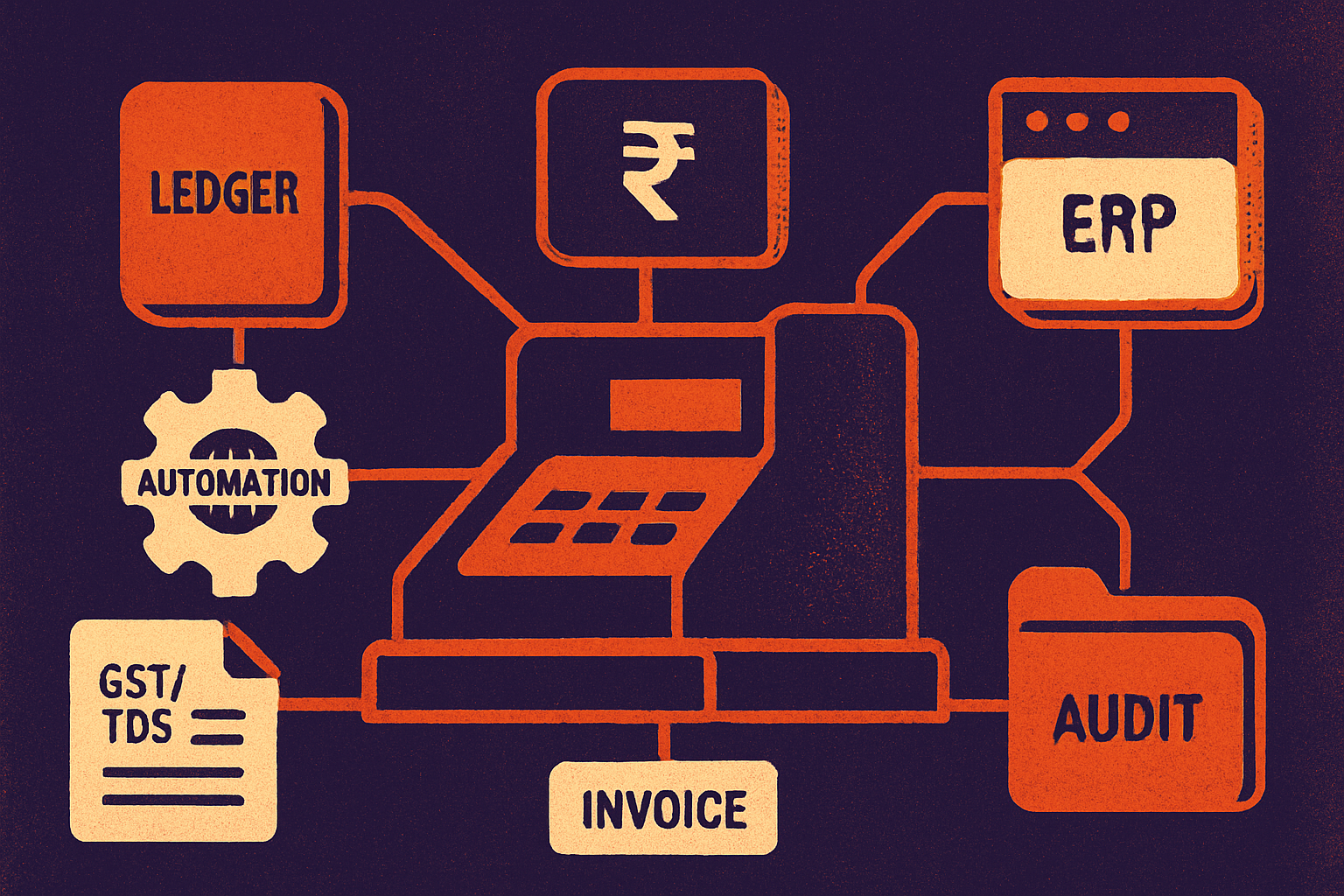
Why Is the Sales Register Still a Manual Afterthought in Most Indian Mid-Sized Companies?
Walk into the accounts team of most ₹100–500 crore Indian companies in August 2026 and you'll still find the sales register living in three places at once: the ERP (Tally or SAP), a parallel Excel tracker the GST team maintains "just to be safe," and a set of PDF invoices sitting in someone's inbox waiting to be keyed in. Nobody designed it this way — it accreted, invoice by invoice, exception by exception.
This isn't a small-company problem. Manual invoice processing remains the single biggest accounting challenge for Indian SMEs, and 69.6% of them cite bill and accounts payable processing as their primary pain point, with GST reconciliation flagged separately by 8.1% (IBS Intelligence). The sales side isn't spared — every mismatch between what's booked in the ERP, what's reported on the e-invoice portal, and what shows up in GSTR-1 becomes a reconciliation project that eats into a controller's month-end week.
The real cost is bigger than the labour hours. Manual data entry alone costs Indian businesses an estimated 10–15 hours every week and carries a 3–5% error rate (LedgerScan). When you multiply that error rate across a mid-sized company issuing 3,000–5,000 sales invoices a month, you're looking at 100–250 invoices with some form of discrepancy — wrong HSN code, mismatched tax rate, missing IRN, wrong customer GSTIN — every single month.
What Does a Broken Sales Register Actually Cost You in Rupees?
CFOs tend to underestimate this because the cost is distributed across departments and doesn't show up as one line item. Let's build the number the way an internal audit would.
Take a company issuing 4,000 sales invoices a month. Using the mid-market benchmark of ₹340+ per invoice in processing cost once you account for staff time, error correction, GST rework and follow-ups (Optivus) — the same order-of-magnitude drag applies on the sales side, where errors trigger credit notes, revised e-invoices, and customer queries:
- 4,000 invoices × ₹340 = ₹13.6 lakh/month in pure processing friction
- Annualised: ₹1.63 crore/year — before you even count penalty exposure
Now layer on the compliance-specific risks that manual sales registers create:
Blocked Input Tax Credit for your customers. An invoice without a valid Invoice Reference Number (IRN) and QR code is invalid under GST law, and your customer cannot claim ITC on it (Tally Solutions). If your sales register and e-invoicing workflow aren't tightly coupled, you will generate invoices that get raised in the ERP before the IRN is fetched, or worse, invoices where the IRN never syncs back into your books. Every one of those becomes a credit note request from an unhappy customer's AP team, a delayed payment, and a dent in the relationship.
The 30-day reporting wall. As of 2026, taxpayers with Aggregate Annual Turnover (AATO) of ₹10 crore and above face a strict 30-day window to report e-invoices — miss it and the Invoice Registration Portal (IRP) rejects the invoice outright (Tally Solutions). A manual register that's updated in weekly batches, not real-time, is structurally incapable of catching this before it becomes a rejected invoice and a scramble to re-issue.
The ₹5 crore threshold catching more companies every year. E-invoicing is now mandatory for any business whose AATO has crossed ₹5 crore in any year since FY 2017-18 (Tally Solutions). Companies that were exempt three years ago are now in scope, often without having redesigned their sales register workflow to match — they're still running the same Excel-plus-Tally process they used pre-2023, just with a mandatory e-invoicing step bolted on.

Where Exactly Does the Sales Register Break Down?
In our client work, the failure points cluster around five recurring gaps. If you're a CFO reading this, walk your own team through these five and you'll likely find at least two live in your organisation right now.
1. The IRN doesn't flow back into the ERP automatically. Someone generates the e-invoice on the government portal or via a GSP, gets the IRN and QR code, and then has to manually paste it back into the ERP record or a tracking sheet. On high-volume days, this step gets skipped or delayed, and your sales register shows invoices without a linked IRN — invisible risk until a customer complains about blocked ITC.
2. Credit notes and debit notes aren't tracked against the original invoice. A ₹12 lakh sales invoice raised in April, followed by a ₹80,000 credit note for a quality rejection in June, needs to net correctly in both your sales register and your GSTR-1. Manually, this net-off is done at month-end using lookups — and it's exactly where the 3–5% error rate concentrates.
3. TDS deducted by customers doesn't reconcile with what's booked. Your customer deducts TDS under Section 194Q or 194C on your invoice and reflects it in their books at 2%, but if GST wasn't shown separately on the invoice, or if the base amount used for deduction included GST, the numbers won't tie out. TDS compliance spans over 30 sections with rates and cumulative thresholds that reset annually (OneFinOps), and TDS should only be deducted on the amount excluding GST when it's shown separately on the invoice (OneFinOps). Most manual sales registers don't have a column for "TDS as per 26AS vs TDS as per books," so this mismatch surfaces only at year-end when Form 26AS reconciliation becomes a fire drill — a mirror of the vendor-side TDS gap we've written about in Vendor Reconciliation Automation: A CFO's Guide to Closing the GST-TDS-MSME Gap.
4. GSTR-1 vs books mismatch surfaces only after filing. Because the sales register isn't the single source of truth, the GST team often builds GSTR-1 from a separate extract. Any invoice raised late, amended, or cancelled after the extract was pulled creates a mismatch that only gets caught during annual return (GSTR-9) reconciliation — sometimes 8-10 months after the fact, by which point correcting it means amendments, interest, and management questions.
5. Statutory register maintenance lags behind actual transactions. MCA compliance requires accurate maintenance of statutory registers and timely annual filings as part of good governance (Corpbiz). When the sales register itself is unreliable, the downstream registers and disclosures inherit the same errors — a governance risk that goes well beyond a finance-team inconvenience.
What Does "Automated" Actually Mean for a Sales Register?
Let's be precise, because "automation" gets used loosely. A properly automated sales register does four things that a spreadsheet-plus-ERP setup cannot:
It captures the invoice once and pushes it everywhere it needs to go. Invoice raised in the ERP → IRN generated automatically via API → IRN and QR code written back into the same ERP record → GSTR-1 draft updated in real time. No re-typing, no separate tracking sheet.
It validates before the invoice leaves the building. GSTIN format checks, HSN-rate mismatches, duplicate invoice numbers, and customer master data errors get flagged at the point of invoice creation — not discovered three weeks later during reconciliation.
It reconciles continuously, not monthly. Every invoice is checked against the e-invoice portal status and the GSTR-1/2B ecosystem daily, so a rejected e-invoice (say, one that missed the 30-day window) is flagged to the sales team the same day, not discovered at quarter-end.
It gives the CFO a live view, not a month-end snapshot. Outstanding e-invoice failures, TDS mismatches, and credit-note netting all roll up into a dashboard the CFO can check on the 5th of the month, not the 25th.
This is the same principle we've argued for cash and working capital visibility in Cash Flow Dashboard Design: A CFO's Blueprint for Mid-Sized Indian Companies — the sales register is simply the upstream data source that determines whether your downstream dashboards are trustworthy at all. Garbage sales register, garbage cash flow forecast.
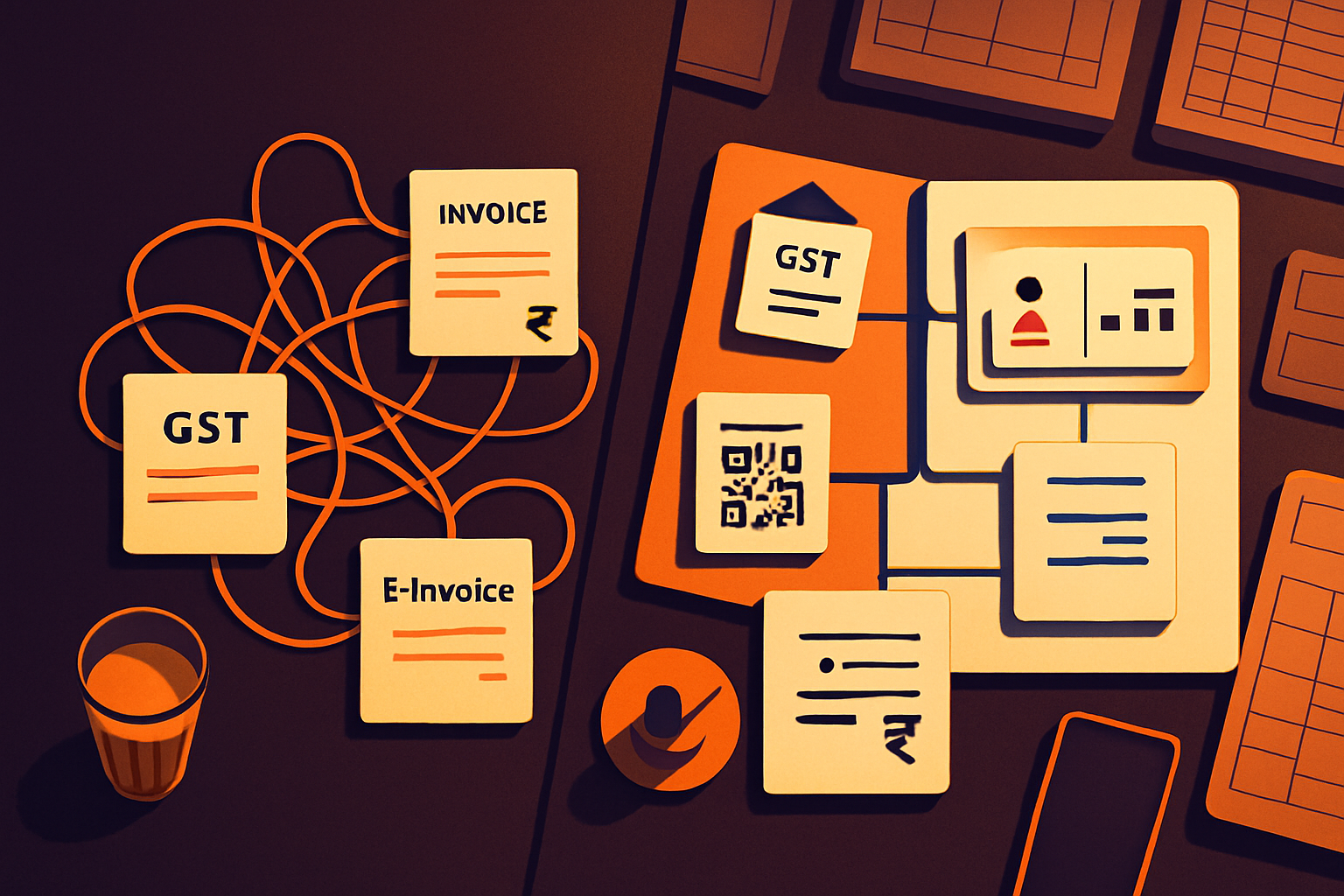
What Does Automation Actually Change at a ₹150 Crore Manufacturing Company? A Worked Example.
Consider a Pune-based auto-components manufacturer with ₹150 crore annual turnover, issuing roughly 350 sales invoices a month across 40 B2B customers, most on 60-90 day credit terms.
Before automation (manual sales register):
- Finance executive manually raises invoice in Tally, separately logs into the GSP portal to generate IRN, then pastes the IRN back into a tracking Excel sheet.
- Average time per invoice: 12 minutes. Across 350 invoices/month, that's 70 hours/month of pure clerical work — nearly half a full-time role.
- Two invoices a month, on average, miss the IRN generation step entirely and get discovered only when the customer's AP team rejects them for ITC purposes — each triggering a re-issue, a delayed payment cycle of 15-20 days, and a strained customer call.
- At year-end TDS reconciliation, ₹4.2 lakh in TDS credits don't match between Form 26AS and the books because three customers deducted TDS on the gross (GST-inclusive) amount instead of the taxable value — requiring letters, corrected TDS returns, and six weeks of back-and-forth to resolve.
After automation:
- Invoice raised in ERP triggers automatic IRN generation via API integration; IRN and QR code populate the invoice PDF and the sales register simultaneously. Time per invoice drops to under 2 minutes of oversight, not entry — a ~48 hours/month saving redeployed to credit control and customer collections follow-up.
- E-invoice failures are flagged same-day, not month-end. Average customer payment delay from invoice disputes drops from 15-20 days to under 3 days.
- TDS mismatches are caught monthly against 26AS data feeds rather than annually, cutting the resolution window from six weeks to under a week and eliminating the year-end scramble entirely.
The ₹150 crore company in this example recovers roughly ₹9-10 lakh a year in direct labour cost, but the bigger number is the working capital unlock: shaving even 10 days off the customer payment cycle on ₹150 crore of annual sales, assuming even 30% of that revenue is affected by invoice-related disputes, frees up close to ₹1.2 crore in trapped receivables at any given point in time.
Isn't This Just a Software Feature — Why Is It a CFO-Level Priority Now?
Because the ownership of automation decisions in Indian companies has shifted. Founders and business owners — not just the accounts team — are increasingly the ones driving adoption of finance automation tools (IBS Intelligence), which tells you this has moved from a back-office efficiency conversation to a board-level risk and growth conversation.
Three structural reasons this now sits on the CFO's desk, not the accountant's:
Regulatory thresholds keep moving down. The ₹5 crore e-invoicing threshold and the 30-day IRN window for ₹10 crore+ turnover businesses (Tally Solutions) mean companies that were comfortable last year can find themselves non-compliant this year purely because their turnover crossed a line. A CFO who treats this as an annual review, rather than a continuous monitoring function, will always be one regulatory update behind.
The volume is genuinely industrial-scale. India's GST portal processes around 100 million invoices daily (International Tax Review). At that scale, manual reconciliation isn't just inefficient — it's statistically guaranteed to miss errors. No amount of diligence from an accounts executive scales to catch what automated matching catches by design.
It compounds with everything else in the finance stack. A clean, automated sales register isn't an isolated win — it's the input that makes MIS reporting, cash flow forecasting, and audit readiness trustworthy. We've made this same argument about the purchase side in Purchase Order to Payment Automation: A CFO's Guide to Compliance-First P2P in India — P2P and sales register automation are two halves of the same data-integrity problem, and fixing only one leaves the other as a bottleneck.
This is also consistent with the broader market signal: mid-sized financial institutions are leading the fastest adoption of B2B SaaS in India's BFSI sector (MENAFN), and 80% of BFSI respondents believe automation adds value to customer servicing, with 60% linking it to customer acquisition (MENAFN). If financial institutions — among the most compliance-burdened businesses in India — are automating at this pace, mid-sized manufacturers and services companies with far simpler tech stacks have no structural excuse to lag.
What Should a CFO Actually Do in the Next 90 Days?
Skip the "digital transformation roadmap" conversation. Here's a sequence that produces measurable results within a quarter:
Weeks 1-2: Audit the current sales register for the five failure points above. Pull a sample of 100 invoices from the last quarter and manually check: Does every invoice have a valid IRN? Do credit notes net correctly against originals? Does TDS booked match Form 26AS for your top 10 customers? This audit alone usually surfaces enough quantified risk to justify the automation budget.
Weeks 3-6: Integrate e-invoicing generation directly into your ERP workflow, not as a parallel portal step. If you're on Tally or SAP, this is typically an API/GSP integration project, not a system replacement — most mid-sized companies can do this without a full ERP migration.
Weeks 7-10: Build the daily reconciliation layer — invoice-to-IRN status, invoice-to-GSTR-1 status, and invoice-to-TDS-credit status, checked daily rather than monthly. This is where the real risk reduction happens, because it converts a month-end fire drill into a same-day flag.
Weeks 11-13: Push the output into your existing MIS and dashboard layer, so sales register health (percentage of invoices with valid IRN, percentage reconciled against GSTR-1, TDS mismatch value outstanding) becomes a standing line in your monthly board pack — the same discipline we've argued for in MIS Reporting Best Practices: Building Power BI Dashboards CFOs Actually Trust.

Is This Really Worth It for a Company That Isn't Huge Yet?
Yes — arguably more so than for large enterprises, because mid-sized companies have less slack to absorb blocked ITC, penalty interest, or a six-week TDS reconciliation fire drill. The data backs this: automation helps Indian MSMEs maintain accuracy in their financial records and significantly reduces compliance risk while improving financial discipline (ANI News), and nearly 60% of Indian MSMEs that adopt digital tools achieve double-digit revenue growth (ANI News). Separately, 67% of Indian companies have already deployed over 300 bots across their enterprise (Economic Times) — automation at scale is no longer the exception, it's the baseline your competitors are already running against.
The sales register is the single most transaction-dense document in your finance function. Every GST filing, every TDS reconciliation, every customer collection call traces back to whether that register was accurate the moment the invoice was raised. Fix it once, properly, and the downstream benefits — faster collections, cleaner GSTR filings, fewer blocked ITC disputes — compound every single month without additional effort from your team.
How BiPivot Helps
BiPivot works with CFOs and controllers at mid-sized Indian companies to design and implement sales register automation that ties directly into e-invoicing, GST filing, and TDS reconciliation workflows — not as a bolt-on tool, but as a redesigned process. If you want a practical assessment of where your own sales register is leaking money and compliance risk, explore our approach at bipivot.com or reach out through our consulting practice).