

The Modern Finance Tech Stack: A CFO's Guide for Mid-Sized Indian Companies
By BiPivot Team · 7 August 2026
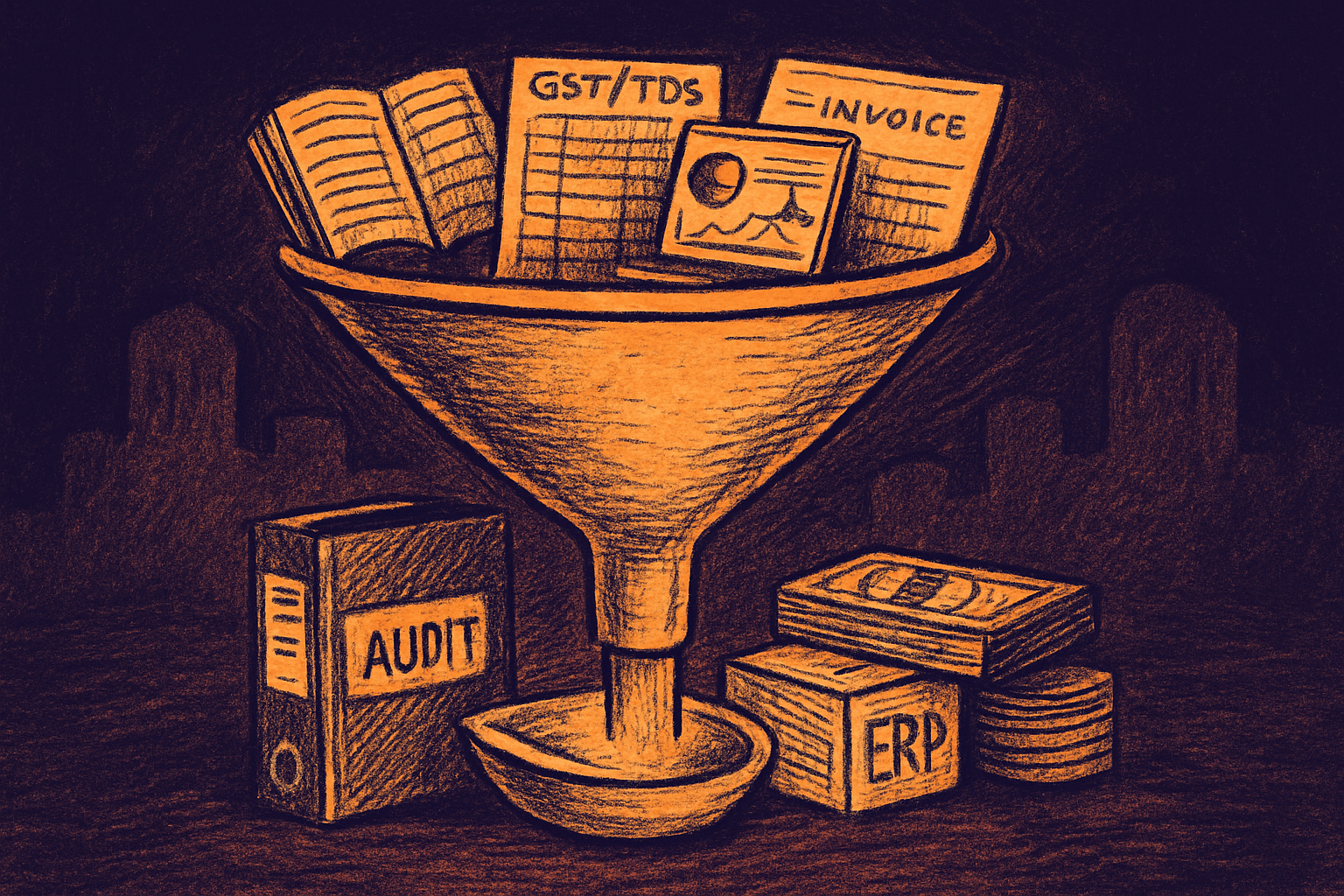
Walk into most mid-sized Indian companies today — a ₹200-500 crore manufacturer in Pune, a services firm in Bengaluru, a distribution business in Ludhiana — and you'll find the same pattern. Tally or an older ERP running the books. Excel doing the heavy lifting for MIS, reconciliations, and cash flow. A GST filing process that eats three people's time every month. And somewhere in a folder, a proposal from a Big 4 firm for a "digital transformation roadmap" that nobody has approved because it costs ₹80 lakh and takes 18 months.
That gap — between what large corporates are deploying and what mid-sized finance teams can actually absorb — is the real story of the modern finance tech stack in India right now. It's not a story about AI replacing accountants. It's a story about sequencing: what to automate first, what to build on top of India's own digital infrastructure, and how to keep governance from becoming an afterthought.
Why is the finance tech conversation different for mid-sized Indian companies?
Large corporates and BFSI institutions are moving fast. Indian AI adoption in financial planning has hit 76% of organizations according to a KPMG-backed survey reported by Tribune India, and Indian wealthy investors are the world's most enthusiastic users of AI for financial research, with 86% adoption per an Economic Times report. The market backs this up: India's Applied AI in Finance sector is projected to grow from USD 0.578 billion in 2025 to USD 3.59 billion by 2035, a 20.28% CAGR according to Market Research Future, and the AI-in-BFSI market alone is set to jump from USD 1,069 million to USD 9,425.2 million by 2034 per IMARC Group.
But that momentum is concentrated at the top. As one industry analysis on SME accounting puts it, while 70-80% of Indian corporates are embracing AI and digital transformation, a large share of SMEs and mid-sized firms are being left behind in the shift, per AI Accountant's analysis. The reason isn't ambition — it's architecture. A ₹300 crore company doesn't have a data science team, doesn't have six months of runway to pilot an AI agent, and can't afford a failed ERP migration. The tech stack conversation for this segment has to be about sequencing and ROI, not about matching the scale of a Reliance or an HDFC.
What does a phased, ROI-first finance stack actually look like?
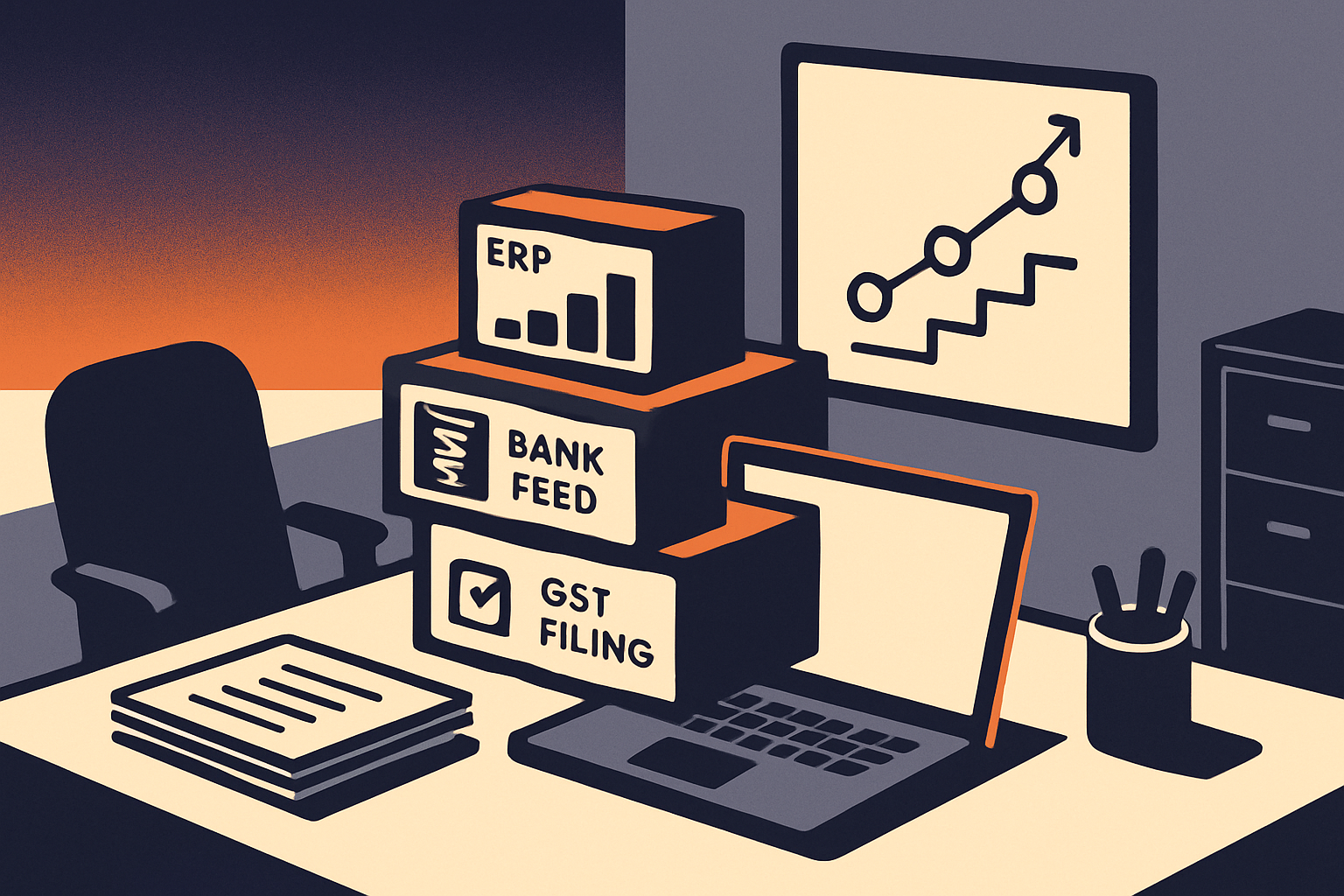
Forget the "three-year digital transformation roadmap." For a mid-sized Indian company, the stack should be built in three deliberate layers, each justified by its own payback period.
Layer 1 — Core systems of record (Months 0-4). This is cloud ERP, and the market has already voted with its wallet: 83% of mid-sized businesses are expected to be on cloud-based ERP or CRM by 2025, moving off legacy infrastructure according to SynapseIndia. In manufacturing specifically, over 62% of mid-to-large companies had already implemented ERP by 2025, and cloud deployments accounted for more than 58% of new ERP installations that year because of shorter go-live times and pay-as-you-use pricing, per Maximize Market Research. If you're still running a 12-year-old on-premise ERP with three custom patches nobody understands, this is where you start — not because it's fashionable, but because every layer above it inherits its data quality.
Layer 2 — Compliance and process automation (Months 3-8). This is where mid-sized companies get the fastest, most measurable ROI, and it's the layer most competing "finance transformation" content skips in favour of talking about AI. TDS automation software can cut compliance workload by up to 80% by eliminating manual rate lookups, challan tracking, and form generation, per AI Accountant's TDS analysis. GST and tax compliance automation has similarly helped Indian businesses eliminate filing errors and cut processing time by up to 80%, according to the same publisher's SME automation piece. We've written in detail about turning GST filing from a compliance chore into a control mechanism in our GST return automation playbook and about closing vendor-side gaps in our vendor reconciliation guide — both worth reading before you shortlist a RegTech vendor.
Layer 3 — Intelligence and forecasting (Months 6-12+). This is AI for cash flow prediction, anomaly detection, and MIS — the layer everyone wants to talk about first, and the one that should come last. AI adoption in financial reporting in India has already produced a reported 40% reduction in reporting errors according to Financial Express, but that number assumes clean, reconciled data feeding the model. Bolt AI onto a mess of unreconciled bank statements and mismatched vendor ledgers, and you'll automate garbage faster. If your bank reconciliation is still a month-end fire drill, fix that first — our piece on automating bank reconciliation covers exactly this dependency.
How does India's own digital infrastructure change the build vs. buy calculation?

Here's an advantage global finance-tech commentary consistently underweights: India already built the plumbing. UPI, Aadhaar, and the Account Aggregator framework — collectively the "India Stack" — give finance teams open APIs and cloud-based rails that would cost a company millions to build privately anywhere else. Research from the Observer Research Foundation notes that this infrastructure significantly accelerates financial inclusion and integration precisely because it's open and interoperable by design, per ORF's analysis of embedded finance in India.
For a mid-sized CFO, this translates into concrete, near-term use cases:
- Account Aggregator for lender and auditor data-sharing. Instead of manually exporting bank statements for a working capital loan renewal or a statutory audit, AA-consented data pulls can cut turnaround from days to hours.
- UPI and API-based collections reconciliation. If your receivables team is still manually matching UPI/NEFT credits against customer invoices in Excel, you're leaving a ready-made digital trail unused. This directly compounds with the sales-side visibility gaps we cover in Sales Register Automation.
- Embedded finance for vendor payments and working capital. The embedded finance market in India is projected to grow 12.4% annually to reach USD 24.03 billion in 2025, per the ResearchAndMarkets/Business Wire databook. For a mid-sized manufacturer, this shows up as embedded vendor financing offered right inside the procurement platform — relevant if you're building or upgrading a P2P workflow, which we detail in Purchase Order to Payment Automation.
The market-level number that ties this together: automated financial services in India are projected to reach USD 1.5 billion by 2026, per Market Research Future — next year. That's not a distant future scenario; it's a procurement decision you're likely already fielding vendor calls about.
Where do data silos and legacy systems actually break the stack?
Every layer above collapses if the foundation is fragmented. Indian financial institutions consistently cite data silos — information scattered across departments and legacy systems — as a primary obstacle to a unified view of operations, per Economic Times BFSI's coverage of data collaboration. Legacy infrastructure compounds this: it's costly to run, complex to upgrade, and often structurally incompatible with newer cloud and AI tools, according to IntegrationQA's analysis of digital transformation barriers.
In practice, this looks like: your sales team's CRM doesn't talk to your ERP, so revenue recognition is a manual monthly export-import exercise. Your procurement system doesn't talk to your GST return filing tool, so input tax credit reconciliation is done by an analyst cross-referencing three spreadsheets. Your bank feeds don't talk to your cash flow dashboard, so the CFO's Monday morning liquidity view is two days stale by the time it's presented.
The fix isn't a single "integration project" — it's picking the two or three highest-friction handoffs and closing them first. If your working capital visibility is the pain point, our Working Capital Dashboard build guide walks through exactly which data feeds matter and which can wait. If it's board-level reporting credibility, the MIS Reporting Best Practices piece covers building dashboards finance leaders will actually trust rather than dashboards that look good in a demo and get abandoned in month three.
Can compliance automation become a genuine competitive advantage, not just a defensive spend?
Most finance teams treat GST, TDS, and MCA compliance as a cost centre to be minimized. That's the wrong frame. India's RegTech sector is growing precisely because compliance automation and risk management are becoming strategic capabilities, not just back-office hygiene, according to IBS Intelligence's review of RegTech platforms.
Consider what "automated compliance" actually buys a mid-sized company beyond avoiding penalties:
-
Real-time input tax credit accuracy. Automating GST 2B against purchase registers, a territory covered in our GST return automation playbook, converts that from a monthly scramble into a daily, near-zero-error process, consistent with the up-to-80% error elimination and processing-time cut reported by AI Accountant.
-
Audit readiness as a byproduct, not a project. When TDS challan tracking, rate application, and Form 26Q/24Q generation are automated — cutting compliance workload by up to 80% per AI Accountant's TDS piece — the audit trail exists by default. No scrambling in March to reconstruct six months of manual TDS calculations for the statutory auditor.
-
Vendor and MSME-status compliance risk reduced structurally. MSME payment-delay penalties under Section 43B(h) and vendor GST-registration mismatches are exactly the gap our Vendor Reconciliation guide addresses — and it's a gap that's structurally closed once vendor master data, GST filing status, and payment terms are automated together rather than checked ad hoc.
Why is AI governance the part CFOs keep underinvesting in?

This is the uncomfortable section, and it's the one most vendor pitches skip. About 85% of Indian finance leaders report being under moderate-to-significant pressure to prove measurable ROI on AI investments, per the Financial Express survey. At the same time, nearly 24% of finance leaders admit their internal controls haven't been updated for AI agents in the past year, according to VARIndia's coverage of the governance gap, and 76% of Indian finance leaders say they lack dedicated in-house knowledge to fully understand how AI agents actually operate, per the same VARIndia report.
Put those three numbers together and you get a dangerous combination: high deployment pressure, weak internal understanding, and stale controls. For a mid-sized company, this typically shows up as an AI-based anomaly detection tool flagging (or worse, missing) a genuine fraud pattern in vendor payments because nobody defined what "normal" looks like for that specific business, or an AI cash-flow forecast that a CFO presents to the board without anyone on the team being able to explain why the model weighted a particular customer's payment history the way it did.
Three concrete governance steps to run in parallel with any AI deployment, not after it:
- Define a model-override log before go-live. Every time a human overrides an AI recommendation (a flagged transaction cleared manually, a forecast adjusted), log why. Review this log monthly. If overrides exceed 15-20% consistently, the model isn't fit for that use case yet.
- Assign named ownership for each AI tool, not "the finance team." A specific controller or FP&A lead should be accountable for understanding, at a working level, what data the model uses and what its known failure modes are — directly addressing the 76% knowledge gap cited above.
- Update your internal controls documentation every quarter, not annually. If GST rates, TDS sections, or MCA filing formats change (as they routinely do), your AI-assisted compliance tool's logic needs a documented re-validation, not a silent assumption that it's still correct. Our AI vs Traditional Automation comparison goes deeper into which category of tool actually needs this level of ongoing governance versus which can run more autonomously.
The broader point tying this article's four pillars together — phased deployment, India Stack leverage, compliance-as-advantage, and governance — is the same one we've made in our piece on building a data-driven finance function: technology without a controls discipline just moves the risk faster, it doesn't remove it.
What should a mid-sized CFO actually do in the next 90 days?
Skip the 18-month roadmap. Run this sequence instead:
- Week 1-2: Audit your current stack against the three layers above. Identify which layer you're missing or weakest in — most mid-sized companies find it's Layer 2 (compliance automation), because it's unglamorous.
- Week 3-6: Pilot one high-friction, high-volume process — GST reconciliation, TDS filing, or bank reconciliation — with a vendor offering a 4-8 week implementation and a clear ROI metric (hours saved, error rate, penalty avoidance).
- Week 7-12: Measure against that metric ruthlessly. If it doesn't show measurable payback within the quarter, don't scale it — reassess before adding Layer 3 AI tools on top.
- Ongoing: Build the governance log and named ownership structure from day one of Layer 2, not as an afterthought when Layer 3 arrives.
This is deliberately unglamorous advice. But 85% of Indian finance leaders are already being asked to prove ROI on tech spend — the CFOs who win that argument in 2026 will be the ones who sequenced correctly, not the ones with the most ambitious slide deck.
How BiPivot helps
BiPivot works with mid-sized Indian finance teams to sequence exactly this kind of stack — starting with the compliance and reconciliation automations that pay back fastest, then layering in AI-driven forecasting once the data foundation is clean. If you're evaluating where your own stack has gaps, explore our approach at BiPivot or see our tools built for this exact problem.