

Finance Automation for Manufacturing Companies: A CFO's Guide to Margins, Compliance and Cash Flow
By BiPivot Team · 29 August 2026
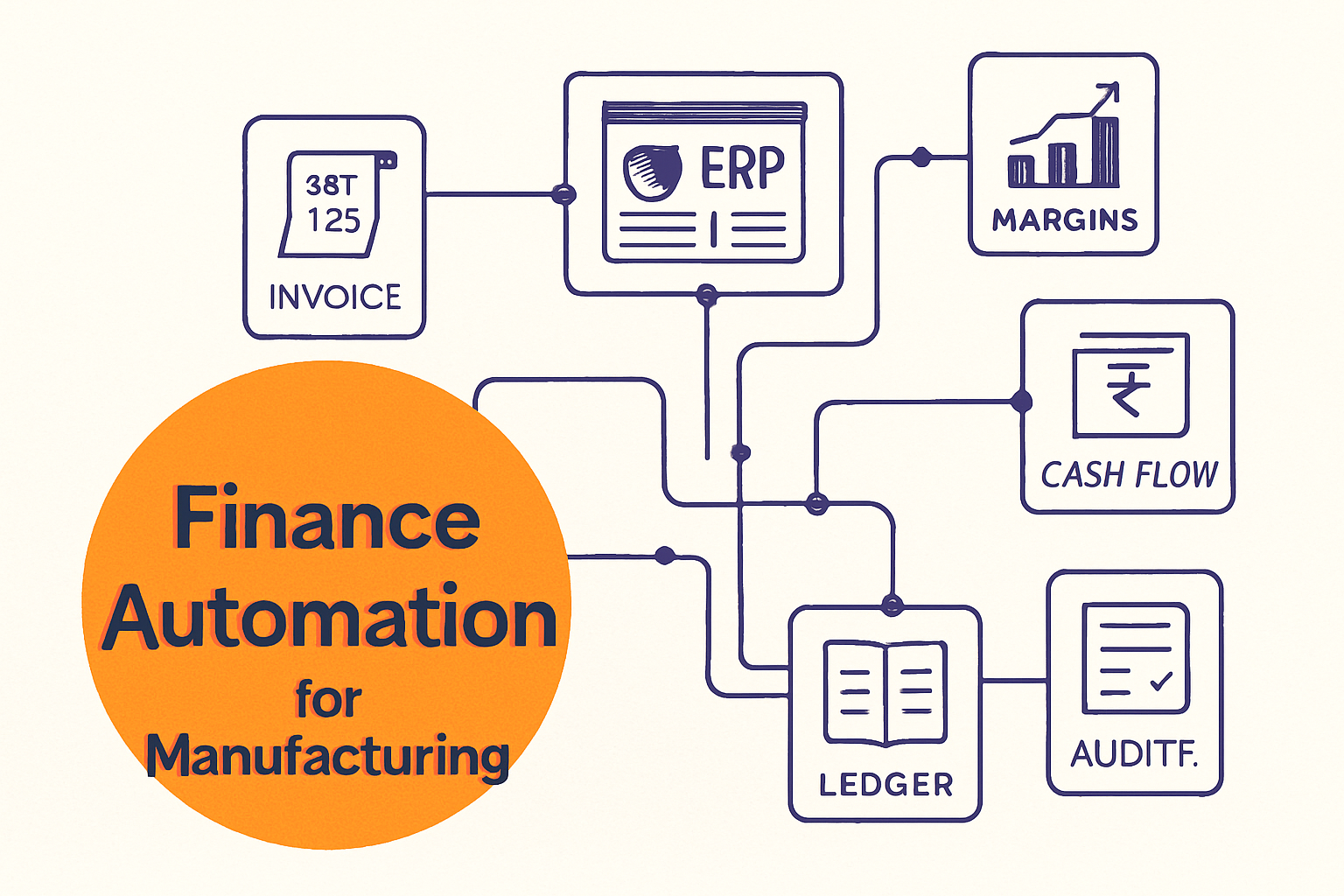
Every mid-sized Indian manufacturer I talk to has the same conversation eventually: the plant is running fine, orders are healthy, but the finance team is drowning. Someone is chasing a GSTR-2B mismatch from March. Someone else is re-keying vendor invoices from three different plant locations into Tally because the ERP at the corporate office doesn't talk to the shop-floor system. And the CFO is trying to explain to the board why working capital days keep creeping up even though sales are growing.
This isn't a technology problem in isolation — it's a survival problem. Manufacturing MSMEs in India carry annual compliance costs of ₹13 lakh to ₹17 lakh just to stay on the right side of GST, TDS, MCA and labour law filings (Way2World). For a company doing ₹80-150 crore in revenue, that's not a rounding error — it's a full-time compliance headcount that produces zero incremental output. Finance automation is how you take that cost back and redeploy it toward margin protection and growth.
Why is finance automation suddenly non-negotiable for manufacturers?
First, the regulatory environment has gotten smarter and less forgiving. Manual filing errors that used to slip through now get flagged automatically. The Ministry of Corporate Affairs launched an AI-enhanced monitoring system in 2026 specifically to detect anomalies and flag possible non-compliance in real time (Maheshwari & Co.). If your MCA21 filings, GST returns and TDS data show inconsistencies, the system is designed to catch it faster than your auditor will.
Second, margins are under structural pressure. Cherry Bekaert's research on mid-market manufacturing CFOs identifies the top pain points as protecting margins against volatile material, labour and energy costs, managing supply chain disruption, and — critically — simply not having the data to make timely decisions (Cherry Bekaert). You cannot protect a margin you cannot see in real time.
Third, the automation wave is now a competitive baseline, not a differentiator. India's industrial automation market is projected to grow from USD 8.89 billion in 2026 to USD 16.67 billion by 2034, at a CAGR of 8.17% (IMARC Group). Your competitors are automating the factory floor. If your finance function is still manual, it becomes the bottleneck that slows down everything the plant just sped up.

What does finance automation actually fix on the shop floor and in the back office?
Repetitive manual work. Data entry, three-way invoice matching, bank reconciliation, and bookkeeping consume a disproportionate share of finance team hours. Automating these tasks is one of the most well-documented efficiency gains in finance transformation, freeing staff from repetitive data input so they can focus on analysis instead of transcription (TatvaSoft).
Error-driven losses. A manual GST reconciliation error that blocks ₹4 lakh of Input Tax Credit isn't just an accounting inconvenience — it's cash you can't use for thirty, sixty, sometimes ninety days while you chase the correction. Automated processes substantially cut these errors, protecting both cash and reputation with regulators and lenders (TatvaSoft). We've covered the mechanics of this in detail in our guide to GST reconciliation using AI — worth reading if ITC mismatches are eating your working capital cycle every month.
Operational blind spots. Here's a stat that should worry every plant CFO: Indian manufacturers lose an estimated 5-7% in operational efficiency due to poor process control and measurement inaccuracy (Economic Times). Finance automation alone won't fix instrumentation gaps on the floor, but it does mean that whatever data the plant does capture — machine uptime, scrap rates, energy consumption per unit — reaches the P&L in near real time instead of showing up as an unexplained variance three weeks after month-end close.
Decision latency. Real-time, accurate financial data is what lets a CFO make a call on pricing, procurement timing, or a customer credit limit before the damage is done, rather than after (Stampli). If your CFO is reading a P&L that's three weeks old, they're not managing the business — they're documenting history.
What does GST and TDS automation actually save a manufacturer?
Take a mid-sized auto-components manufacturer with ₹120 crore annual turnover, three plants, and roughly 40 vendors and 250 monthly outward invoices.
Under a manual process, the finance team spends approximately 12 person-days a month reconciling GSTR-2B against purchase registers, another 5 days on TDS rate lookups, challan tracking and Form 26Q/24Q preparation, and 3-4 days chasing vendors whose GSTIN mismatches are blocking ITC claims. At a fully loaded cost of ₹90,000/month per finance executive, that's roughly ₹1.6-1.8 lakh a month, or about ₹20 lakh a year, spent purely on compliance mechanics — before you even count the ITC that gets permanently lost because notices arrive after the correction window closes.
TDS automation software alone can cut this compliance workload by up to 80% by eliminating manual rate lookups, challan tracking and form generation (AI Accountant). Applied to our example, that turns a 5-day monthly task into roughly 1 day, freeing close to 4 person-days every month for higher-value work like vendor negotiation or cash flow forecasting. We've written a deeper playbook on this specific problem — see TDS Compliance Automation: Why Mid-Sized Indian CFOs Can't Wait for the New Income Tax Act 2026 — if TDS is your immediate pain point.
On the GST side, the story is similar but the stakes are higher because ITC directly hits cash. GST implementation itself already reduced structural complexity for manufacturers through simplified logistics, lower costs from Input Tax Credit, and digitized compliance workflows (CashFlo). But the digitization of GST also raised the bar on data accuracy — GSTN's matching algorithms don't forgive typos the way a human reviewer once might have. If you're still manually keying vendor invoices, our article on OCR for GST Compliance explains why treating OCR as a mere data-entry shortcut undersells what it can actually do for reconciliation accuracy.
How does automation solve the working capital problem specifically?
This is the piece most generic automation articles skip, and it's the one that actually keeps mid-sized manufacturing CFOs up at night.
Manufacturers operate on thin, seasonal cash cycles: raw material purchase, production, dispatch, invoicing, and then — often — a 60 to 120 day wait for payment from a large OEM buyer who dictates the terms. Add to this the fact that ITC claimed on inputs is often blocked or delayed because of vendor-side GST filing mismatches, and you have a cash trap on both ends of the cycle.
Consider a components supplier that buys ₹8 crore of raw material a month. If 8-10% of ITC claims are routinely delayed by two to three months due to vendor reconciliation mismatches — a common real-world figure — that's ₹65-80 lakh of working capital tied up at any given time, financed either through overdraft (at 10-12% annual interest) or through stretched payables to your own smaller vendors. Automated reconciliation that flags GSTIN mismatches, invoice date errors and rate discrepancies at the point of entry — rather than at month-end filing — is what closes this gap. Our detailed breakdown of the specific error types that block ITC is in Common GST Errors AI Can Detect Before They Cost You ITC.
The other side of working capital — delayed buyer payments — is harder to automate away entirely, but automation still helps: real-time receivables ageing dashboards let a CFO escalate a slipping payment on day 45 instead of discovering it on day 90 during month-end close. That's the difference between a phone call to a customer's procurement head and a formal recovery notice.
What are the real implementation hurdles — and how do you actually get past them?
The theoretical challenges of finance automation are well documented: data quality problems, integration complexity with legacy systems, and organizational resistance to change (Staple.ai). But for a mid-sized Indian manufacturer, these show up in very specific, very unglamorous ways.
Legacy ERP fragmentation. It's common to find a plant running an old Tally installation for local purchases, a separate SAP Business One instance at the corporate office for consolidated reporting, and an Excel-based payroll system that nobody wants to touch because "it works." Automation tools need clean, structured data to function — bolting an automation layer onto three disconnected systems just automates the chaos faster. The fix is sequencing: consolidate reporting architecture first, then automate on top of it. Our Cloud Reporting Architecture blueprint is written for exactly this sequencing problem, and if Tally is your core ledger system, Tally to Power BI Guide shows a practical middle path that doesn't require ripping out what already works.
Data quality, not data volume. The problem usually isn't that manufacturers lack data — it's that vendor masters have three different spellings of the same supplier name, GSTINs are entered inconsistently across plants, and cost centers were set up by whoever was doing the job five years ago. Before automating a reconciliation workflow, spend two to three weeks on master data cleanup. Skipping this step is the single most common reason automation projects stall six months in.
Resistance from the accounts team. In a traditionally manual finance function, automation can feel like a threat to job security rather than a productivity tool. The practical answer: reframe the rollout around eliminating the tasks people already hate — repetitive data entry, chasing vendors for missing invoices, manual challan downloads — rather than around headcount reduction. Teams that see automation remove drudgery, not jobs, adopt faster and become internal champions rather than blockers.
Implementation cost versus payback. For a mid-sized manufacturer, an automation rollout incurs initial implementation costs including integration and training. Against the estimated annual compliance labor cost and the working capital unlocked from faster ITC realization, the investment can provide a realistic, defensible payback.

Businesses in India that have implemented automation report cost reductions of approximately 20% (MVSA CMEI), and in finance-specific processes with disciplined implementation, efficiency gains of 50-80% are achievable (nCino). Both numbers assume you've done the unglamorous groundwork first — clean masters, sequenced rollout, and a change-management plan that treats the accounts team as stakeholders, not obstacles.
Why should you connect shop-floor data to the finance function?
This is the piece that separates a genuinely competitive manufacturer from one that's merely digitized its paperwork.
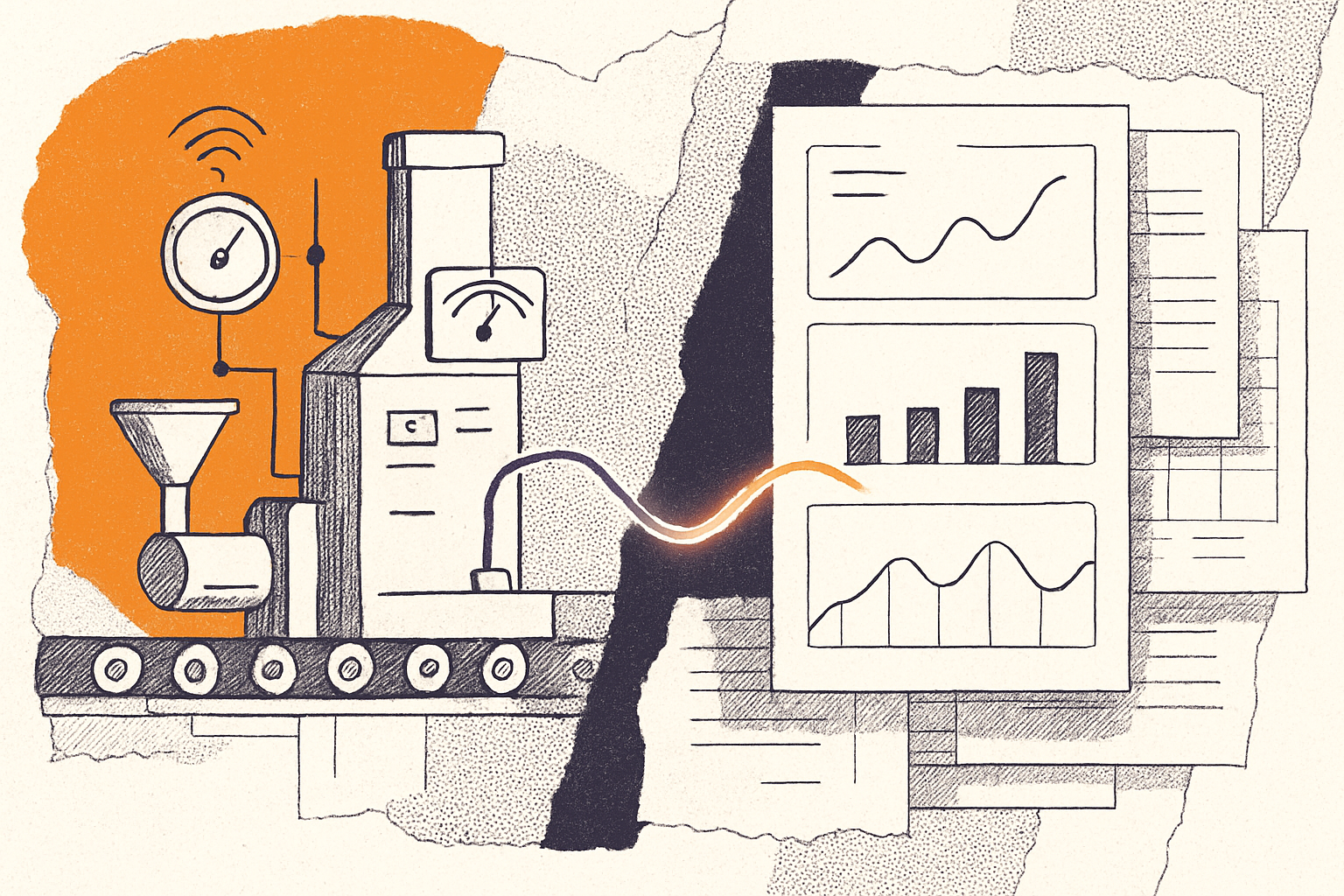
Most finance automation conversations stop at invoices, GST returns, and TDS filings. But a manufacturer's real cost drivers — machine downtime, scrap rate, energy consumption per unit produced, raw material yield variance — live on the factory floor, often in IoT sensor data or basic PLC logs that never make it into the finance system until someone manually types a summary into a spreadadsheet at month-end.
Bridging this gap changes what finance can actually do. Instead of discovering in the monthly P&L that machining costs spiked 8% last month, a CFO with integrated OT-to-finance data can see it happening in week one — a specific machine's energy draw is trending up, correlating with a maintenance schedule slip, and now costing an extra ₹3-4 lakh a month in power and scrap. That's the difference between automation as a bookkeeping convenience and automation as competitive intelligence.
This requires deliberate architecture — pulling production metrics into the same reporting layer as your financial ledgers, typically through a data platform rather than manual exports. If your team is exploring this, our guide to Microsoft Fabric for Finance Teams covers how to build this kind of unified reporting layer without a multi-year IT project.
Can automation actually turn compliance into a competitive advantage?
Yes — and this is where government policy intersects directly with your finance automation roadmap.
The Production-Linked Incentive scheme and broader "Make in India" push are actively rewarding manufacturers who can demonstrate clean, verifiable, timely financial and production data — because eligibility, disbursement, and audit for these incentives depends on exactly the kind of accurate record-keeping that automation produces. Government initiatives like PLI are explicitly designed to support the automation transition by providing financial incentives to companies that make the shift (MVSA CMEI). A manufacturer that can generate an audit-ready PLI claim in days rather than weeks, because its financial data is already reconciled and traceable, has a real edge in capturing incentive payouts before deadlines lapse.
Broader industrial automation investment backs this up: automation across Indian manufacturing is reducing operational costs by up to 25% and improving asset utilization by 15-20% (TechSci Research), and automation-linked investment in India's industrial sector grew 38% year-over-year as of 2025 (Nexdigm). Finance automation is the natural companion to this factory-floor investment wave — without it, you have faster machines feeding into a slower, error-prone finance function that can't keep pace with the data being generated.
What internal controls does automation require you to build first?
Automation without governance is just faster chaos. Before you automate GST filing, TDS deduction, or vendor payments, you need internal financial controls that define who can approve what, at what threshold, and with what audit trail. A common failure mode is automating a payment approval workflow without first defining segregation of duties — which means you've simply made it faster to make an unauthorized payment. Our detailed breakdown in Internal Financial Controls Explained is a useful pre-read before you sign any automation vendor contract, and if your board is asking how AI-driven finance tools fit into your governance framework, Governance in the Age of AI covers the oversight questions you should be able to answer.
For manufacturers running multiple plants with decentralized purchasing, this also means deciding early whether automation should centralize approval authority or simply speed up the existing decentralized structure. Get this wrong and you either create a bottleneck at head office or you automate a control gap across three plants simultaneously.
How BiPivot helps
BiPivot works with mid-sized Indian manufacturers to sequence finance automation the right way — cleaning up master data, connecting fragmented ERP and shop-floor systems into a single reporting layer, and building GST/TDS reconciliation workflows that actually hold up to MCA and GSTN scrutiny. If you're trying to figure out where to start, explore our consulting work or browse our tools built specifically for Indian compliance and reporting workflows.