

Common GST Errors AI Can Detect Before They Cost You ITC
By BiPivot Team · 26 August 2026
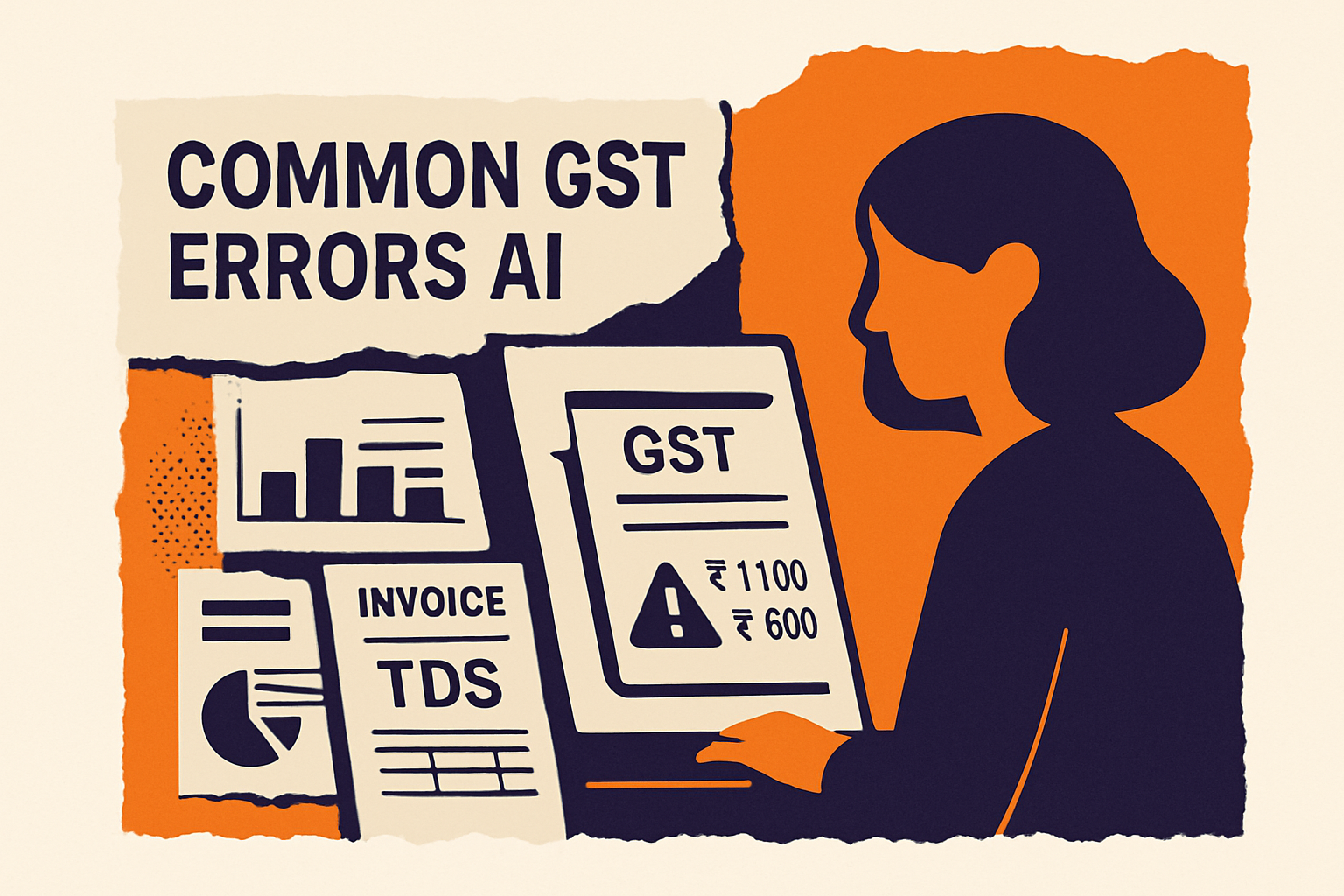
Every mid-sized Indian company we've worked with has a version of the same story: a finance executive discovers, usually in the third week of the month, that ₹8-12 lakh of Input Tax Credit is stuck because a vendor filed GSTR-1 late, or filed it with the wrong GSTIN, or didn't file it at all. The credit exists on paper. It doesn't exist in GSTR-2B. And until it does, that cash sits locked up, financing your vendor's compliance failure instead of your working capital.
This isn't a training problem. Your team knows the rules. It's a volume and pattern-recognition problem — the kind AI is specifically good at, and manual reconciliation is specifically bad at. Nearly 60% of Indian businesses report struggling with GST reconciliation because of frequent regulatory updates (SmartLedger, 2025), and roughly 40% of MSMEs end up paying external consultants just to keep up (MGM Publications). We covered the mechanics of fixing the reconciliation pipeline itself in our CFO's guide to AI-driven GST reconciliation. This article goes one layer deeper: which specific errors AI is catching in live Indian finance functions right now, and what each one actually costs you if it slips through.
Why does manual GST review miss what AI catches?
A person reviewing GSTR-2B against purchase registers is doing line-by-line matching across hundreds or thousands of rows, often in Excel, often at month-end when everyone is also closing books. Humans are good at judgment calls. They are bad at exhaustive, repetitive cross-referencing across three returns and a purchase ledger simultaneously, especially under deadline pressure.
AI systems don't get tired at row 4,000. They can hold GSTR-1, GSTR-2B, GSTR-3B, and your ERP purchase/sales register in memory at once and flag every discrepancy in seconds — including ones your reviewer would only catch on a second or third pass, if at all. The GST Council's own move toward real-time data exchange between GSTR-1, 2B, and 3B in FY 2025-26 has narrowed the room for error considerably (Masters India) — which means the errors that used to slide through quietly now surface as automated mismatches almost immediately. The margin for "we'll catch it next quarter" is gone.
Here are the specific error categories AI-based GST tools are catching in mid-sized companies today, and what each one actually costs.
What does a GSTR-2A/2B mismatch actually cost you?
This is the single biggest ITC leak we see. Your purchase register says you're owed credit on an invoice. Your vendor either filed late, filed with a wrong GSTIN, entered the wrong invoice number, or simply didn't file. Your GSTR-2B doesn't reflect it. You either claim the credit anyway (risking a notice and reversal with 18% per annum interest) or you don't claim it (and your cash stays locked until the vendor sorts it out).
Worked example: A Pune-based auto components manufacturer with ₹180 crore annual turnover runs roughly 620 vendor invoices a month. In a typical month, our reconciliation review found 34 invoices — worth ₹14.2 lakh in ITC — missing or mismatched in GSTR-2B against the purchase register. Manually, their two-person AP team caught 19 of these before filing, using spot checks. The remaining 15 (₹6.1 lakh) went unclaimed for the month and had to be carried forward, deferring cash by 30-45 days. An AI reconciliation engine matching invoice number, GSTIN, taxable value, and tax amount across both datasets caught all 34 in under ten minutes, with each flagged by specific mismatch type — vendor not filed, amount mismatch, or GSTIN error — so the AP team could chase the right vendor with the right ask instead of generic follow-up emails.
This is precisely the discrepancy pattern flagged in industry reconciliation guidance: vendor non-compliance directly denies ITC and hits working capital (CAclubindia). The fix isn't better spot-checking — it's matching every line, every month, without fatigue.
Can AI tell the difference between a genuine mistake and something an auditor will call fraud?
This is where pattern recognition beats rule-based checking. A single missed invoice is a clerical error. But if the same vendor consistently files 20-25 days late every month, or if a cluster of invoices from one vendor always show taxable value just under a round threshold, that's a pattern worth flagging differently — not necessarily fraud, but a vendor risk profile that deserves scrutiny before you extend more credit terms or increase order volume.
Indian tax authorities are already doing this at scale. GST officials using AI systems like NETRA, BIFA, and ADVAIT detected 14,597 tax evasion cases and ₹18,000 crore in fake input tax credit claims between April and December 2023 alone, resulting in 98 arrests (OECD.AI). If the department's systems are pattern-matching vendor behavior at that scale, your own AI layer should be doing the same on the buy side — flagging which of your vendors are becoming compliance liabilities before the department's algorithms flag them for you and your ITC gets caught in the crossfire of someone else's fraud investigation.
Where do inter-state vs. intra-state classification errors quietly bleed cash?
Confusing IGST with CGST+SGST is a rate-table error but it behaves like a cash-flow error. Get it wrong and you either overpay tax that then needs a refund claim (locking up cash for months) or underpay and accrue interest at 18% per annum plus exposure to notices (BC Shetty & Co.).
This shows up most often in companies with multiple GSTINs across states — a common structure for mid-sized manufacturers and distributors with regional warehouses. A Bengaluru head office invoicing a customer in Hosur (Tamil Nadu) needs IGST. The same product shipped to a Bengaluru customer needs CGST+SGST. When billing teams handle both scenarios manually across multiple state registrations, place-of-supply errors creep in, especially for services and job-work transactions where "place of supply" isn't the obvious delivery address.
Worked example: A Chennai-based textile exporter with GSTINs in Tamil Nadu, Karnataka, and Gujarat had its Karnataka unit charge CGST+SGST on a consignment that was actually billed to a Karnataka-registered buyer but shipped from the Gujarat warehouse — a job-work arrangement where the place of supply rules point to IGST. The error sat in the books for two filing cycles (₹3.4 lakh in wrongly-charged tax) before a client query surfaced it. An AI system trained on place-of-supply logic — cross-referencing shipping GSTIN, billing GSTIN, and transaction type — would have flagged the mismatch at invoice creation, not two months later when the buyer's finance team called asking why their GSTR-2B didn't tally.
Is your reverse charge mechanism liability actually complete?
RCM is the error nobody remembers to look for because there's no vendor invoice prompting review — the liability sits entirely with you. Payments to unregistered vendors, GTA (goods transport agency) charges, sponsorship fees, director sitting fees, and legal fees from individual advocates all typically attract RCM. Missing these is a common compliance gap that surfaces almost exclusively during departmental audits (BC Shetty & Co.) — by which point you're not just paying the tax, you're paying interest and possibly penalty on it, with no offsetting ITC timing benefit.
Worked example: A Delhi-NCR logistics-adjacent trading company paid ₹42 lakh over a financial year to unregistered goods transport agencies for local delivery. Nobody in the AP team flagged these as RCM-liable because the payments were processed as routine freight expense in Tally, with no GST charged on the vendor's invoice (since they weren't registered) — which is exactly the point at which RCM applies but is easiest to miss. An AI layer scanning ledger entries for vendor-registration-status combined with expense-category codes (freight, legal fees, sponsorship, director fees) flags every transaction that matches an RCM-notified category, whether or not the vendor charged GST. That single review recovered ₹7.56 lakh in unrecognized RCM liability before the year-end audit — avoided as a penalty exposure rather than paid as one.
Why do HSN/SAC code inconsistencies matter more than they look?
Using different HSN or SAC codes for the same product across invoices, branches, or ERP modules doesn't cause an immediate cash problem — but it's a classification query magnet. Tax authorities increasingly cross-check HSN code consistency for the same SKU across a taxpayer's own filings, and expanded e-invoicing applicability has made this data far more visible to the department than it was even two years ago (Masters India).
We've seen this most often in companies that grew through acquisition or have multiple plants using slightly different master data setups in Tally or SAP — the same finished good coded under two HSN codes because two plants set up their item masters independently five years apart. An AI system doing a periodic HSN consistency scan across your entire item master and invoice history catches this in one pass; manually, it requires someone to think to look for it, which mostly doesn't happen until a departmental notice forces the question.
Is your e-invoicing threshold compliance actually current?
The mandatory e-invoicing turnover threshold for B2B/B2G supplies currently stands at ₹5 crore as of August 2026 (Masters India), and it has moved downward repeatedly over the past several years.
Companies that crossed this threshold mid-year — a common event for growing mid-sized businesses — sometimes don't update their invoicing workflow immediately, especially if the crossing happened on the strength of one large seasonal order.
The practical cost isn't a fine from the department first — it's your customer's finance team. If your invoice isn't in their GSTR-2B because you didn't generate a valid IRN, they will withhold payment until it is, since claiming ITC on an invoice missing from 2B risks a notice on their side too.
An AI monitoring layer tracking rolling 12-month turnover against the current threshold — and flagging the month you cross it — prevents the awkward call where your biggest customer's AP team asks why your invoice isn't showing up in their reconciliation.
What does missing a filing deadline actually cascade into?
The direct cost is well understood: ₹50 per day in late fees (₹25 CGST + ₹25 SGST), dropping to ₹20 per day for NIL returns, plus 18% per annum interest on any unpaid liability (GSTIndia.com; CA4Filings). What CFOs underestimate is the cascade. Miss GSTR-3B for two consecutive months or quarters and your e-way bill generation gets blocked — which means trucks carrying your goods can't move (CA4Filings). Continue that pattern for around six months and you risk outright GST registration cancellation — after which you can't issue valid tax invoices or claim ITC at all (CA4Filings).
This is rarely a willful default in mid-sized companies — it's usually a lean finance team, a key person on leave, or a systems migration that disrupted the filing calendar. An AI-based compliance calendar that tracks filing status across every GSTIN a company holds, and escalates automatically at 7 days, 3 days, and 1 day before deadline, removes the single-point-of-failure risk that a two-person compliance team otherwise carries. This kind of control gap is exactly the territory we address in our broader piece on internal financial controls for mid-sized Indian companies — GST deadline management is one of the more concrete, measurable controls you can actually automate rather than just document.
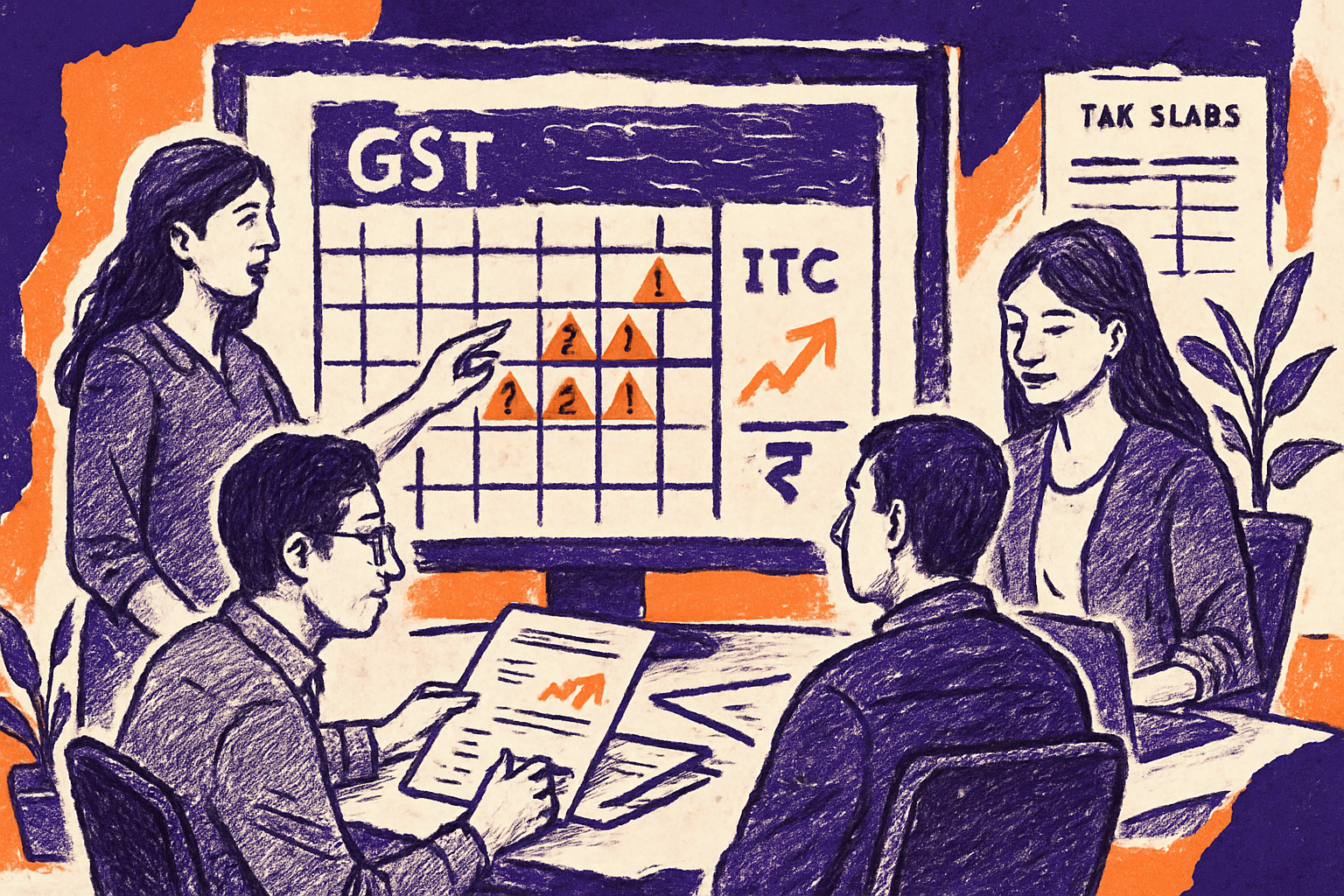
What's the hidden cost of "we already have a semi-automated process"?
Most mid-sized companies we meet aren't doing GST reconciliation entirely by hand — they have Tally or SAP generating reports, and someone exporting to Excel for comparison. That's semi-automation, and it has a hidden cost structure CFOs rarely quantify:
- Working capital lock-up. Every unreconciled invoice sitting in limbo is credit you've financed for your vendor. At even ₹10 lakh average monthly unclaimed ITC across a 30-45 day resolution cycle, that's a recurring working capital drag equivalent to a small working capital loan you're not getting interest on.
- Team burnout and attention diversion. A 37% reduction in GST compliance time was reported by business owners who moved to better tools, per Statista data cited by GSTHero (GSTHero) — which means the inverse is also true: businesses without that tooling are burning nearly 40% more finance-team hours than they need to, hours that should go toward forecasting, vendor negotiation, or margin analysis instead of Excel VLOOKUPs at 11 PM before a filing deadline.
- External consultant dependency. Roughly 40% of MSMEs pay outside consultants specifically because internal teams can't keep pace with reconciliation volume and regulatory change (MGM Publications) — a recurring cost that scales with transaction volume, unlike a one-time AI implementation.
None of these show up on a P&L line called "GST error cost." They show up as elevated working capital, overtime, and consulting fees that finance leadership rarely connects back to the root cause.
Does this mean replacing Tally or SAP?
No — and this is the practical objection we hear most from CFOs who've been burned by "rip and replace" software pitches before. The AI layer that catches these errors sits on top of your existing ERP, pulling data from Tally or SAP rather than replacing either. It reads your purchase and sales registers, cross-references GSTN portal data (GSTR-1, 2B, 3B), and flags discrepancies back into a dashboard your existing finance team already monitors.
We've written in more detail about how this kind of integration works without disrupting your core system in our guide on turning Tally data into real-time financial intelligence, and the same integration principle — augment, don't replace — applies directly to GST-specific reconciliation tooling.
How should a CFO prioritize which errors to fix first?
Not every error class deserves equal urgency. Based on what we've seen across client engagements, prioritize in this order:
- GSTR-2B mismatches — direct, immediate cash impact through blocked ITC. Fix this first; it's usually the largest number on the table.
- RCM gaps — no offsetting benefit, pure penalty and interest exposure, and almost always surfaces at audit rather than earlier.
- Inter-state/intra-state classification — smaller per-transaction impact but compounds across volume; catch it at invoice creation, not after filing.
- HSN/SAC consistency — low immediate cost, high notice-generation risk; worth a quarterly automated scan rather than real-time monitoring.
- Filing deadline management — binary risk (either you file or you don't), best handled by an automated calendar with escalation rather than a person's memory.
A finance team implementing AI-based checks against this priority order typically sees the ITC recovery number move first and fastest — often within the first filing cycle — because it's the most direct, measurable fix. The other four categories reduce notice frequency and audit exposure over subsequent quarters, which is harder to put a single INR figure against but shows up unmistakably in reduced departmental correspondence and calmer month-ends.
How BiPivot helps
BiPivot works with mid-sized Indian finance teams to build AI-based GST reconciliation and error-detection layers on top of the ERP systems you already run — Tally, SAP, or hybrid setups — without a system overhaul. If ITC leakage, RCM gaps, or classification errors are costing your team cash flow and weekend hours, visit bipivot.com to talk through where your specific reconciliation gaps are.