

TDS Compliance Automation: Why Mid-Sized Indian CFOs Can't Wait for the New Income Tax Act 2026
By BiPivot Team · 20 August 2026
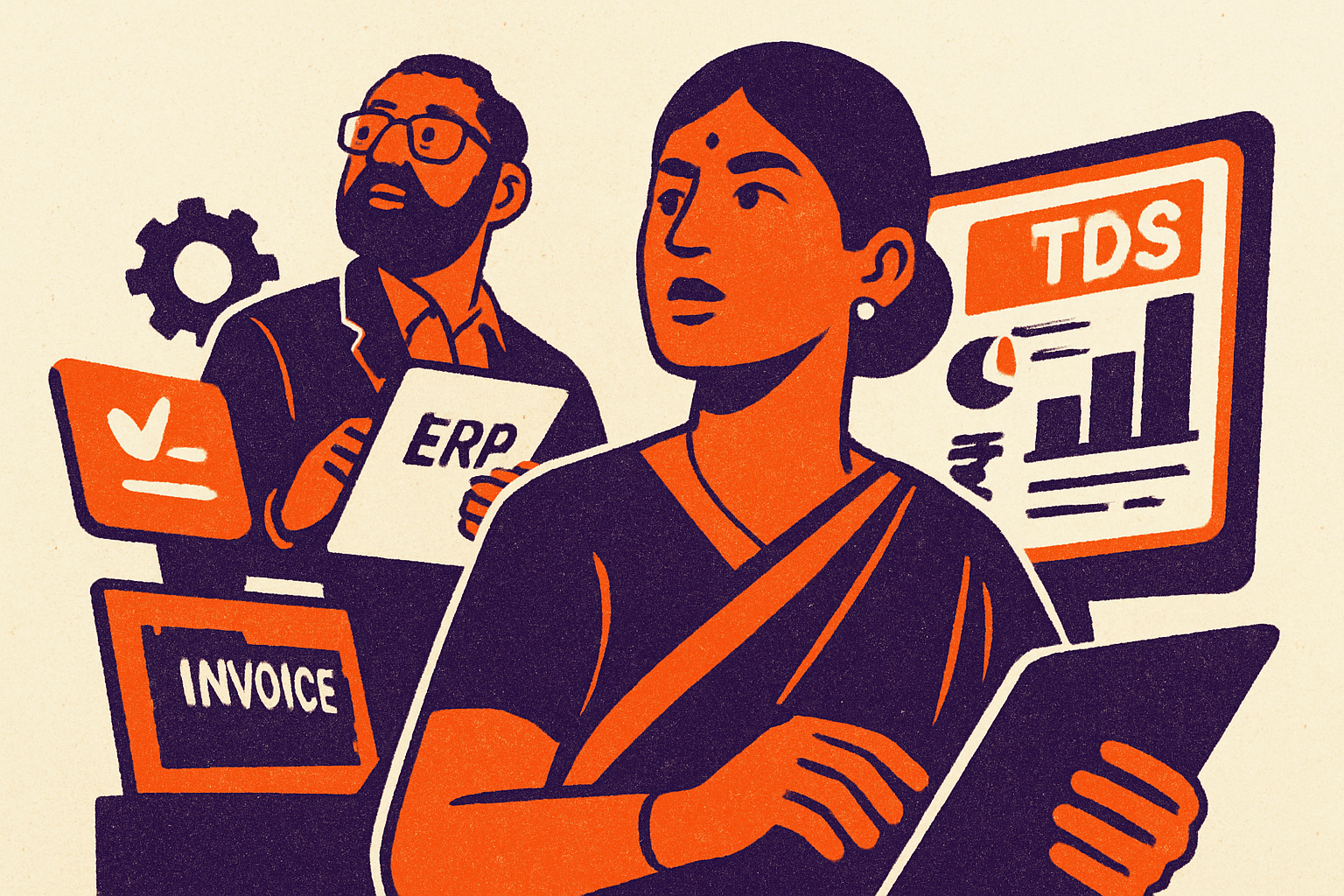
Ask any finance controller at a ₹200-400 crore Indian manufacturer or IT services company what keeps them up at night in August 2026, and TDS compliance will make the list — right after GST reconciliation and payroll. Not because the concept is hard. Deduct at the right rate, deposit by the 7th, file the return by the 31st. Simple, in theory.
In practice, a mid-sized company runs 40-plus TDS sections across thousands of vendor and employee transactions every quarter, tracked in Tally or SAP by an accounts team that also closes books, handles GST, and manages vendor queries. One misclassified contractor payment, one PAN that silently went inoperative, one threshold breach missed across three invoices from the same vendor — and you're staring at penalties that dwarf the tax amount itself.
That calculus has changed permanently. The New Income Tax Act 2025, effective April 1, 2026, has replaced the 1961 Act and digitized the TDS framework end to end (source). Combined with TRACES 2.0's real-time architecture and CBDT's AI-driven Project Insight, the era of "we'll fix it at year-end reconciliation" is over. This article lays out exactly what's changed, what it costs you if you don't adapt, and what a genuinely automated TDS function looks like for a mid-sized Indian company.
Why is TDS suddenly a real-time compliance risk, not a quarterly task?
For two decades, TDS compliance ran on a batch-processing rhythm: deduct through the quarter, reconcile before the return, file by the deadline, fix errors when TRACES flagged them weeks or months later. That gap between action and detection is what's disappearing.
TRACES 2.0 is API-driven and real-time. It reflects TDS credit instantly in a taxpayer's Unified Tax Ledger (UTL) and issues pre-correction alerts the moment an error is detected — no more waiting for a mismatch to surface at assessment time (source). Layered on top is Project Insight, CBDT's AI and machine learning platform that cross-references your TDS returns against bank data, ITR filings, and property records continuously, flagging non-compliance within days rather than the multi-year lag finance teams used to count on (source).
Think about what this means operationally. A short deduction on a vendor payment that used to surface during an assessment 18 months later can now trigger a notice within the same quarter. A finance team relying on month-end Excel reconciliation is structurally incapable of matching that speed. This is the same shift we've written about on the GST side — see our piece on GST return automation as a control mechanism — and TDS is now following the identical trajectory, just with sharper penalty math attached.
What does non-compliance actually cost a mid-sized company?
CFOs often underestimate TDS penalty exposure because each individual provision looks manageable. Stacked together across a full financial year, they aren't.
Late filing fee (Section 234E): ₹200 per day for every day of delay in filing the TDS return, capped at the total TDS deductible for that quarter (source). A 45-day delay on a quarter with ₹18 lakh in TDS liability means ₹9,000 in late fees alone — and that's before interest.
Interest on delayed deduction and deposit: 1% per month for delayed deduction, 1.5% per month for delayed deposit of TDS already deducted (source). On a ₹10 lakh TDS deposit delayed by 40 days (two months for interest calculation purposes), that's ₹30,000 in interest — recurring every time a payment cycle slips.
Section 271H penalty: ₹10,000 to ₹1,00,000 for non-filing beyond one year of the due date, or for returns with material errors like incorrect PANs (source). This is separate from and additional to the late filing fee.
Section 40(a)(ia) disallowance: if TDS isn't deducted or deposited on a payment, 30% of that expenditure gets disallowed and added back to taxable income (source). Worked example: a ₹50 lakh professional fee payment on which TDS under Section 194J was missed means ₹15 lakh added to taxable income — at a 25% corporate tax rate, that's ₹3.75 lakh in additional tax, purely from a classification miss.
Run these three together — a delayed deposit, a late return, and one disallowed expense — on a mid-sized company's typical quarterly TDS volume, and you're easily looking at ₹5-8 lakh in avoidable cost from what started as an administrative oversight. None of this includes the reputational cost of a Project Insight-triggered notice landing on your auditor's desk during statutory audit season.
Where do TDS errors actually originate in a mid-sized finance team?
Before automating anything, it's worth being honest about where the breakdowns happen. Based on how these processes run inside most mid-sized Indian companies, four failure points recur constantly:
- Vendor misclassification. Is a payment to a marketing agency a contract (194C, 1-2%) or a professional/technical service (194J, 10%)? Get this wrong at vendor onboarding and every subsequent invoice inherits the error.
- Cumulative threshold tracking across invoices. Section 194C's ₹30,000 single-payment / ₹1 lakh aggregate annual threshold is easy to breach silently when a vendor bills you monthly and no one is tracking the running total in one place.
- Section confusion (194C vs 194J vs 194Q vs 194M). With overlapping thresholds and rates across a dozen-plus sections, manual classification by an AP executive under month-end pressure is where most errors creep in.
- Form 26AS/AIS reconciliation gaps. Credits reflected in the vendor's Form 26AS not matching what was actually deposited — usually due to PAN entry errors or challan mismatches — surfaces late and burns hours to trace.
These are documented, well-known pain points (source), and they're structural to how AP teams work — invoice-by-invoice, under deadline pressure, without a system that holds the full vendor history in view at the moment of deduction.
What does end-to-end TDS automation actually look like?
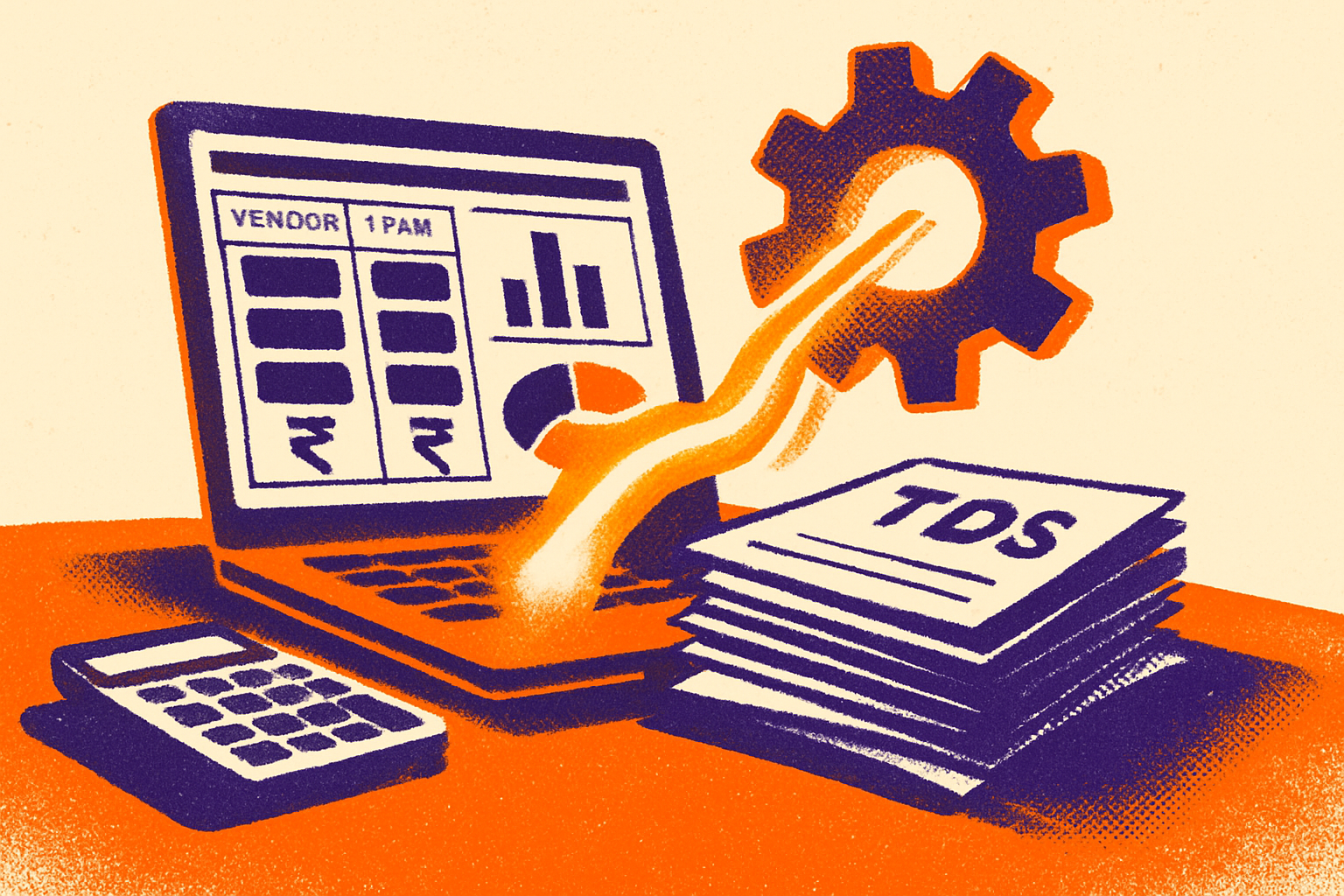
Automation here doesn't mean a tool that generates Form 26Q at quarter-end faster. That's the low-value part of the problem. Genuine automation intervenes at the point of deduction, not the point of filing. A functioning system does five things:
1. Master-data-driven vendor classification. Every vendor is tagged at onboarding with the correct TDS section based on the nature of service, contract type, and applicable exemptions — and that classification travels with every invoice automatically, rather than being re-decided each time.
2. Real-time cumulative threshold tracking. The system holds a running total per vendor per section per financial year, so the 45th invoice from a contractor is checked against the same aggregate ledger as the 1st — catching threshold breaches the moment they happen, not at year-end audit.
3. PAN-Aadhaar and TRACES validation at source. Since an unlinked PAN goes inoperative and forces deduction at the higher of 20% or twice the applicable rate (source), automated PAN status checks against TRACES before every payment run prevent both under-deduction (compliance risk) and over-deduction (unnecessary vendor friction and working capital lock-up).
4. Predictive payment-timing and deduction flags. AI-based tools now offer predictive insights on optimal payment timing and automatically flag payments to deductees holding lower-deduction certificates or non-PAN status (source) — turning a compliance check into a working-capital decision made before money leaves the account.
5. Continuous Form 26AS/AIS reconciliation. Rather than a scramble before return filing, credits are matched against deposits weekly, so mismatches are caught and corrected while the challan is still fresh in everyone's memory.
The reported impact of doing this properly: a 75-80% reduction in TDS bookkeeping and reconciliation workload (source). For a finance team of four handling TDS as one of several responsibilities, that's the difference between TDS eating two full days a week and it running as a background process with human review only on exceptions.
This mirrors what we've argued for vendor payment hygiene more broadly — our vendor reconciliation automation guide covers the GST-TDS-MSME triangulation problem in depth, and it's worth reading alongside this piece if your AP team is fighting fires on all three fronts simultaneously.
How does the MSME payment rule interact with your TDS process?
Section 43B(h) has quietly become one of the most operationally disruptive rules for mid-sized companies buying from MSME vendors. It mandates payment within 15 days without a written agreement, or 45 days with one, to claim the expense as a deduction — and delayed payments attract compound interest at three times the bank rate (source).
Here's why this matters for your TDS automation build, not just your AP calendar: MSME vendor status, TDS section applicability, and payment due dates all need to sit in the same vendor master. If your TDS system doesn't know a vendor is Udyam-registered, it can't flag the 15/45-day clock, and you risk both a disallowed expense under 43B(h) and a compliance miss on the TDS side for the same vendor, on the same invoice. Worked example: a ₹12 lakh annual purchase from an MSME supplier, paid 60 days late without a written agreement, exposes you to expense disallowance under 43B(h) plus TDS interest if the deduction itself was delayed alongside the payment — a compounding, avoidable cost from one vendor relationship.
Any TDS automation initiative for a mid-sized company should be scoped alongside your broader accounts payable data model, not built as an isolated module bolted onto Tally.
Does TDS under GST need a separate compliance track?
Yes, and it's frequently overlooked because it applies to a narrower set of transactions. Under Section 51 of the CGST Act, 2017, specified government entities and PSUs must deduct 2% TDS (1% CGST + 1% SGST, or 2% IGST) on the taxable value — excluding GST — for supplies exceeding ₹2,50,000 under a single contract (source).
If your company supplies to government departments, PSUs, or notified authorities, this is a second, entirely separate TDS regime running parallel to income-tax TDS — different portal (GSTN), different return (GSTR-7), different reconciliation (GSTR-2A/2B credit for the deducted amount). Worked example: a ₹40 lakh contract with a state PSU means ₹80,000 deducted at source under GST TDS, credited to your electronic cash ledger — and if your team isn't tracking this separately from income-tax TDS, that credit sits unreconciled and effectively locks up working capital until someone notices.
This is a good moment to point back to how we've framed GST return hygiene generally — our GST return automation playbook goes deeper into GSTR reconciliation discipline, and a mature TDS automation setup should feed the same reconciliation engine rather than running as a disconnected spreadsheet exercise.

Why are mid-sized companies more exposed than large enterprises here?
Large enterprises run dedicated tax teams with in-house TDS specialists, often supported by Big Four advisory retainers reviewing quarterly filings before submission. Mid-sized companies rarely have that luxury — TDS compliance typically sits with a senior accountant who also owns GST filings, vendor reconciliation, and month-end close.
That concentration of responsibility is precisely why automation matters more here, not less. A ₹300 crore company doesn't have the compliance budget of a ₹5,000 crore one, but it faces the same TRACES 2.0 real-time scrutiny and the same Project Insight cross-referencing.
The penalty math doesn't scale down with company size — a ₹1 lakh Section 271H penalty hits a mid-sized company's bottom line far harder than it does a large enterprise's.
The practical answer isn't hiring a bigger tax team — most mid-sized companies can't justify that headcount for a function that should be running at 75-80% lower manual effort in the first place (source). It's building the right system so your existing team spends its time on exceptions and judgment calls — genuinely ambiguous 194C vs 194J classifications, lower-deduction certificate applications, notice responses — rather than manual threshold tracking and PAN lookups.
Globally, 84% of finance and tax teams already use AI-powered tools in some form (source), and Indian mid-sized companies competing for talent, credit lines, and investor confidence can't credibly lag that curve, especially with the regulatory environment tightening simultaneously.
What should a CFO do in the next 90 days?
Concretely, before the next TDS return cycle:
- Audit your vendor master for PAN-Aadhaar linkage status. Run every active vendor PAN against TRACES to identify inoperative PANs before your next payment run, not after a higher-rate deduction has already happened.
- Rebuild your vendor classification logic as a single source of truth. Every vendor should carry one definitive TDS section tag, reviewed at onboarding and re-verified annually — not re-decided by whoever processes the invoice that month.
- Map cumulative thresholds per vendor per section for the current financial year. If you can't produce this report in under five minutes today, that's your automation priority.
- Cross-check MSME (Udyam) status against your AP aging report to quantify current 43B(h) exposure before it shows up as a disallowance at year-end.
- Set up weekly, not quarterly, Form 26AS/AIS reconciliation for at least your top 20 vendors by TDS value, so mismatches get caught while corrections are still cheap.
None of this requires ripping out your existing ERP. Whether you're on Tally or SAP, the fix is a layer of validation, classification, and reconciliation logic sitting on top of your transaction data — which is the same architectural principle we've laid out for finance data more broadly in our modern finance tech stack guide.
How BiPivot helps
BiPivot works with mid-sized Indian finance teams to build TDS and vendor compliance automation directly into their existing Tally or SAP environment — vendor classification, threshold tracking, PAN validation, and 26AS reconciliation running continuously rather than at quarter-end. If your team is still deducting TDS manually and reconciling it under deadline pressure, get in touch through bipivot.com to see what a 90-day automation build looks like for your compliance profile.