

OCR for GST Compliance: Why Mid-Sized Indian CFOs Can't Treat It as a Data-Entry Tool Anymore
By BiPivot Team · 27 August 2026
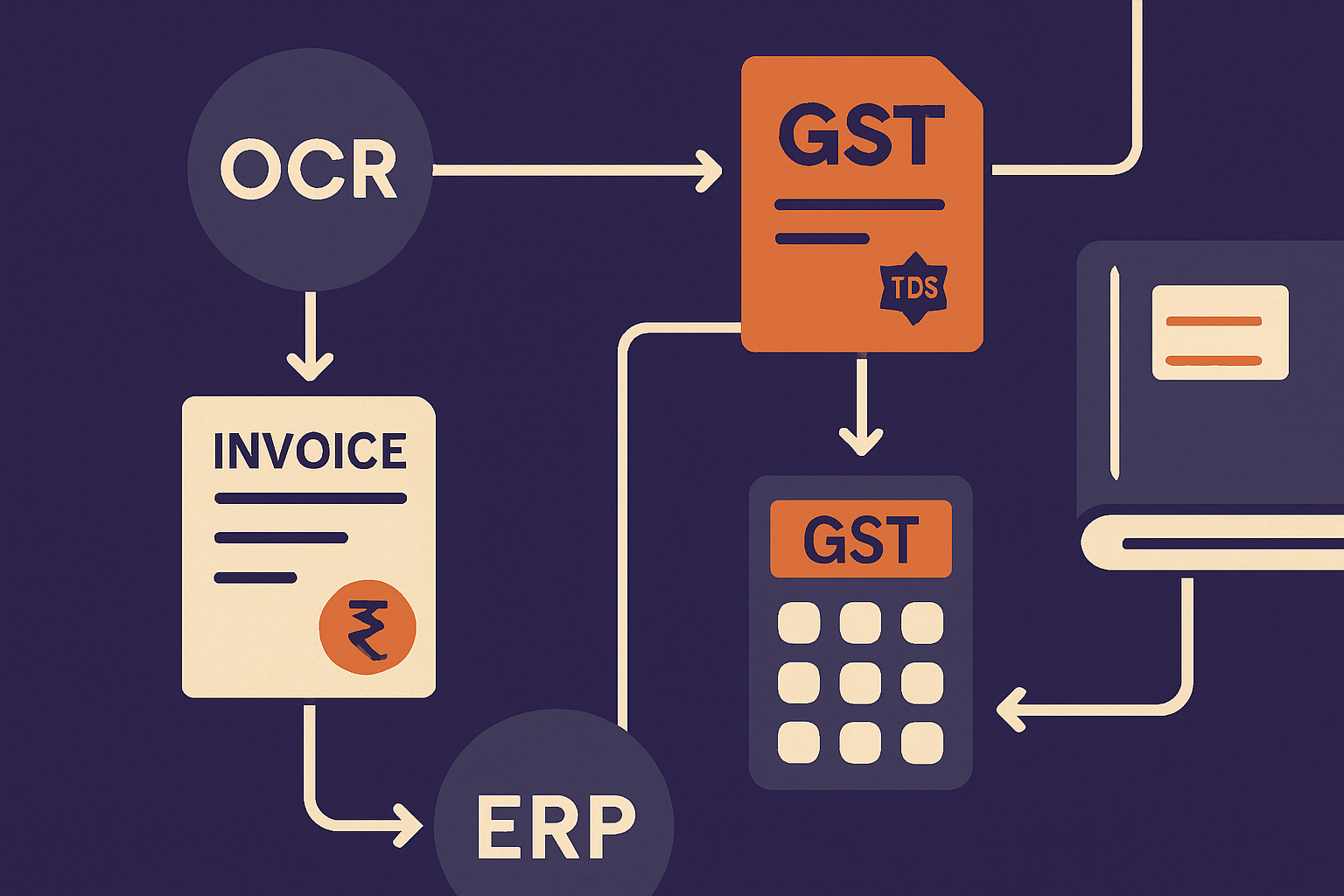
Most finance controllers still think of OCR as a scanning trick — point a camera at an invoice, get a text file, save some typing. That framing was fine in 2019. It is dangerously outdated in 2026, when a missed IRN or a mismatched GSTIN can mean losing Input Tax Credit outright, not just a data-entry correction.
The trigger for this shift is structural. From April 2025, the e-invoicing mandate dropped to ₹1 crore turnover, pulling a huge population of mid-sized manufacturers, distributors and service firms into a regime previously reserved for large enterprises (source). If your company crossed that line, your AP and AR teams are now handling e-invoice volumes and IRN validations that your existing Excel-and-Tally workflow was never designed for. OCR isn't optional convenience anymore — it's the only realistic way to process this volume without adding headcount or absorbing error rates that put ITC at risk.
Why does GST compliance suddenly need OCR, not just more staff?
The honest answer: because manual processing doesn't scale, and the penalty structure doesn't forgive scale-related errors. Nearly 70% of Indian businesses still name manual invoice processing as their single biggest accounting challenge (source). And the reason isn't laziness — it's arithmetic. Manual data entry runs a 3-4% error rate (source). For a company processing 2,000 vendor invoices a month, that's 60-80 invoices with a wrong GSTIN, mistyped taxable value, or misclassified HSN code — every single month.
Run that forward. Say your average invoice value is ₹85,000 with 18% GST, meaning ₹15,300 ITC per invoice. If 70 invoices a month carry a data error that later gets flagged in GSTR-2B reconciliation, that's roughly ₹10.7 lakh in ITC sitting in dispute or delay every month, purely from typos and misreads — not fraud, not vendor default, just human fatigue at 4 pm on a Friday.
What exactly does OCR extract, and where does plain extraction fall short?
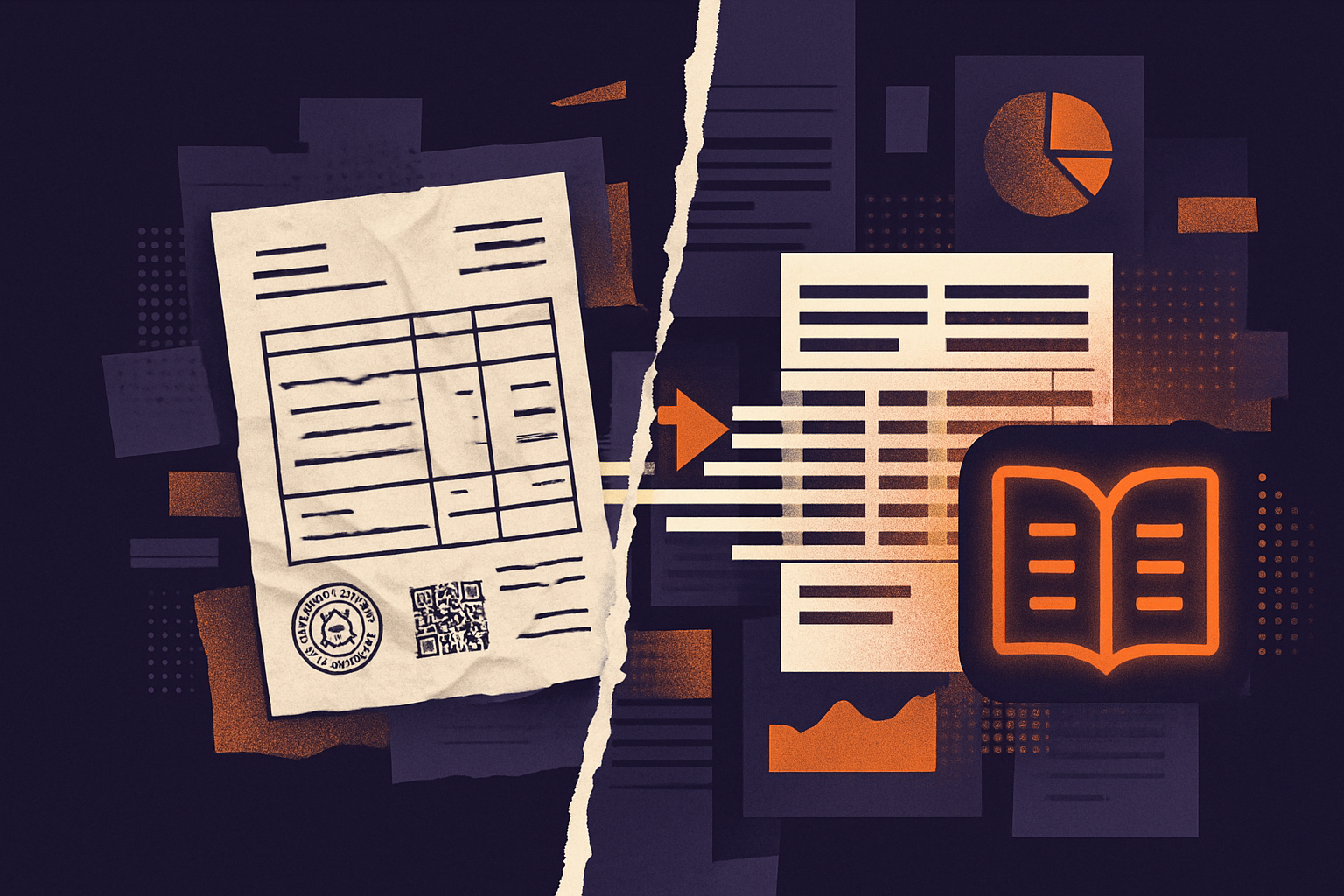
A working OCR engine for Indian invoices should reliably pull: GSTIN (buyer and seller), invoice number and date, HSN/SAC codes, taxable value, CGST/SGST/IGST splits, total invoice value, and — for e-invoices — the IRN and QR code payload. This is the baseline capability most vendors advertise (source).
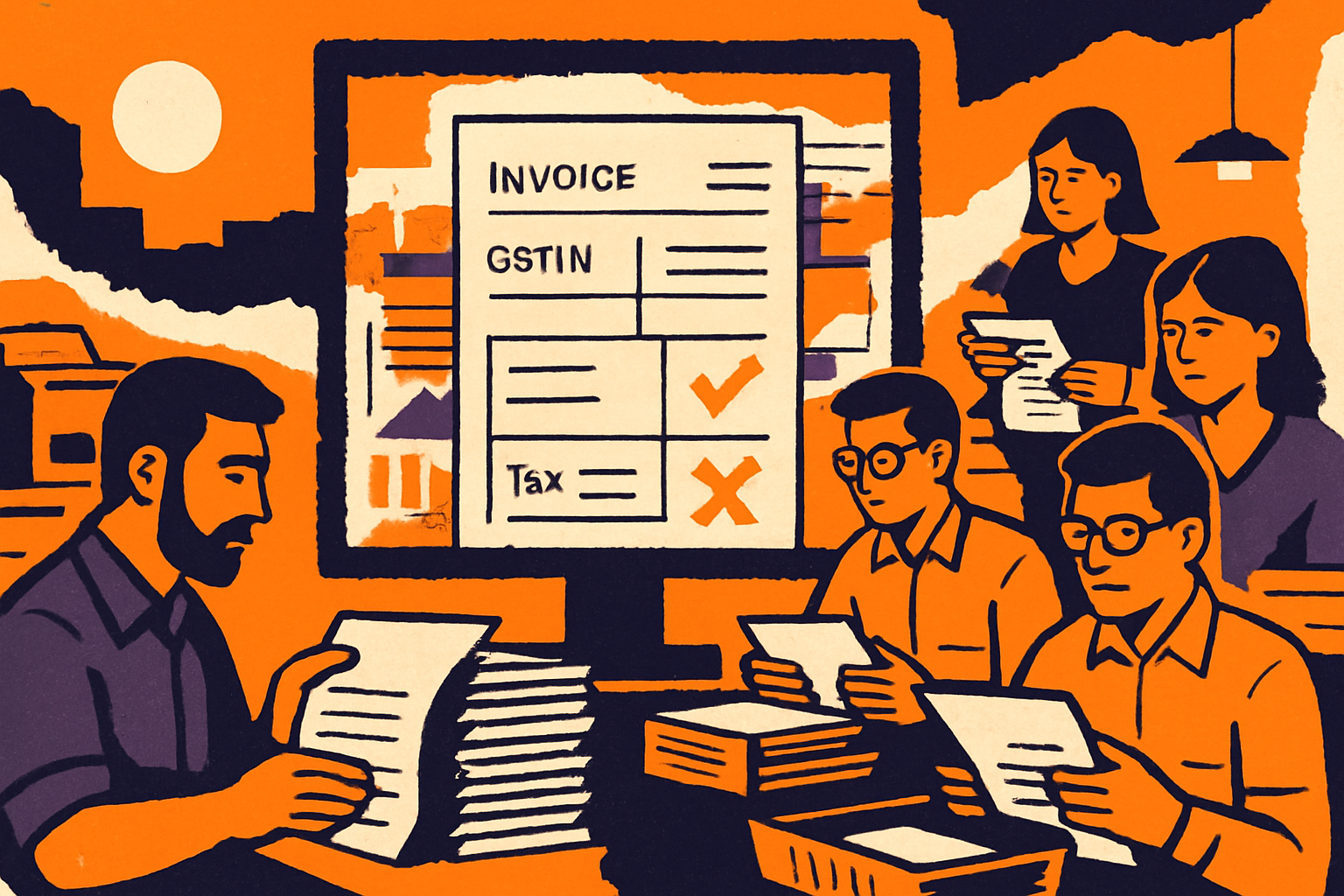
But extraction alone is a trap. A generic OCR tool trained on Western invoice layouts — clean, single-column, standard fonts — hits 95%+ accuracy in demos and then quietly drops to 70-75% the moment it meets a real Indian invoice: a distributor's carbon-copy triplicate, a GST invoice with a hand-stamped signature over the tax table, a scanned PDF from a phone camera at an angle, or a vernacular-script vendor name mixed with English line items. These aren't edge cases in India — they're Tuesday.
The dangerous part is that generic OCR fails silently. It doesn't throw an error; it just extracts "18%" as "1.8%" or reads a "0" as an "8" in a GSTIN, and the number flows straight into your ledger looking perfectly normal. You only discover it three months later when GSTR-2B doesn't match your purchase register, by which point the vendor has moved on, the credit is blocked, and someone in your team is writing a reconciliation memo instead of doing forecasting. We've written separately about the common GST errors AI can detect before they cost you ITC — worth reading if you want the fuller catalogue of what typically slips through.
What does "compliance-aware" OCR actually mean, and why should a CFO insist on it?
This is the distinction most vendor pitches gloss over. Extraction answers "what does this invoice say?" Compliance-awareness answers "is this invoice something I can legally act on?" Those are different questions, and only the second one protects your cash flow.
A compliance-aware OCR layer, sitting on top of extraction, should do four things before an invoice ever touches your books:
- GSTIN validation — checking the extracted GSTIN against GSTN's registered format and status (active, cancelled, or suspended), not just confirming it's 15 characters.
- IRN/QR verification — for e-invoice-eligible transactions, confirming the IRN embedded in the QR code actually matches a live entry on the Invoice Registration Portal, rather than trusting a printed number that could be stale or fabricated.
- ITC eligibility check — cross-referencing the invoice against your GSTR-2B data as it lands, flagging invoices where the vendor hasn't filed, so you know before the return deadline, not after.
- Duplicate and anomaly flagging — catching the same invoice submitted twice, or a taxable value that's inconsistent with the tax computed.
Platforms built for the Indian market are increasingly designed around exactly this stack — GSTIN validation, IRN/QR verification, and GSTR-2B-based ITC protection bundled as one capture step (source). If your current tool only does step one — extraction — you're automating the wrong 20% of the problem.
The stakes here are not abstract. If your business issues an e-invoice-eligible document without a valid IRN, the penalty is 100% of the tax due or ₹10,000, whichever is higher — and worse, your customer cannot claim ITC on that invoice at all (source). For a supplier relationship worth ₹40 lakh a year, that's not a compliance footnote — it's a reason your best customer stops ordering from you.
What can a ₹1 crore mid-sized firm actually save with compliance-aware OCR?
Take a Pune-based auto-components distributor, turnover ₹9 crore, processing roughly 3,500 inbound purchase invoices and 1,200 outbound sales invoices a month across three warehouses. Before automation:
- 2 accounts executives spend roughly 55 hours/month on manual invoice keying and cross-checking against GSTR-2B.
- At an average error rate of 3.5%, that's about 165 invoices a month with some data mismatch.
- Reconciliation delays push GSTR-3B filing close to the deadline every month, with an average of ₹2.8 lakh in ITC held up in "under verification" status at any given time due to vendor non-filing or mismatched entries.
- One missed IRN validation last year triggered a penalty notice of ₹18,500 plus interest.
After deploying compliance-aware OCR integrated with their Tally instance:
- Extraction accuracy moves from an estimated 78% (generic scanning tool they'd tried earlier) to over 96%, because the model is trained specifically on Indian invoice layouts including handwritten annotations and regional GST formats.
- Reconciliation time drops from 55 hours to roughly 12 hours a month — a productivity gain in line with what Indian CA firms report after adopting AI automation, where manual reconciliation hours fall 70-80% (source).
- IRN mismatches are caught at the point of invoice receipt, not at filing time, eliminating the class of penalty risk entirely.
- Blocked ITC drops from an average ₹2.8 lakh to under ₹40,000 in a typical month, because vendor non-filing is flagged the day the invoice is booked, giving the AP team time to chase the vendor before the return window closes.
None of these numbers require heroic assumptions — they're the kind of gains you'd expect simply from removing manual retyping and adding a validation gate before, not after, the return is filed.
How does this fit into the actual GST filing cycle — GSTR-1, GSTR-3B, GSTR-2B?
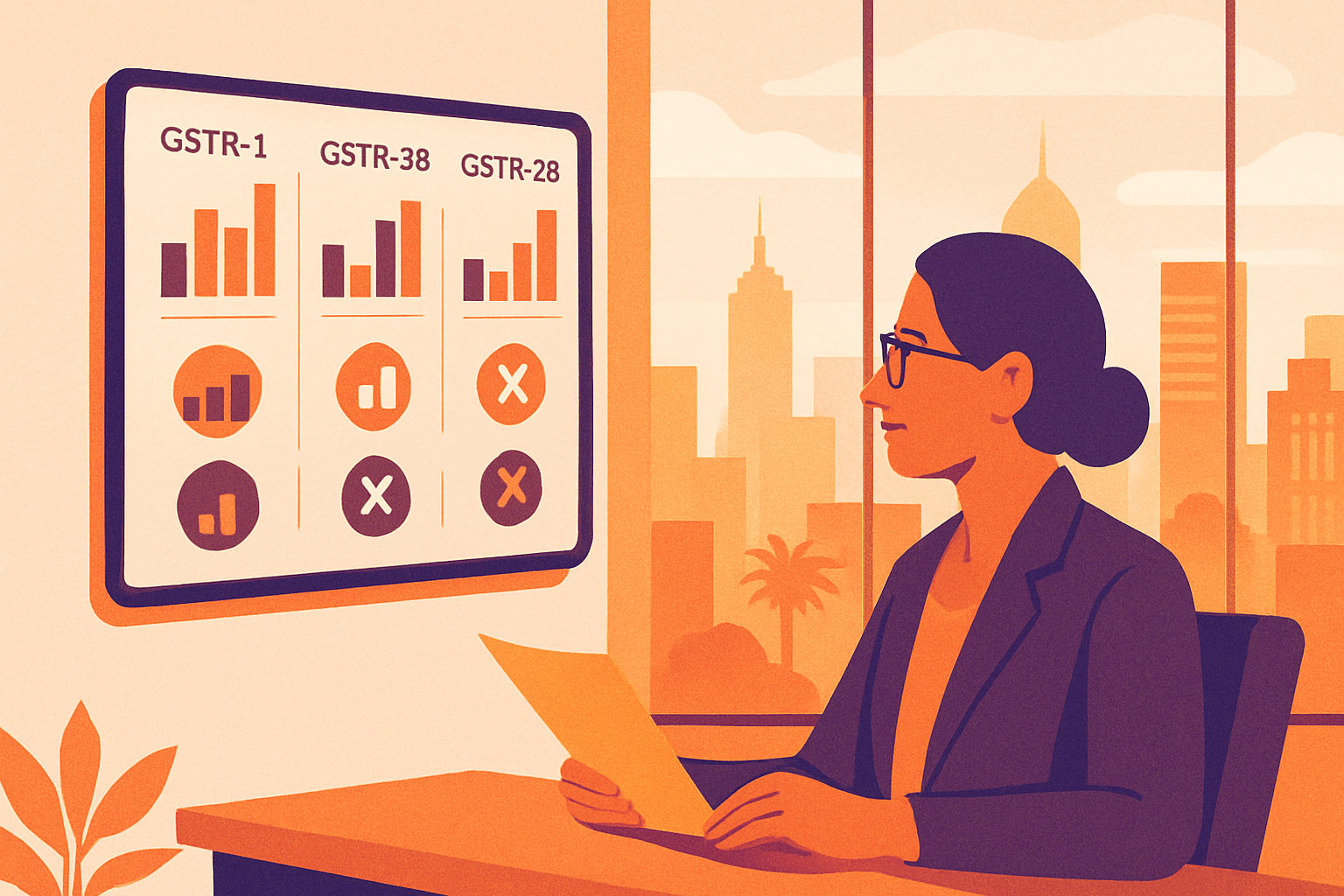
OCR's real value shows up in the plumbing between filings, not in the filing itself. Structured, validated invoice data flows directly into reconciliation between your purchase/sales register and what actually appears in GSTR-1, GSTR-3B, and GSTR-2B (source). Mismatches between these three returns, incorrect invoice reporting, and vendor non-compliance leading to blocked ITC remain the most common and most damaging pain points for Indian finance teams (source).
When OCR captures clean, validated data at the point of invoice entry, that data becomes the single source of truth flowing into your reconciliation engine — so by the time GSTR-2B is auto-populated by GSTN, you already know which line items will match and which won't. If you want a deeper walkthrough of building that reconciliation muscle specifically, our earlier piece on GST reconciliation using AI covers the return-matching logic in more depth — this article is focused specifically on getting clean, compliance-checked data in at the source, which is the precondition for that reconciliation to work at all.
Does OCR actually connect with Tally, or is it another disconnected tool?
This is the practical objection every controller raises, and it's a fair one. Most mid-sized Indian firms run Tally or a Tally-adjacent ERP, and the last thing anyone needs is a shiny OCR dashboard that requires manual export-import cycles — which just relocates the data-entry burden rather than removing it.
The workable pattern looks like this: OCR captures and validates the invoice, structured data gets pushed via API or a Tally-compatible import format directly into your voucher entries, and the compliance flags (GSTIN status, IRN validity, ITC eligibility) travel with the record as metadata rather than getting stripped out. Done correctly, your AP clerk sees a pre-validated voucher ready for approval, not a raw text dump they still have to interpret.
This only works if you treat the integration as a data governance decision, not an IT ticket. We've argued elsewhere that GST compliance is moving from a monthly scramble to a continuous data governance process embedded in your enterprise systems, where integrity is maintained from the source document all the way to GSTN (source). OCR is the entry point of that pipeline; if you get the entry point wrong, every downstream control — reconciliation, filing, audit trail — inherits the error. If your broader controls framework isn't yet mapped out, our guide on internal financial controls for mid-sized Indian companies is the right companion piece for structuring that governance layer.
What happens when errors slip through anyway — is there any relief?
Worth knowing, because it changes how you should design your escalation process: the Supreme Court has ruled that businesses should be allowed to rectify clerical or human errors in GST filings without automatic penalties or denial of ITC, pushing tax authorities toward a more pragmatic stance (source). That's a meaningful safety net, but it's not a strategy — you still have to prove the error was genuinely clerical, which requires an audit trail showing what data your OCR captured, what got flagged, and what a human approved. A compliance-aware OCR log that timestamps every validation check is exactly the evidence you'd want to hand an assessing officer, rather than reconstructing intent after the fact.
Why does this matter more for mid-sized firms than for large enterprises?
Large enterprises already run SAP or Oracle stacks with in-house tax teams and dedicated compliance software budgets. Mid-sized firms — broadly the ₹1-250 crore turnover band — typically run lean finance teams of 3-8 people covering everything from payroll to board reporting, with GST compliance squeezed in as one more monthly fire drill.
MSMEs make up over 60% of all GST-registered entities in India (source, and out of the roughly 1.4 crore businesses registered under GST nationally (source, this segment is generating a huge share of the monthly return volume — India files over 1.1 crore GST returns every month (source.
Digital filing adoption already exceeds 95% (source, which means the filing mechanics aren't the bottleneck anymore — the quality of what gets fed into filing is where the remaining risk lives. Compliance rates nationally have climbed past 85% thanks largely to this automation and stricter enforcement (source — the pressure to keep up is now systemic, not optional.
There's also an economy-wide efficiency case: full-scale e-invoicing adoption could unlock roughly ₹32,035.71 crore in annual economic value nationally, saving the average Indian business approximately ₹1.09 crore a year (source. Even if your firm captures a fraction of that average, it justifies the investment several times over against the cost of a mid-market OCR deployment, which typically runs a few lakh rupees a year in subscription and integration cost.
How should a CFO evaluate an OCR vendor without getting a generic tool in Indian clothing?
Ask these five questions before signing anything:
- What's the accuracy rate specifically on Indian invoice formats — carbon copies, handwritten annotations, regional-language line items — not on clean sample PDFs the vendor demos with. Insist on testing with 200 of your own real invoices before committing.
- Does it validate GSTIN status and IRN/QR live against GSTN, or does it just extract the printed numbers and trust them?
- Does it reconcile against GSTR-2B automatically, flagging vendor non-filing before your return deadline, not after?
- How does it integrate with your ERP — is it a genuine API/voucher-level integration with Tally or SAP, or does someone still need to export a CSV and re-import it?
- What's the audit trail — can you produce a timestamped log of what was captured, validated, and approved, in case you ever need to argue a genuine clerical error under the Supreme Court's rectification standard?
If a vendor can't answer question 3 with specifics, they're selling you a scanner, not a compliance system.
How BiPivot helps
BiPivot works with mid-sized Indian finance teams to design compliance-aware invoice automation that plugs into your existing Tally or SAP setup rather than sitting beside it as one more disconnected tool. If you want to see how invoice extraction and GST validation work on your own documents, try our invoice extractor or explore our broader consulting work on finance automation at bipivot.com.