

Perplexity vs ChatGPT: Which AI Tool Should Indian CFOs Trust in 2026?
By BiPivot Team · 16 September 2026

The honest answer is neither tool wins outright. They solve different problems, and the real cost of getting the choice wrong isn't a wasted subscription — it's a GST notice, a DPDP penalty, or a board deck built on a hallucinated number.
India's generative AI market is not a side conversation anymore. It was valued at USD 1.5 billion in 2025 and is projected to reach USD 6.2 billion by 2034 at a 14.59% CAGR (IMARC Group), while a more aggressive estimate puts it growing from USD 2,225.8 million in 2025 to USD 41,513 million by 2030 — a 51.9% CAGR that outpaces the global rate (MarketsandMarkets). Nearly half of Indian SMEs — 47% in 2026, up from just 12% two years ago — are already using at least one AI tool (Qreo Digital). The tools are already inside your finance function, whether procurement signed off on them or not. The question is whether you're deploying them deliberately or letting a junior analyst paste vendor contracts into a free-tier chatbot.
What is the actual difference between Perplexity and ChatGPT for finance work?
Perplexity is built as an answer engine. It searches the live web, synthesizes a response, and — critically — attaches inline citations to every claim (CloudZero). For a finance team, that citation trail is the whole point: if you're validating a customer's credit rating, checking a competitor's latest quarterly filing, or confirming an RBI circular date, you want a tool that shows its working, not one that sounds confident.
ChatGPT is a general-purpose assistant — reasoning, writing, coding, generating images and video, and running agentic multi-step tasks, drawing primarily on trained knowledge with optional browsing layered on top (Medium — ChatGPT vs Perplexity for Business Research). It's the stronger tool when you need it to draft a board note, build a financial model narrative, or automate a recurring workflow that touches your ERP data.
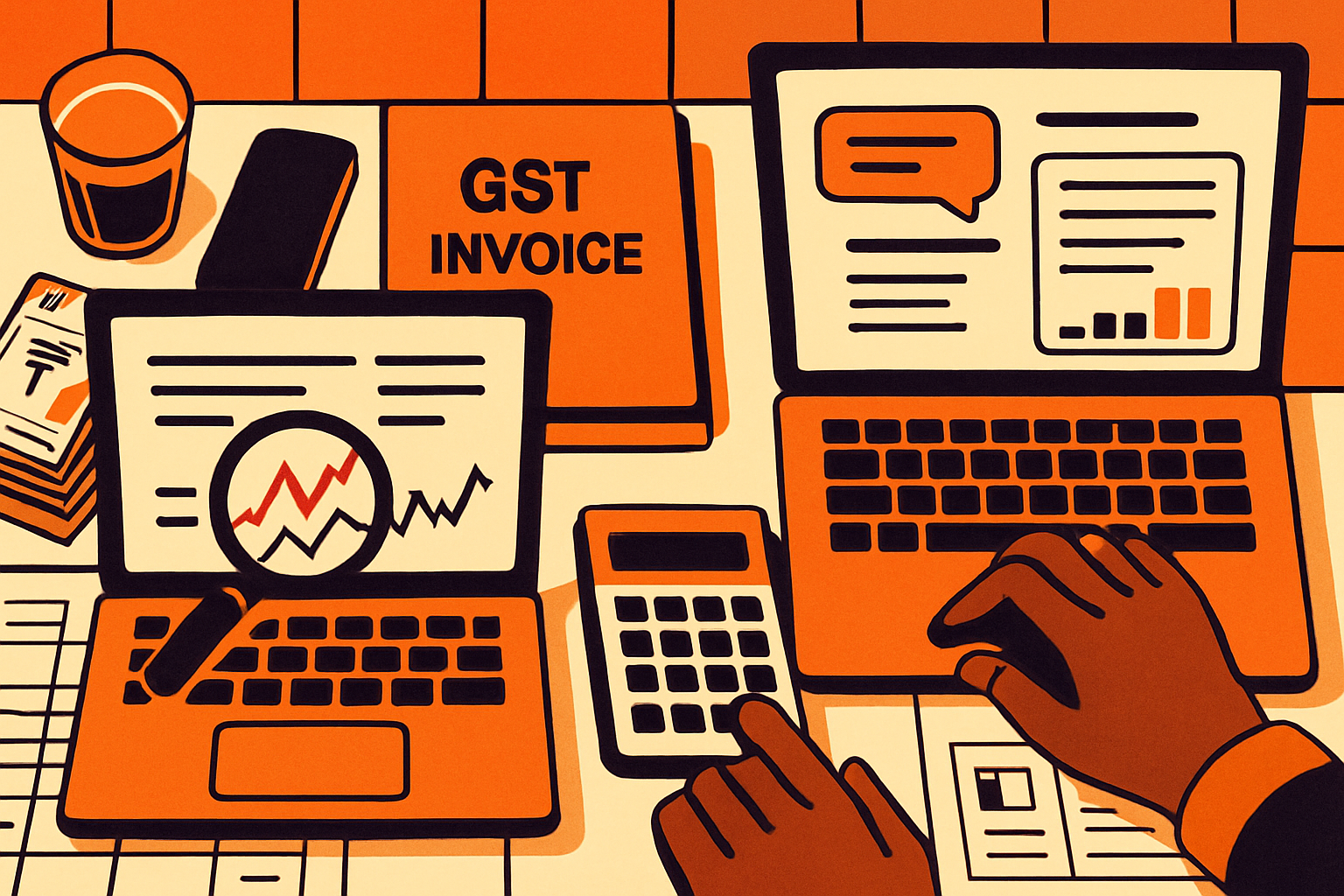
For financial research specifically that needs real-time data and verifiable sourcing, Perplexity Finance is generally the stronger option — it offers a dedicated Finance mode with real-time stock data and SEC filing access (Finatune). But OpenAI closed part of that gap fast. On September 10, 2026, it launched ChatGPT for Financial Services — a specialized product for financial institutions with premium financial datasets and enterprise-grade security, initially aimed at investment banking and equity research (OpenAI Help Center). That version bundles data feeds from Daloopa, PitchBook, LSEG News, and Crunchbase, with citations that trace figures back to source (The Statesman). If your team has been comparing ChatGPT's older general-purpose tier against Perplexity, know that the comparison has shifted — but the financial-services tier is priced and positioned for large institutions, so mid-sized companies are still choosing between Perplexity and standard ChatGPT plans for most day-to-day work.
If you're weighing ChatGPT against other assistants already sitting inside your Microsoft or Google stack, our comparisons of Microsoft Copilot vs ChatGPT for finance teams and ChatGPT vs Claude for finance cover adjacent ground — this article focuses specifically on the research-verification-vs-synthesis trade-off that Perplexity and ChatGPT represent.
Which finance workflows actually fit each tool?
Stop thinking in terms of "which AI tool should we buy" and start mapping tool to task. Here's how it plays out in a typical mid-sized Indian finance function with revenue between ₹150 crore and ₹800 crore:
Use Perplexity when:
- Validating a prospective customer's or vendor's financial health before extending credit terms — pull recent news, litigation history, and rating agency commentary with citations you can drop straight into a credit memo.
- Due diligence for an acquisition or JV — cross-checking target company disclosures, promoter background, and sector benchmarks where an auditor will later ask "where did this number come from?"
- Tracking real-time commodity prices, forex movements, or interest rate changes that feed into treasury decisions.
- Building a board-ready competitive landscape slide where every claim needs a traceable source.
Use ChatGPT when:
- Drafting the narrative sections of a board pack, investor update, or MD&A commentary once the numbers are finalized.
- Automating repetitive analytical tasks — variance commentary templates, month-end close checklists, first-draft policy documents.
- Running agentic workflows that chain multiple steps: pull a trial balance summary, flag anomalies, draft a summary email — provided the underlying data is already verified.
- Generating scenario models and what-if narratives for internal planning, where creative synthesis matters more than external verifiable citation.
Worked example. A Pune-based auto-components manufacturer (annual revenue ₹340 crore) was evaluating a new tier-2 supplier in Vietnam. The finance team used Perplexity to compile the supplier's export history, recent customs flags, and currency exposure — complete with source links to trade databases and news reports — in about 40 minutes, a task that would have taken a junior analyst a full day of manual searching. They then fed the verified summary into ChatGPT to draft the risk-assessment memo for the CFO's sign-off, cutting drafting time from three hours to 45 minutes. Total task time: under two hours, versus a typical one-and-a-half to two working days. That's the pairing that works — research tool for facts, generation tool for output — not a single tool doing both jobs unsupervised.
How does the DPDP Act change what you can safely paste into these tools?
This is the part most vendor blogs skip, and it's the part that will actually get a CFO called into a compliance review. India's Digital Personal Data Protection Act, 2023 imposes real obligations — consent, purpose limitation, and reasonable security safeguards — the moment you paste an Indian resident's personal data into a third-party AI tool (NexusNest AI). That covers employee salary data, customer PAN numbers, vendor bank details — the exact kind of information that ends up in finance prompts when someone is trying to save time.
The Act does allow cross-border data transfers, but it holds you accountable for what happens after, with penalties running up to ₹250 crore for security-safeguard failures that lead to a data breach (Protecto AI). And here's the uncomfortable stat: only 9% of surveyed Indian organizations report a comprehensive understanding of the DPDP Act (Protecto AI). If your finance team doesn't have a written policy on what can and cannot be pasted into Perplexity or ChatGPT, you are statistically in the majority — and that's not a comfortable place to be when a regulator asks for your data-handling policy.
Practical rule for finance teams: never paste customer PII, employee compensation data, or unpublished financial results into a consumer-tier chatbot session. Use anonymized or aggregated figures ("a manufacturing client with ₹200-250 crore turnover" instead of the actual company name and numbers) when you need AI to help structure analysis. If your organization needs to process real customer or employee data through AI, that requires an enterprise agreement with contractual data-processing terms — not a personal ChatGPT Plus or Perplexity Pro login expensed on a corporate card.
What are the GST and TDS implications of paying for Perplexity or ChatGPT subscriptions?
Both platforms are foreign-origin digital services, which means Indian tax rules on cross-border digital payments apply — and most finance teams haven't checked this at all.
GST: AI tools delivered online to Indian users typically fall under Online Information and Database Access or Retrieval (OIDAR) service rules, with the tax treatment depending on where the recipient is located (Ebizfiling). If your company is procuring a business subscription (not an individual employee's personal card), you're generally liable to pay GST under reverse charge as the recipient of an OIDAR service from a non-resident provider. This is exactly the kind of line item that gets missed when a team lead expenses a Perplexity Pro subscription on a personal credit card instead of routing it through procurement — no GST is accounted for, and it surfaces as a discrepancy at audit time.
TDS: This is murkier and worth a specific conversation with your tax advisor. Foreign AI platforms generally don't deduct Indian TDS themselves, but the Indian company making the payment may have a withholding obligation if the payment qualifies as "royalty" or "fees for technical services" under the Income Tax Act (CAclubindia). Whether a standard SaaS subscription for an AI chatbot triggers this classification is a genuinely contested area — don't assume either way. For any AI subscription above a few lakh rupees annually, get a one-time written opinion from your tax consultant on the TDS treatment and file it with your vendor master record. It's a ₹15,000-25,000 advisory cost that protects you from a disallowance under Section 40(a)(i) that could run into lakhs.
Worked cost example. A mid-sized NBFC in Ahmedabad budgeted ₹4.2 lakh annually for 15 seats across Perplexity Pro and ChatGPT Team plans. After routing the procurement through finance instead of individual expense claims, they identified ₹75,600 in reverse-charge GST liability that had gone unaccounted for the prior year under ad-hoc personal subscriptions — a correction that cost more in penalty interest than it would have to get it right from month one.
Why do 41% of finance-related AI queries risk being wrong — and what do you do about it?
Here is the number every CFO needs pinned above their desk: AI hallucinations — plausible-sounding but fabricated or inaccurate outputs — occur in up to 41% of finance-related queries (Aveni AI). On legal questions specifically, general-purpose chatbots showed hallucination rates of 58-88% in 2024 testing (Deloitte Switzerland). These aren't obscure edge cases — they're the baseline error rate you should assume for any unverified AI output touching numbers, dates, or regulatory citations.
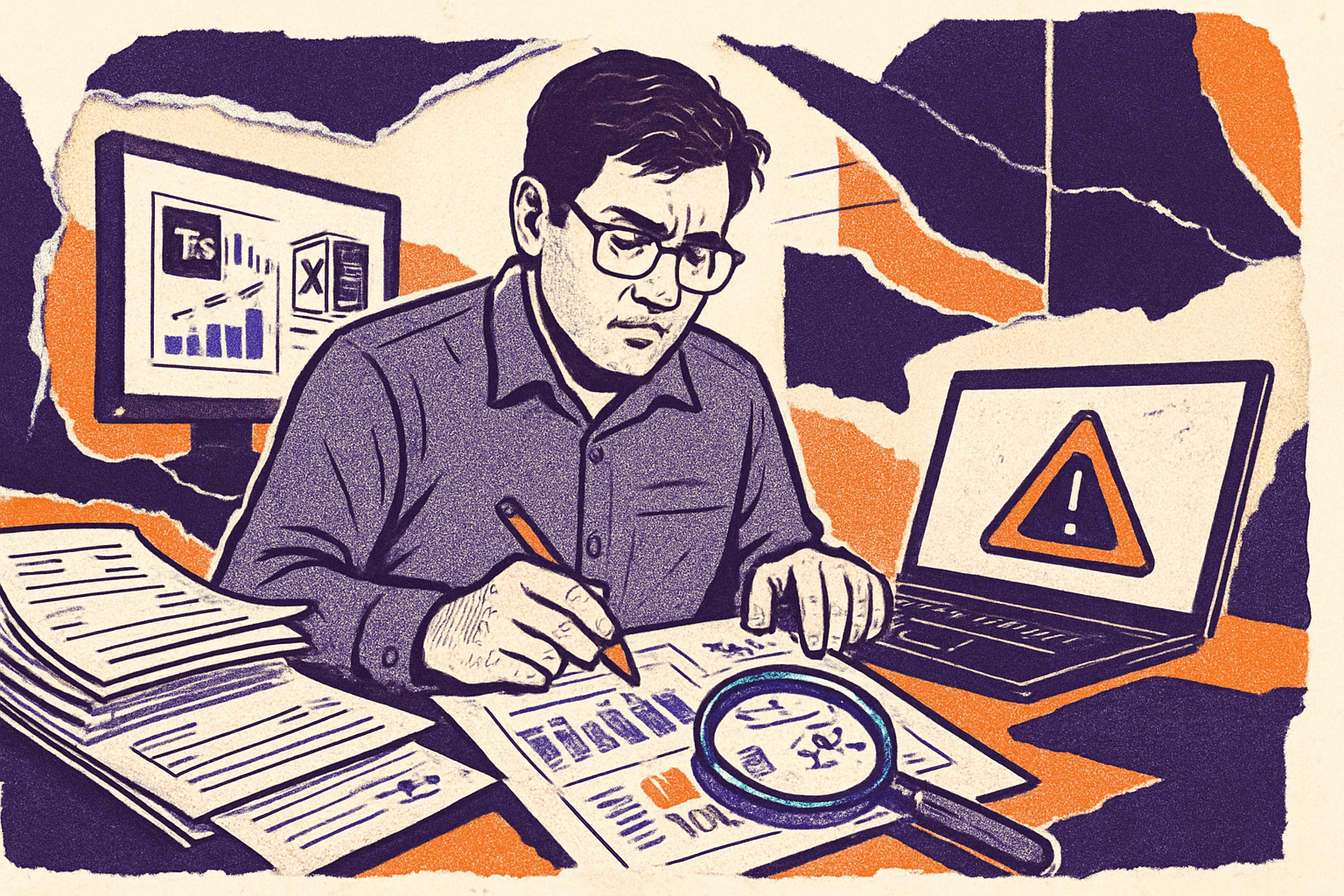
The mechanism matters for how you build controls. AI models don't just get facts wrong randomly — they misinterpret data, invent plausible-sounding explanations, and attribute information to the wrong source entirely (Federal Finance Journal). That last failure mode is particularly dangerous with Perplexity: a citation next to a number creates false confidence. Analysts stop verifying because "it has a source," when the AI has sometimes summarized the source incorrectly or attached the wrong citation to the wrong figure. AI accelerates the reporting cycle — it does not replace professional judgment, and treating a citation as proof rather than a starting point for verification is how errors slip into board packs.
Three non-negotiable controls for any finance team using either tool:
- Every number that lands in a filed document, board pack, or external communication gets manually traced to source — no exceptions, regardless of which tool produced it or whether it carried a citation.
- Maintain a two-person review for any AI-assisted analysis above a materiality threshold you set (many mid-sized companies use ₹5-10 lakh as the line for mandatory second review).
- Log which tool generated which output, with a timestamp and the prompt used, so if a number is later questioned, you can trace exactly how it was produced. This is the same discipline you'd apply to a spreadsheet with a hardcoded override — know where the number came from.
If you're already building out review discipline for AI-generated coding and automation scripts touching your finance stack, our guide on AI coding tools for finance automation walks through similar verification checkpoints for that adjacent use case.
How do you build this into a workflow instead of ad-hoc tool usage?
The most effective approach for Indian businesses is to build systematic, AI-powered workflows around specific business processes — treating these tools as components in a larger strategy, not "magic buttons" for instant answers (Qreo Digital). Fragmented usage — one analyst using ChatGPT for one thing, another using Perplexity for something unrelated, with no shared standards — is how you end up with inconsistent quality and untracked compliance exposure.
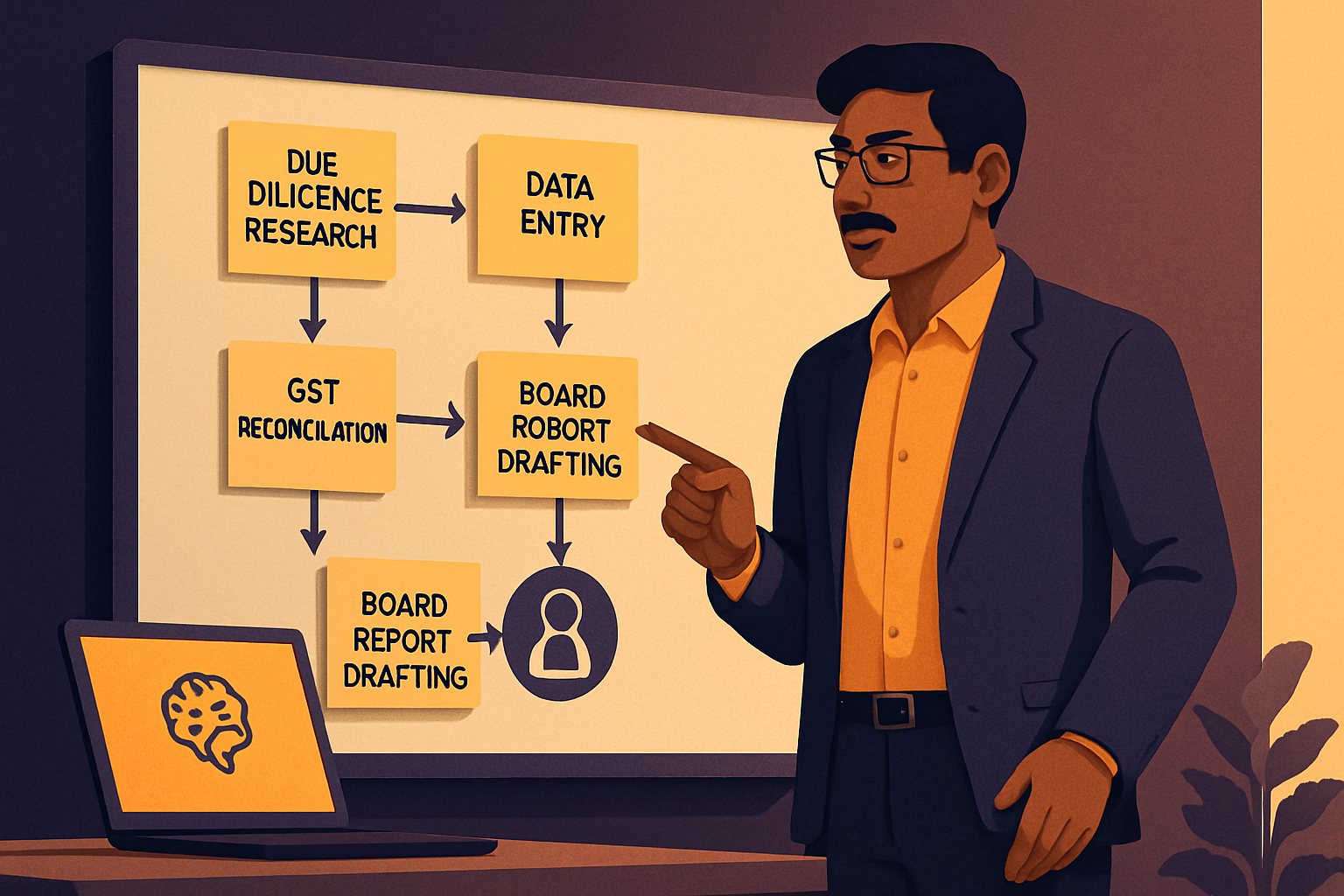
A practical workflow structure for a mid-sized finance team:
- Define the use case list explicitly. Write down the five to eight recurring tasks where AI adds value — vendor due diligence, competitive benchmarking, board note drafting, variance commentary, policy drafting. Anything not on this list requires sign-off before use.
- Assign tool-to-task mapping using the Perplexity-for-research, ChatGPT-for-synthesis split described earlier, and put it in writing as a one-page policy.
- Set a data classification rule — what can go into a prompt (anonymized, aggregated, published data) versus what cannot (PII, unpublished results, employee data) — tied directly to your DPDP obligations.
- Route procurement centrally. No individual expense-claimed subscriptions for tools touching company financial data; route through IT/finance procurement so GST and TDS treatment is handled consistently.
- Build a verification checkpoint into every workflow before AI output reaches an external audience — this is where the human sign-off happens, not as an afterthought but as a designed step.
This mirrors the discipline we've written about for dashboard and reporting workflows — see our ERP reporting best practices playbook for how the same "define, verify, sign-off" structure applies when AI-generated commentary feeds into your executive dashboards.
Is the cost-vs-compliance trade-off worth it for a price-sensitive Indian buyer?
Indian companies buy differently than their global peers. Nearly 50% of Indian companies prioritize pricing over performance when adopting generative AI models — a marked difference from global buyers, who weight performance first (Deloitte India). That instinct is reasonable for a marketing copy tool. It is a genuinely risky instinct for a finance function, where the downside of a wrong or non-compliant AI output isn't a mediocre blog post — it's a restated filing, a DPDP notice, or a credit decision built on fabricated data.
Run the actual numbers before defaulting to the cheapest tier. ChatGPT for Financial Services is priced for enterprise financial institutions, indicating that for mid-sized companies, the decision often comes down to standard Perplexity and ChatGPT plans. The math isn't "can we afford the better tool" — it's "can we afford not to have a verification process," because even the most expensive AI tier doesn't eliminate the need for one.
Meanwhile, the leadership confidence gap is real and worth naming: 69% of CFOs globally believe understanding AI is crucial for future leaders, yet only 28% feel confident in their ability to implement it (Russell Reynolds). Globally, 78% of companies now use AI in some form, with 90% using or exploring it (Exploding Topics). Waiting for perfect confidence before starting is not a strategy — building a narrow, well-governed pilot around one or two use cases (vendor due diligence with Perplexity, board note drafting with ChatGPT) for one quarter, with the controls above in place, is how mid-sized Indian finance teams are actually closing that confidence gap without exposing themselves to hallucination or compliance risk.
How BiPivot helps
BiPivot works with mid-sized Indian finance teams to design AI adoption roadmaps that start with the use case and the compliance boundary, not the vendor pitch — mapping which workflows genuinely benefit from tools like Perplexity or ChatGPT and where human verification stays non-negotiable. If you're weighing AI tools against your existing ERP, reporting, and dashboard stack, our team can help you build the governance layer before the subscription, not after the audit finding. Explore our approach at bipivot.com.