

AI Coding Tools for Finance Automation: A CFO's Guide for Mid-Sized Indian Companies
By BiPivot Team · 10 September 2026
Why should a CFO care about AI coding tools, beyond standard AI software?
Every CFO in India has already sat through a pitch for "AI-powered" finance software. Fewer have considered that the more durable advantage might come from building rather than buying. AI coding tools — generative AI paired with low-code/no-code platforms — let a finance team member with no formal programming background construct a working reconciliation script, a custom ERP connector, or a compliance dashboard in days, not the 4-6 months a typical IT vendor project takes.
The India AI in Finance Market is projected to grow from USD 867 million in 2023 to an estimated USD 9,651 million by 2032, at a CAGR of 30.7%. Separately, India's Generative AI in financial services segment is expected to reach USD 1,345.5 million by 2033, growing at a CAGR of 36.38% from 2026. If you wait for the market to mature and a perfect off-the-shelf product to appear, you'll spend the next three years paying licence fees for capability you could have built in-house for a fraction of the cost.
The uncomfortable truth for mid-sized Indian firms: 57% of finance organizations plan to invest in AI and machine learning in 2026 (source), making it the top planned technology investment. AI coding tools flip the equation — they're the difference between renting a solution and owning one.

What exactly counts as an "AI coding tool" for a finance team?
Three categories matter in practice for an Indian mid-sized company:
- Generative AI code assistants (e.g., GitHub Copilot, Claude, ChatGPT used for code) — you describe a task in plain English ("write a Python script that pulls GSTR-2B data from our GSP API and flags line items where ITC exceeds the matched invoice by more than 5%") and get working code back in seconds.
- Low-code/no-code automation platforms (e.g., Power Automate, Zoho Creator, n8n, Retool) — drag-and-drop builders for workflows, now increasingly embedding generative AI to auto-generate the workflow logic itself.
- RPA-plus-AI hybrids — bots that combine screen-scraping/rule-based automation with an AI layer for judgment calls, like classifying an ambiguous vendor invoice line item.
We've already covered the AI model choice for finance conversations in ChatGPT vs Claude for Finance: What Mid-Sized Indian CFOs Should Actually Use in 2026 — that article is about which chatbot to talk to. This one is about a different question: which tool do you use to build something that runs unattended every night in your finance stack, without you re-typing a prompt every time.
A concrete example: a Pune-based auto-components manufacturer with ₹180 crore turnover had a finance analyst spend three days a month manually matching 2,200 purchase invoices against GSTR-2B in Excel. Using a low-code platform (Retool) with a Python script drafted by Claude for the matching logic, the same task now runs as a scheduled job that completes in 40 minutes and flags only the 60-80 genuine mismatches for human review. Analyst time freed up: roughly 34 hours a month, redeployed to vendor negotiation analysis.
How do AI coding tools help with the GST "Zero Mismatch" deadline?
This is the sharpest, most immediate reason for finance heads to act now rather than in six months. The Zero Mismatch GST policy, effective April 2026, will block GSTR-3B filing outright if a company's claimed ITC exceeds GSTR-2B by more than 5% (source). That is not a warning notice or a late fee — it is a hard stop on your ability to file. For a company with monthly GST liability of ₹2.5 crore, even a two-week filing delay caused by manual reconciliation backlog can mean working capital getting stuck, interest exposure under Section 50, and vendor payment cycles unravelling.
Manual reconciliation teams typically catch mismatches at month-end, when it's too late to chase vendors for corrected invoices before the filing deadline. An AI-coded reconciliation script changes the cadence entirely:
- Daily ingestion: A script (built once, using generative AI to draft the parsing logic) pulls GSTR-2B data via GSP/ASP API and your purchase register from Tally or SAP, nightly.
- Automated matching: Fuzzy-matching logic — GSTIN, invoice number, amount, tax rate — flags exceptions same-day instead of at month-end.
- Exception routing: A Slack/Teams/email alert goes to the specific purchase team member responsible for that vendor, with the invoice attached, on day 2 instead of day 28.
AI is already transforming this space more broadly through automated invoice processing, ITC reconciliation, and anomaly detection (source). But most off-the-shelf GST software treats reconciliation as a monthly batch job, not a daily discipline — because that's what a generic product built for thousands of customers has to assume. A custom-coded workflow, tuned to your specific vendor mix and ERP quirks, can run daily. That's the practical edge AI coding tools give you over buying a licence.
If you're also rebuilding your invoice-matching process from scratch, read our detailed playbook in Invoice Matching Automation: A CFO's Guide to Protecting ITC and Cash Flow in India — it goes deep on the matching rules; this article focuses on the tooling choice to implement them.
How do legacy ERPs and fragmented data actually break automation projects?
Ask any Indian mid-sized CFO what killed their last automation initiative and the answer is rarely "the AI wasn't smart enough." It's almost always: the data lived in three systems that don't talk to each other. A distribution business might run Tally for the head office books, a separate WMS for warehouse stock, and Excel for distributor claims — with no API connecting any of them.
This is a well-documented pain point: managing regulatory overload, integrating new digital tools with legacy systems, proving ROI, and overcoming fragmented data for real-time insights are consistently cited as the top pain points for Indian CFOs (source). And the reason is structural: mid-sized firms simply don't have five ERP consultants sitting idle waiting to build a custom connector between Tally and a distributor portal. Standard integration platforms rarely ship a pre-built connector for the specific combination of tools an Indian mid-market company runs.
This is precisely where AI coding tools change the economics. Building a custom API connector used to require a developer who charges ₹1,200-2,000/hour and takes two to three weeks. Today, a finance ops lead who understands the data — even without a computer science degree — can describe the integration to a generative AI code assistant, get a working Python or JavaScript script, test it against sample data, and have a working connector live in three to five days, with IT reviewing security and access controls before deployment.
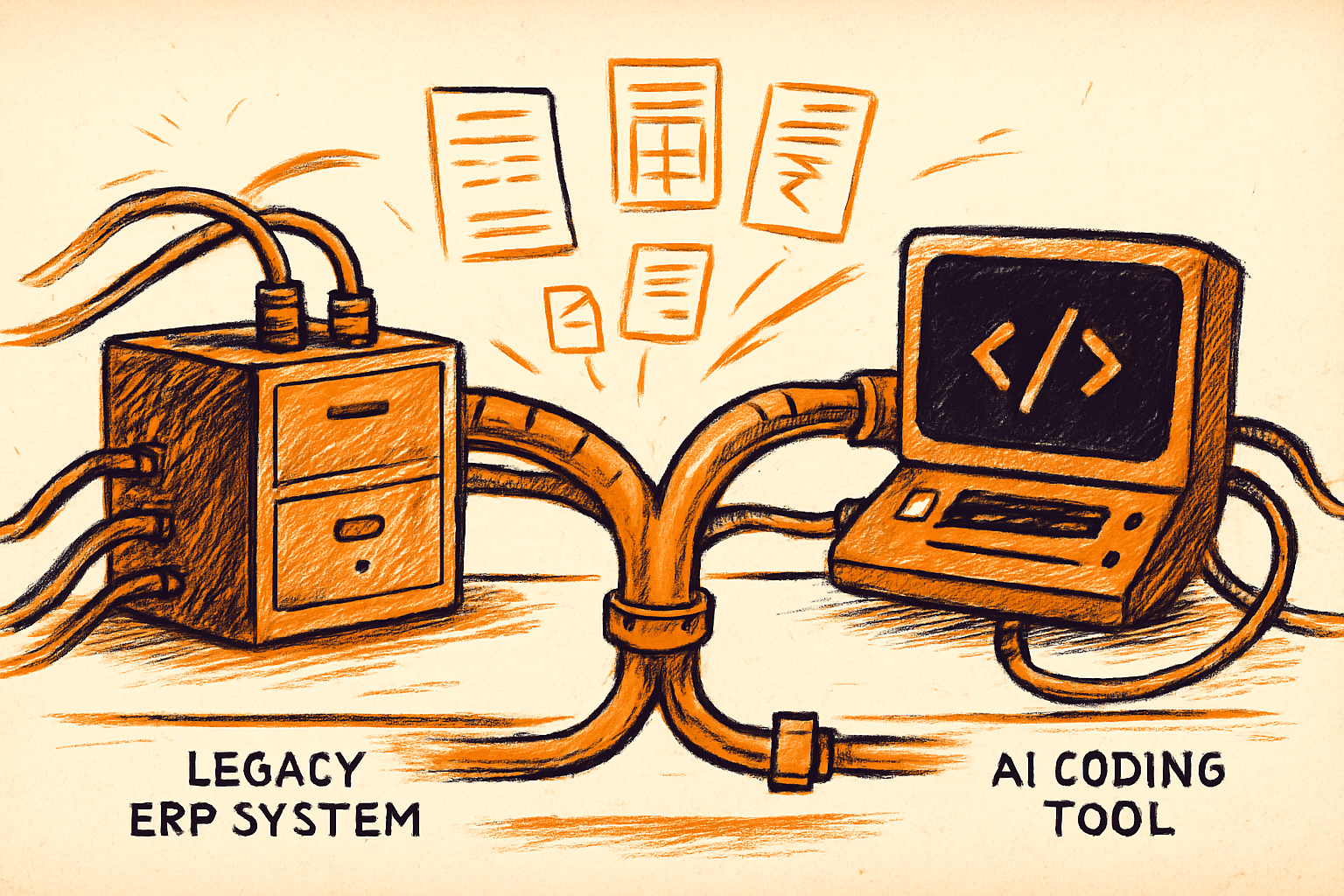
A worked example: a Coimbatore-based textile exporter with ₹95 crore turnover needed to reconcile export shipment data (from a freight-forwarder portal, no API) with their SAP Business One ledger for GST refund claims. Rather than wait for SAP's integration partner (quoted ₹8 lakh, 10-week timeline), the finance controller used a low-code tool to build a scraper-plus-API bridge, drafted with AI assistance, for roughly ₹40,000 in developer review time and three weeks. The resulting automated reconciliation reduced the export refund claim cycle from 45 days to 12 days — meaningfully improving working capital for a business where export refunds routinely exceeded ₹1.5 crore per quarter.
For companies whose real bottleneck is reporting rather than reconciliation, our existing guide on Best Practices for ERP Reporting: A CFO's Playbook for Mid-Sized Indian Companies covers report design; this article's angle is specifically about the tooling that lets you build the connector feeding that report, without a six-figure SAP consulting invoice.
Does building your own tools mean building your own compliance risk?
Yes, if you're careless — and this is where CFOs need to slow down even as the technology tempts them to move fast. Two regulatory frameworks now directly shape how AI-coded finance tools should be built in India.
The DPDP Act, 2023 requires purpose limitation, consent management, data minimization, and security safeguards for any AI system processing personal data (source). If your AI coding tool pulls employee salary data, vendor bank account details, or customer PAN numbers into a workflow, you are now a "data fiduciary" for that data, whether the workflow was built by IT or by a finance analyst using a no-code tool over a weekend. Practically, this means: never paste real customer or employee PII into a public generative AI chat interface to "test" a script — use masked/synthetic data, and route production data only through workflows with logged access controls.
The RBI's FREE-AI Framework, established in 2025, sets guiding principles for responsible AI adoption in financial services around accountability, fairness, and explainability (source). For most mid-sized manufacturing or FMCG companies, this framework is most relevant if you're using AI-coded tools to score vendor or customer credit risk internally. RBI guidelines require human review for AI-driven credit decisions and mandate bias testing for credit scoring models to ensure non-discriminatory lending (source). If your finance team has built (or is planning to build) an internal model that scores distributor creditworthiness before extending credit terms, that decision cannot be fully automated — a human must sign off, and you should be able to explain, in plain terms, why the model flagged a particular distributor as high risk.
A practical governance rule we recommend to clients: any AI-coded automation that touches money movement, credit decisions, or personal data gets a one-page "build note" — what data it touches, who approved it, what the fallback is if it fails, and who reviews its output monthly. It takes 20 minutes to write and has saved more than one client from an audit headache.
What's the realistic build-vs-buy calculus for a 50-100 crore turnover company?
Don't over-rotate toward "build everything in-house." The right posture is selective: build where your process is genuinely unique to your business (vendor-specific reconciliation rules, a bespoke MIS dashboard combining data no vendor's product anticipates), and buy where the problem is generic and well-solved (core ERP, statutory GST filing engines, payroll compliance).
Rough framework we use with clients:
| Scenario | Build with AI coding tools | Buy off-the-shelf |
|---|---|---|
| Reconciling GSTR-2B against a non-standard ERP export format | Yes | No standard product handles your exact export format |
| Statutory GST return filing itself | No | Established ASPs/GSPs already do this reliably |
| Custom MIS dashboard blending sales, distributor claims, and freight data | Yes | Generic BI tools force you into their data model |
| Payroll and PF compliance | No | Regulatory risk too high for a DIY build |
| Daily ITC exception alerts routed to the right buyer | Yes | Most GST software batches this monthly, not daily |
If your team's real problem is dashboards misleading rather than missing, that's a different failure mode — see our breakdown in Common Dashboard Mistakes That Are Quietly Costing Indian CFOs Money before you build a new one from scratch; sometimes the fix is redesigning what exists, not coding something new.
The talent gap is real and worth naming honestly. Mid-sized Indian firms face significant AI complexity costs, integration challenges, and talent shortages that hinder successful scaling of AI initiatives (source). AI coding tools genuinely reduce — but do not eliminate — this gap. You still need someone in finance who understands both the accounting logic and enough of the tooling to prompt effectively, test outputs, and catch when the AI-generated code is subtly wrong (which happens more often than vendors admit — always run generated code against a known reconciled dataset before trusting it in production).
What actions should a CFO take in the next 90 days?
Skip the pilot-purgatory trap of running a proof-of-concept for six months with no production deployment. Instead:
- Week 1-2: Pick one painful, well-bounded process — GSTR-2B/3B reconciliation is the highest-ROI starting point given the April 2026 deadline. Document the current manual steps precisely.
- Week 3-4: Have one finance analyst (not IT) experiment with a generative AI code assistant to draft the matching logic against a sample dataset of 200-300 invoices, using masked data only.
- Week 5-8: Build the workflow in a low-code platform, test it in parallel with the existing manual process for two full GST cycles, comparing outputs line by line.
- Week 9-12: Go live for that one process, write the one-page governance note, and only then pick the next candidate process from your build-vs-buy table.
This sequencing matters because AI in finance delivers its real value — improved accuracy, faster processing, better fraud detection, and cost savings — only when a process actually goes live, not when it stays a demo (source). Industry adoption is already well ahead of most mid-sized companies' comfort level — 84% of BFSI organizations in India were using AI by August 2025, with 67% actively experimenting with generative AI for fraud detection, compliance, and customer analytics (source), and 78% of financial institutions were implementing or planning generative AI integration as far back as May 2024 (source). The RBI's own analysis suggests generative AI could enhance Indian banking operations by as much as 46% by 2030 (source) — a rare case where the regulator itself is signalling the direction of travel to the sector it oversees.
The strategic reframe worth internalizing: AI in finance is no longer just an automation technology. Finance leaders increasingly treat it as a decision-support layer that improves the quality of the financial decisions themselves (source). AI coding tools are how a finance team with 8-10 people, no dedicated developer, and a limited IT budget gets to participate in that shift — not by waiting for a vendor's roadmap, but by building the specific tool their business needs, this quarter.
How BiPivot helps
BiPivot works with finance teams at mid-sized Indian companies to identify which processes are worth building with AI coding tools versus buying outright, and to implement the first working automation — GST reconciliation, ERP connectors, or custom reporting — safely and on a realistic timeline. If you're weighing where to start, visit BiPivot to talk through your specific ERP and compliance setup.