

AI for Internal Audit: Practical Use Cases for Mid-Sized Indian Companies
By BiPivot Team · 21 July 2026 · AI in Finance, Internal Audit, GST Compliance, TDS, Continuous Controls Monitoring, CFO Technology
Is your internal audit still fighting yesterday's fraud with last quarter's data?
Traditional internal audit often relies on manual, sample-based testing and retrospective reporting. By the time the audit committee reads the report, the anomaly may have already triggered a GST or TDS notice, emphasizing the need for more timely detection.
The direction of travel is clear. AI adoption in internal audit is projected to double to 80% globally by 2026, with 39% of internal auditors already using AI and another 41% planning to adopt it within 12 months as of May 2025 (source). This isn't a Big 4 or NASDAQ-listed enterprise story. For a ₹300-800 crore turnover Indian manufacturer or trading company, the practical question is narrower and more urgent: which AI use cases pay for themselves in the first year, and which ones are still too risky to hand over without a human checking every output?
This article sticks to what's actually workable for finance teams of 15-40 people, with real INR numbers, not vendor slideware.
What changes when audit moves from sampling to full-population testing?
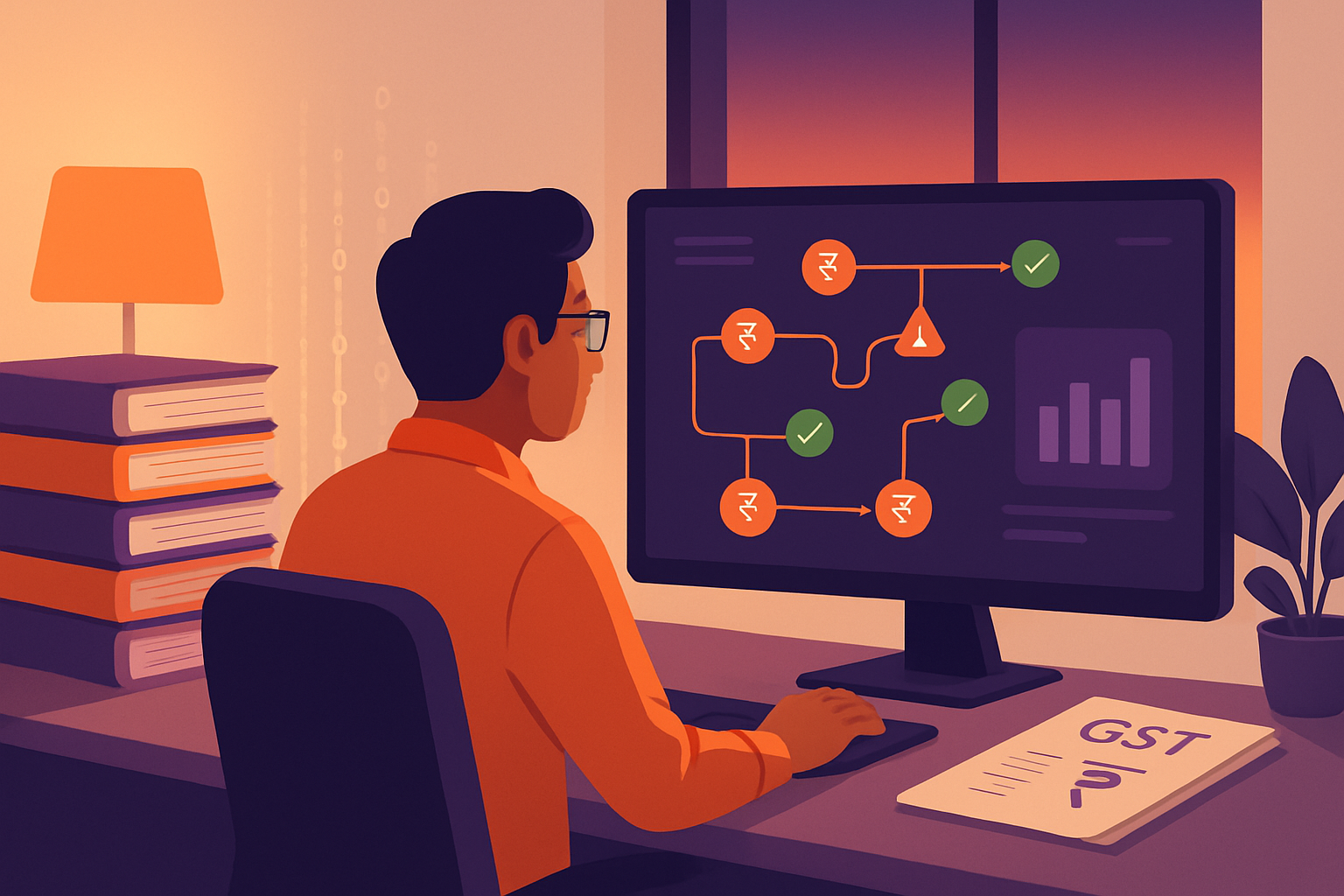
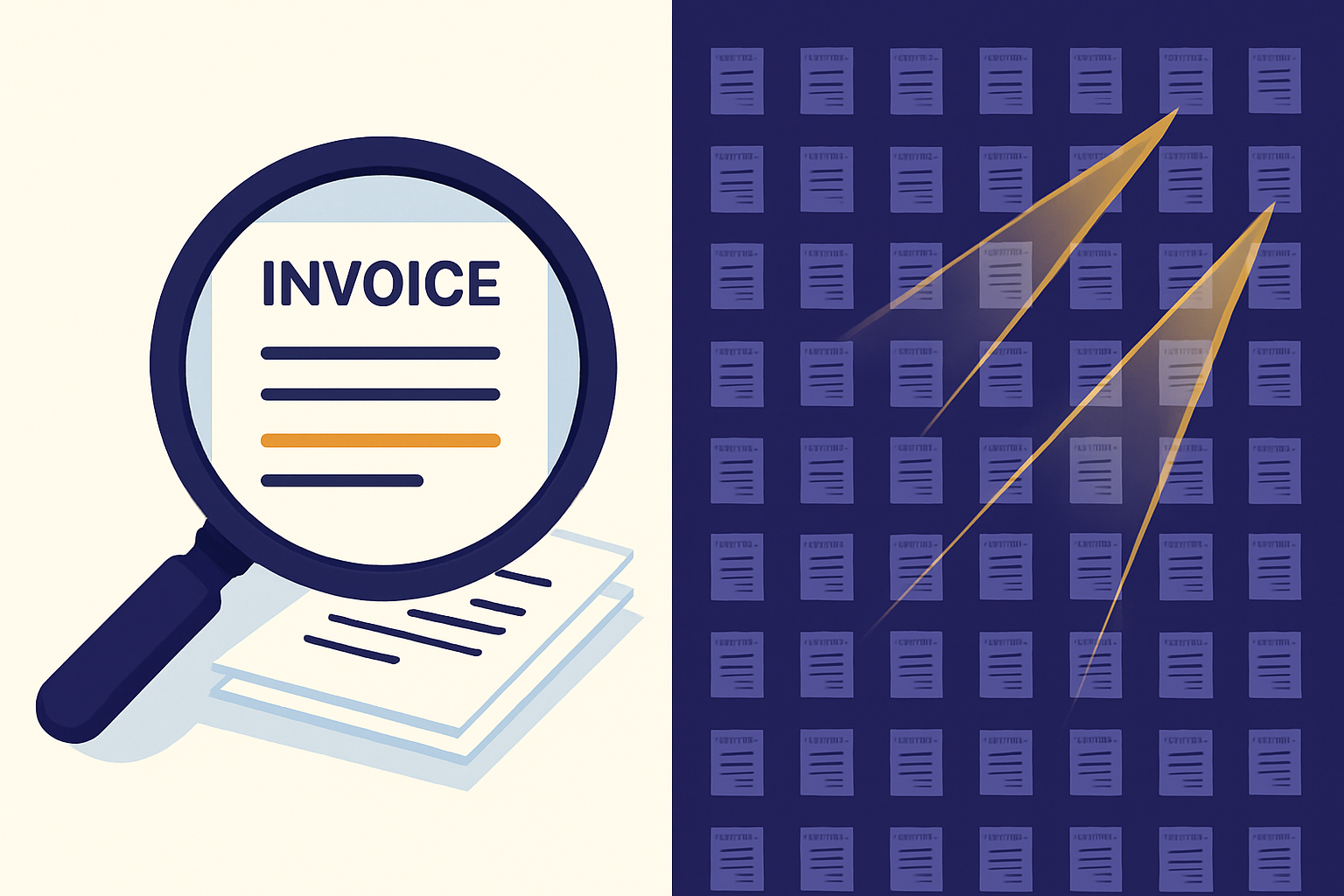
The single biggest structural shift AI brings is the move from sample-based testing to full-population transaction analysis. Traditional internal audit often involves sampling a small percentage of transactions. An AI-driven analytics layer can run rule-based and pattern-based checks on the full population of transactions, every month, automatically.
Concretely, here's what full-population testing catches that sampling usually misses:
- Split invoicing to bypass approval limits. For example, a vendor consistently billing just under an approval limit multiple times in a short period for what appears to be a single delivery. A full-population script can flag such patterns that limited sampling would miss.
- Duplicate payments across different GSTINs of the same vendor group. This is a common issue in India where related entities supply the same buyer.
- Round-tripping through employee-linked vendors. Matching PAN details of vendor masters against employee PAN in HR records is trivial for an AI script, but near-impossible manually across a large number of vendor records.
This is why AI significantly enhances fraud detection by analyzing extensive financial data and identifying patterns manual sampling misses (source). A 2025 academic study on AI-based automated audit systems found agreement scores of 0.75 (Cohen's kappa) against human auditor assessments, alongside a 50% reduction in audit process time versus traditional manual audits (source). That 0.75 score matters — it's good, not perfect, which is exactly why you keep a human reviewing every flagged exception before it goes into a formal finding.
Which routine audit tasks should you automate first?
Not every AI use case needs a data science team. Start with routine, high-volume, rule-based work. AI can automate PBC (Prepared by Client) list generation, automating audit planning based on real-time risk profiles, streamlining reporting of findings, and executing automated control testing (source).
A phased first-90-day rollout that mid-sized companies can realistically execute:
Days 1-30: PBC automation and reconciliation Feed your ERP export into an AI reconciliation tool that auto-matches relevant financial data and auto-generates the PBC request list for the next audit cycle based on what's outstanding. Indian CA firms handling 25+ clients using this approach report a 70% reduction in reconciliation workload, 90% fewer data entry errors, and 75% faster invoice processing (source).
Days 31-60: Automated control testing Configure standing rules for key controls, such as those related to purchase orders, approvals, and vendor master edits, and let the tool run these against 100% of transactions continuously.
Days 61-90: Findings and reporting Use AI drafting to turn flagged exceptions into structured findings memos, streamlining reporting and cutting down the time spent on report drafting.
The financial-institution benchmark here is instructive: AI-powered compliance platforms have delivered 50-70% reduction in audit preparation time while improving accuracy rates above 95% (source). Even at a conservative rate for a first-year mid-sized rollout, significant time savings can free up resources for deeper risk work rather than mechanical testing.
How can AI tighten your GST, TDS and MCA compliance specifically?
This is where the ROI case stops being theoretical for Indian companies, because it isn't just about internal efficiency — the tax department is already using AI against you. The Income Tax Department and GST authorities are cross-referencing ITR data with AIS, TDS records, GST turnover figures, and MCA filings to flag inconsistencies and issue notices automatically (source). If regulators are running full-population matching on your data, a traditional internal audit function relying on sampling is structurally outmatched.
Three concrete GST/TDS use cases worth deploying now:
1. GSTR-1 vs GSTR-2A/2B reconciliation, automated monthly, not annually. A typical mid-sized company processes a significant volume of purchase invoices annually. Manually reconciling GSTR-2B against the purchase register, especially if done only once a year, often reveals mismatched ITC claims, such as those from vendors who filed late, wrong GSTIN entries, or invoices never uploaded by the supplier. AI reconciliation tools can be run automated for GST reconciliation, matching GSTR-1, GSTR-2A/2B line by line every month (source), so mismatches get chased with the vendor within 30 days instead of discovered 11 months later when reversal with interest under Section 16(2) becomes unavoidable.
2. TDS threshold and classification monitoring, transaction-level. Different TDS sections carry specific threshold and rate logic, and mid-sized companies can routinely misclassify vendor payments. An AI layer sitting on top of your accounts payable can flag every vendor invoice where the nature-of-service description doesn't match the TDS section applied, before the payment is processed, not after the TDS return is filed and a short-deduction demand arrives.
3. MCA filing cross-checks. Discrepancies between related-party transaction disclosures in filings and the general ledger are recurring audit findings. AI tools can flag related-party transactions in the ledger that have no corresponding MCA disclosure trail, closing a gap that otherwise surfaces during a statutory audit qualification or an MCA scrutiny letter.
Continuous Controls Monitoring (CCM) built on this kind of AI and data analytics stack is exactly this shift — from reactive, once-a-year audits to real-time, proactive risk oversight (source). SEBI, RBI and MCA are all pushing enterprises toward real-time compliance readiness rather than annual assurance (source), which for a mid-sized company means the audit calendar increasingly needs to become continuous, not quarterly. If you're still building your GST reconciliation processes from scratch, our piece on setting up a GST-compliant close process covers the month-end mechanics that feed this monitoring layer.
Why can't AI replace your internal audit team — and where does that leave human judgment?
Every one of the use cases above has a common thread: AI surfaces the exception, a human decides what it means. This distinction matters legally and practically. Internal audit cannot be fully automated — human judgment, professional skepticism, ethical reasoning, and industry-specific knowledge remain essential (source).
Consider a real-world type of scenario: an AI reconciliation tool flags a vendor payment as anomalous because the invoice amount doesn't match the PO by more than the set tolerance rule. A junior team member closing the loop mechanically might write this up as a control breach. A human auditor who understands the business knows this vendor supplies imported machine components where freight and customs duty variance routinely causes exactly this kind of gap — a legitimate business reason, not a fraud indicator. The AI did its job by flagging it; the human did their job by contextualizing it. Without that second step, you either bury the audit committee in false positives or, worse, miss the one flag that's genuinely fraudulent because everyone's stopped reading them carefully.
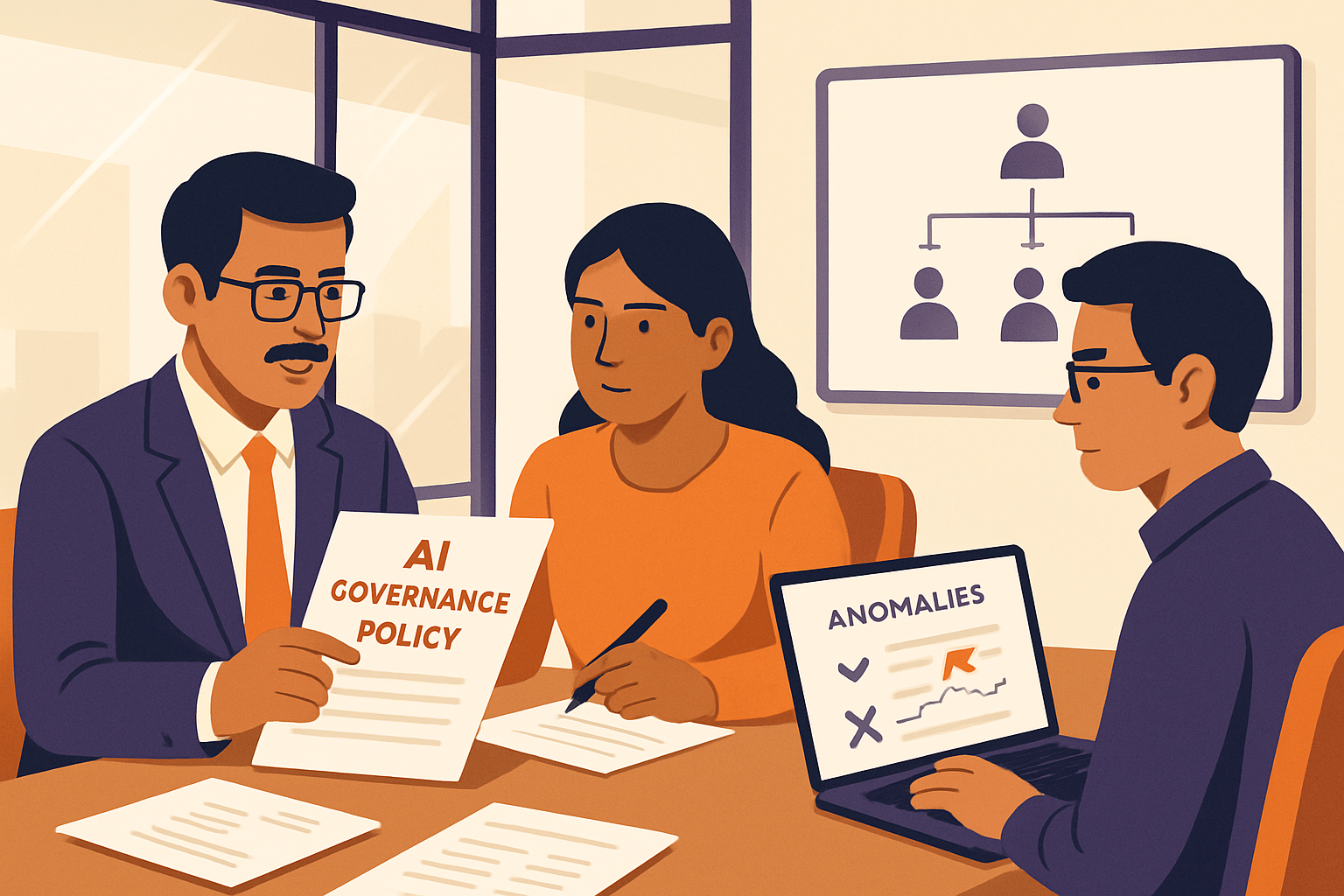
This is also where governance discipline earns its keep. Only 28% of internal audit leaders are confident their teams can effectively audit AI-related risks themselves, and 63% of organizations had no formal AI risk appetite or governance framework as of November 2025 (source). For a mid-sized Indian company, this translates into a very simple internal rule worth writing down formally: no AI-flagged exception becomes a final audit finding without sign-off from a qualified internal auditor who has reviewed the underlying transaction, not just the AI summary.
What are the real barriers, and how do you actually solve them?
Three obstacles show up repeatedly in mid-sized companies attempting this transition, and each has a workable fix that doesn't require a large budget.
Talent gap. A shortage of skilled staff in data analytics, AI, and cybersecurity is a common pain point for internal audit teams in India (source). You don't need to hire a data scientist. Instead, consider upskilling an existing internal auditor in basic data manipulation or deeply training them on the specific AI reconciliation and analytics tool you've licensed. One trained internal champion who can configure rules and interpret outputs is worth more than an external consultant who understands your control environment poorly.
Data quality and access. Disparate systems make data access a genuine challenge (source). If your data sits in unconnected, disparate systems, no AI tool fixes that by itself. Before deploying any AI solution, prioritize standardizing your vendor master, GL account codes, and other key data definitions across systems. This groundwork determines whether the AI tool works effectively from the start.
Data privacy and hallucination risk. With India's DPDP Act now shaping how personal and financial data can be processed, concerns about confidentiality and AI "hallucinations" — fabricated or inaccurate outputs — are legitimate, not paranoid (source). Before deploying any generative-AI drafting tool for findings memos, confirm in writing where the vendor hosts data (India vs. offshore servers), whether your data is used to train their model, and retention periods. And treat every AI-generated narrative — a findings summary, a risk categorization, a root-cause note — as a first draft requiring verification against source documents, never as a final output.
Organizational inertia. A "wait and see" attitude and lack of executive prioritization for AI investment slows most mid-sized companies down more than any technical barrier (source). If you're the CFO reading this, the fix is simple and within your direct control: advocate for an AI-driven audit pilot, such as GST reconciliation, and place it on the agenda for the next audit committee meeting, with a defined pilot budget. This approach can demonstrate value and overcome inertia.
Where should a mid-sized company start this quarter?
If you're prioritizing under budget and time constraints, a sequence that produces fast, defensible ROI includes: (1) automated GSTR-1 vs 2A/2B reconciliation, (2) automated control testing on key purchase-to-pay controls, and (3) TDS section-classification checks on vendor payments. It is advisable to leave more complex fraud-pattern detection and CCM dashboards for later phases, once your data is clean and your team has gained experience with AI-assisted testing with human review built into every step. The global market for AI-powered audit analytics — valued at USD 2.9 billion in 2025 and projected to hit roughly USD 20.1 billion by 2035 at a 21.5% CAGR (source) — will keep pushing pricing down and tool maturity up, which favors companies that build the internal muscle now rather than waiting for a "mature" solution that never quite arrives.
How BiPivot helps
BiPivot works with finance teams to design phased AI adoption plans for internal audit — from GST/TDS reconciliation automation to control-testing frameworks that keep human sign-off at every decision point. If you're evaluating where to start, we can help you scope a 90-day pilot that fits your existing systems and budget. Get in touch at bipivot.com.